
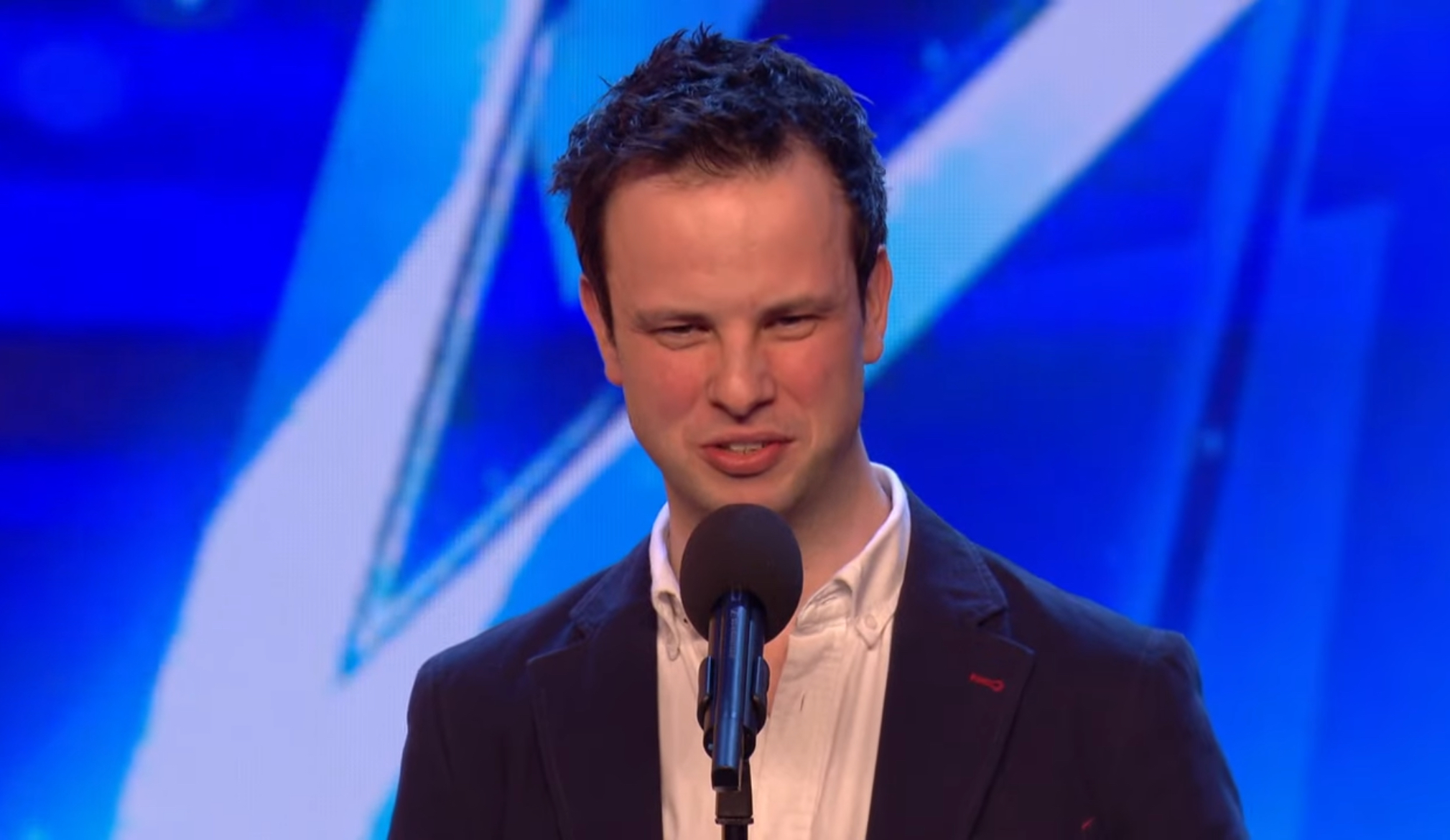
When thirty-three-year-old Ronan Busfield walked onto the Britain’s Got Talent stage and introduced himself as an employee of a well-known supermarket, the casualness of that revelation set up an immediate and striking contrast to what was about to follow. The image of someone stocking shelves or manning the tills is familiar and ordinary, but Ronan was quick to let the audience know this moment had been “building up inside me for years and years.” For him, a successful audition wasn’t just a fleeting thrill — it would be utterly life-changing. With his wife and young son waiting nervously backstage, you could see the stakes written on his face: terrified, excited, and desperate to show the world the part of himself that had been quiet for too long.
He chose a daring, emotionally charged number: “Maria” from West Side Story. It’s a song that requires both vocal ability and theatrical conviction; it’s not something you merely sing, but something you inhabit. The instant Ronan opened his mouth, his powerful operatic tenor filled the theatre with a force that felt almost cinematic. The texture of his voice was rich and resonant, the kind of instrument that carries effortlessly over an orchestra and reaches into the rafters. The audience reacted accordingly — not the polite applause reserved for a pleasant performance, but an audible, immediate intake of breath followed by rising cheers. The judges, too, were visibly stunned; expressions shifted from polite curiosity to open amazement as the sound unfolded.
There was something captivating about how Ronan combined technical precision with raw emotion. He didn’t treat the song as a showcase of high notes alone; he shaped phrases, lingered on vowels, and delivered with a dramatic clarity that conveyed the song’s yearning. It was easy to forget the everyday shop employee he had just introduced and simply watch an artist at work. His stage presence felt effortless, as if the spotlight had always been a natural place for him to stand — a surprising contrast to the humble job title he’d given at the start. It became clear in that moment that Ronan was far more than his day job; he was a man reclaiming a voice that had once been central to his life.
That revelation made the story behind his audition especially poignant. During the feedback, Ronan admitted he had actually worked as a professional singer five years earlier. Life, however, had a way of reshaping priorities: after his father passed away and he started a family, he stepped away from the professional music world. He told the judges he had “just fallen out of love with singing,” a phrase that carried both regret and acceptance. Many of us understand how grief and responsibility can push dreams to the margins; bills need paying, children need care, and sometimes passions are shelved. But Ronan’s confession wasn’t delivered with bitterness. Instead, there was a quiet determination in his voice — a wish to show his wife and son that the old dream was still possible, that he could balance family life and personal aspiration.
The judges’ responses matched the emotional weight of that admission. Simon Cowell praised the performance as “very passionate,” noting the kind of authenticity that invites audiences to root for a contestant. David Walliams was equally effusive, describing Ronan’s rendition as “fantastic,” and the rest of the panel echoed that sentiment. What stood out in their praise was an emphasis not only on vocal quality but on the human story behind it — the idea that viewers would connect to Ronan because his audition represented more than talent; it represented resilience.
Backstage, you could imagine the scene: his wife and son watching with wide eyes, perhaps clutching each other as Ronan moved through the song, and then the swell of relief and pride that must have come when the judges responded so warmly. For Ronan himself, the unanimous four “yeses” were validation on multiple levels. They weren’t simply a ticket to the next round; they were a signal that stepping back into music had been the right choice, that the voice he’d set aside could still move people and change his life.
The result was a powerful comeback. Ronan left the stage having done more than impress the judges — he’d restarted a career and, in doing so, given his family a renewed sense of possibility. The supermarket uniform and the ordinary rhythms of his day job now sat beside the knowledge that he could still command a stage. For an artist who had paused his professional life for the sake of family and healing, the unanimous yeses felt like permission to dream again, this time with the support of his loved ones and the confidence that real talent can be rediscovered and celebrated.