
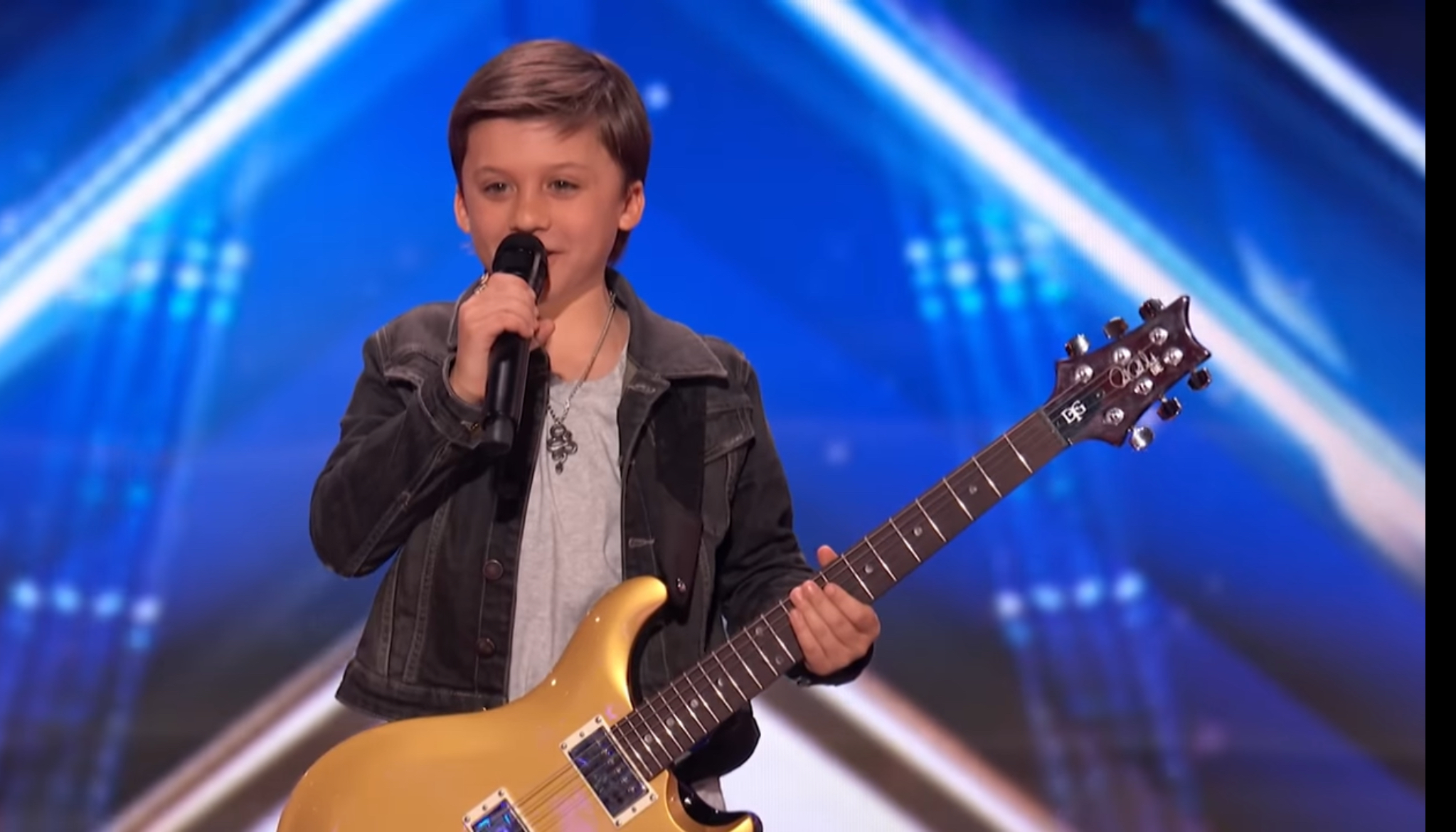
When ten-year-old Bay Melnick Virgolino bounded onto the America’s Got Talent stage, he arrived with a swagger that felt far too large for someone still in primary school. Part of that confidence came from the prop he slung over his shoulder: a guitar that looked almost comically oversized for his small frame. It was the kind of visual that made people smile immediately, but Bay’s presence was more than a cute novelty. He told the judges he was feeling “good nerves,” the proud kind of anxiety that comes before something exciting rather than the paralysing fear of stage fright. Even before he played a single note, his backstory framed him as more than just another talented kid — he’d started playing guitar at five, driven by a fascination with Slash from Guns N’ Roses, and his parents, whom he affectionately called his “roadies,” were backstage beaming with support. That combination of familial encouragement and early dedication set the stage for a performance that would feel both inevitable and electric.
From the first chord, Bay made it clear this wasn’t a tentative childhood recital. He launched into a high-energy set with a gusto that made it easy to forget his age. His fingers moved with surprising agility and precision across the fretboard, executing riffs and runs that many older amateurs would struggle to pull off. Yet his technical skill was only part of the picture. Bay sang with a raw, spirited voice that conveyed more than rehearsed notes — it carried an enthusiasm and joy that was contagious. As he dug into the melody and solos, the audience responded as they would to any seasoned rocker: standing, cheering, clapping along. There was a particular moment during one solo when he leaned into the stage, eyes bright, and the roar from the crowd answered him like a challenge met.
What made the performance especially compelling was how Bay combined showmanship with genuine musicality. He understood dynamics, letting sections breathe before kicking them into overdrive; he played with timing, occasionally stretching a phrase to heighten drama; and he let his face and body tell part of the story, grinning through tricky passages and closing his eyes when a passage required focus. For a child who’d started emulating Slash in his bedroom, the ability to channel that icon’s aura while making the performance distinctly his own was remarkable. One judge later commented on how Bay was having the “best time” of his life, and that joy was evident in every riff and flourish.
The judges’ reactions captured the mix of astonishment and affection his audition inspired. Mel B connected Bay’s raw, energetic performance to big-name rock stars, saying she believed someone like Lenny Kravitz would be proud — a comparison that underlined the maturity and soulfulness of his delivery. Heidi Klum’s response was laced with delight; she called him “one of the coolest kids I have ever met” and referred to him as a “little mini tiny little superstar,” a line that made the audience laugh and clap. Howie Mandel distilled the moment with a practical, crowd-based observation: “There’s no question… this audience just said it.” His comment pointed to the undeniable proof in the room — the reaction from hundreds of people who had just watched a ten-year-old deliver something electrifying.
Behind the praise, there was also an appreciation for the way Bay balanced youthful exuberance with discipline. Young performers often rely on novelty — age as a gimmick — but Bay’s audition had been convincing because it felt authentic. He wasn’t playing kid-appropriate campfire songs; he was tackling the swagger, the attitude, and the technical demands of classic rock. His stagecraft suggested he’d spent hours practicing not only scales and chords but also how to move and engage an audience. His parents’ presence backstage, quietly cheering, added an emotional layer: they weren’t there merely to boost ratings, but to support a child whose passion had been nurtured from an early age.
The unanimous four “yeses” that followed were as much endorsement as reward. They signified that each judge, in their own way, recognized a rare combination: talent that was already developed beyond his years, and star quality that could be shaped and guided. For Bay, the moment carried the promise of change. Suddenly the path forward — lessons, mentorship, bigger stages, perhaps even professional opportunities — opened wide in a way it hadn’t before. For viewers at home and in the theatre, it was a reminder of the thrill of discovery: that sometimes the future of a genre can arrive wrapped in pint-sized clothing and a giant guitar.
Walking offstage, Bay’s grin seemed to stretch from ear to ear, a mix of relief and elation. His parents met him with hugs, and judges continued to murmur their amazement. For a ten-year-old from New York City who idolized a guitar hero and called his parents his roadies, the audition was a crystallising moment — the kind that takes a hobby played in bedrooms and turns it into the first step of a much bigger journey. The applause, praise and unanimous yeses marked the start of something new: a young performer’s first, unmistakable confirmation that he belonged on the stage he’d always dreamed of commanding.