
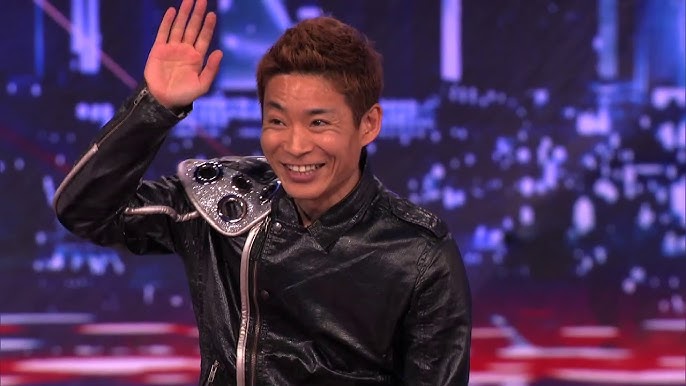
You’ve never seen dancing done like this. Watching Kenichi Ebina is less like attending a performance and more like stepping into a vivid, unpredictable dream where the rules of gravity, rhythm and character all bend to his will. From the moment he takes the stage, there’s a quiet electricity in the air — a sense that something unusual is about to happen — and he delivers on that promise in ways that leave you laughing, gasping, and sitting forward in your seat all at once.
Ebina’s style refuses to be pigeonholed. He blends mime, acting, contemporary dance and martial arts into a seamless whole, and the result is pure showmanship. One instant he’s a still, statuesque figure lit from above; the next, he’s streaking across the floor in a blur of limbs and expression. He uses his whole body as an instrument of storytelling: a tilt of the head or a twitch of a finger becomes a punchline; a slow, careful undulation becomes a weather system inside his chest. It’s this theatricality that makes his performance feel intimate, even when he’s performing elaborate, physics-defying maneuvers.
Take, for example, his famous “head fall.” It’s not just a stunt for shock value — it’s choreographed with such precision that you forget to worry about the mechanics and instead focus on what it communicates. He lets his body fold and collapse in a blink, only to spring back as if nothing happened, the movement punctuated by a beat of silence that forces the audience to register what they’ve just seen. You can almost hear the collective intake of breath in the theater. It’s a small moment, but it pulls you deeper into the world he’s creating, where vulnerability and virtuosity exist side-by-side.
Then there are the Matrix-style moves: those slow-motion, anti-gravity arcs that call to mind bullet-time and wirework, but here they’re grounded in raw bodily skill. He leans into an impossible angle, limbs extended, as if the laws of balance are merely a suggestion. At points he appears to freeze mid-motion, a living photograph; at others he snaps through full-range motion so quickly it feels like a reset of the room’s tempo. The combination of martial arts precision — the crisp, snapping kicks and the controlled lunges — with contemporary dance’s fluidity makes those sequences electrifying. You don’t just admire the technique; you feel it in your bones.
What makes Ebina’s performance particularly compelling is the way he marries comedy and danger. One moment he’ll play the role of a hapless drama student, tumbling over imaginary furniture with exaggerated facial expressions; the next, he’s a masked warrior executing a flawless roundhouse kick. The tonal shifts are effortless. They keep you off-balance in the best possible way, and they let the dramatic peaks land harder. There’s a humor to it, yes — a gleam in his eye and a willingness to make himself the butt of a joke — but it never undercuts the genuine physical risk he takes every time he goes for a daring move.
Small details amplify the effect. The way he times a blink to a drumbeat, or how he uses shadow to extend a gesture, shows an acute awareness of stagecraft. He turns props into partners: a simple chair becomes an adversary, a microphone stand a staff to duel with. Costume choices play their part too — close-fitting pieces that emphasize musculature during strength moves, or looser fabrics that billow and exaggerate motion during spins. All of these choices work together to create a performance that’s both polished and surprising.
But beyond the spectacle, there’s a human thread. Ebina’s performances often suggest a narrative — a search, a transformation, a conflict resolved through movement. You can see it most clearly in the slower passages, where subtle facial shifts and controlled breath work convey vulnerability. Those quiet moments make the daring feats feel earned; they transform stunts into storytelling beats. When he finally launches into the showstopping sequences, you’re not merely impressed by technique; you’re rooting for a character you’ve come to know.
By the time the curtain falls, you’ve been on a full arc: amused, astonished, moved, exhilarated. Kenichi Ebina doesn’t just execute tricks; he constructs an experience that lingers. You leave the theater replaying moments in your mind — the impossible slant of a pose, the comedic timing of a pratfall, the way a Matrix-style spin seemed to pause time — and you find yourself recommending it to friends with that particular urgency that comes from having witnessed something rare. This is dancing, but not as you’ve seen it before. It’s choreography that tells a story, physical comedy that demands technical respect, and spectacle that somehow manages to feel personal. If you get the chance to see him live, go. You’ll walk away with new definitions of what dance can do.