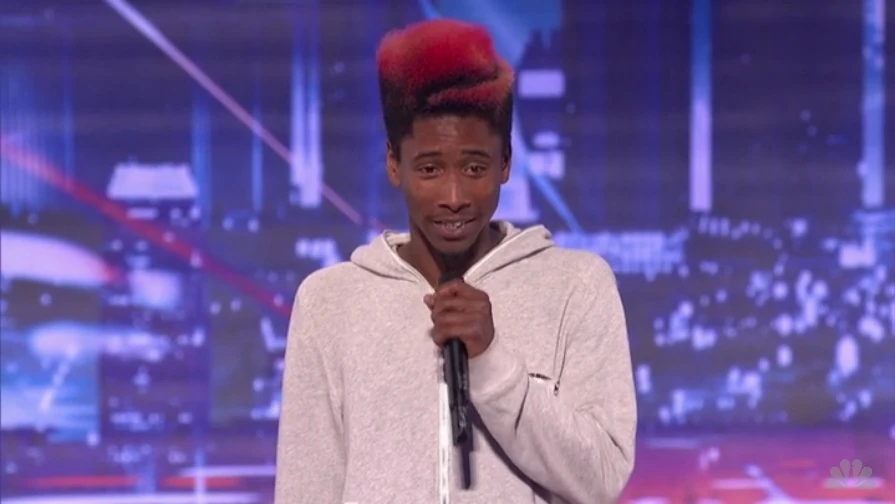
When Alonzo “Turf” Jones walked onto the America’s Got Talent stage in San Francisco, you could feel the room tilt toward him before he even took a step. He didn’t arrive with the swagger of a polished entertainer; he arrived with the ragged honesty of someone who’d lived on the edge for years. Turf told a story that sounded almost too raw for television: he’d been kicked out of his home for choosing dance, spent two years homeless, and survived by street performing — sleeping in shelters or on borrowed couches, carrying his dreams in a duffel bag and practicing until dawn. The detail about choosing between paying for a hotel room or keeping time with his routine was small but vivid; it turned abstract hardship into the concrete decisions that shaped the person standing under the lights.
That background gave the performance a gravity that made every twist and turn meaningful. Turf’s style — “extreme hip-hop contortionism” — is the sort of thing you don’t learn in a studio curriculum. It’s earned through repetition on unforgiving pavement, through late-night sessions in parking lots and subway platforms where the only audience is a stray dog or a passerby with spare change. You could sense that urban apprenticeship in his movement: the way his shoulders rolled like pistons, the way his spine folded and unfolded with uncanny precision, the subtle micro-adjustments he made mid-air to land on a precise beat. There was a built-in humility to the spectacle; he wasn’t there to merely perform tricks, he was there to share a language he’d honed in the city’s margins.
From the first bars of music, the crowd leaned in. Turf’s choreography fused the hard edges of hip-hop rhythm with the liquid, almost surreal quality of contortion, producing shapes that looked physically impossible yet entirely controlled. One moment he was grounding himself in a low, pounding groove; the next he unfurled into a handstand that bent around his own torso like a living sculpture. Those transitions were the most arresting part: the seamless passage from breakneck footwork to slow, deliberate holds that stretched his body into geometric forms. Each freeze felt like a punctuation mark, giving the audience time to register both the technical skill and the emotional heartbeat behind it.
Small, precise choices made the routine tell a story beyond flashy moves. Turf used eye contact sparingly but effectively, drawing attention to the moments that mattered: a hand extended toward the judges, a brief smile at the camera, a flash of exhaustion turned to defiance in the final seconds. He also played with the music’s dynamics, allowing silence or a stripped-down beat to spotlight a contortion that would otherwise be lost in noise. That sense of pacing — when to explode and when to reveal — made the number feel like a narrative rather than a highlight reel. It’s a mark of someone who understands not only the physicality of their craft but its theatrical possibilities.
The judges’ reactions were immediate and visceral. Howard Stern, who’s heard a lifetime of unusual acts, praised Turf’s originality and star quality, pointing out that it’s rare to encounter a performer who truly belongs to no single category. Sharon Osbourne picked up on something else: the seasoned command he displayed, the kind of presence that only comes from performing in public for long stretches. When you perform on the streets you learn quickly how to read a crowd, how to hold attention for a handful of coins, and those lessons were evident in how Turf calibrated his energy from the first step to the final pose.
Howie Mandel’s response brought the emotional arc full circle. He spoke directly to the redemptive power of Turf’s journey, telling him that his story would inspire any young person told they couldn’t follow their passion. That kind of validation matters — not just as a compliment, but as an antidote to the years of rejection and survival Turf had endured. The three enthusiastic “yes” votes felt less like gatekeeping and more like a collective acknowledgment that a life spent in pursuit of art, even under dire circumstances, had just been honored on a national stage.
By the time the music cut and the arena rose to its feet, it was clear why the performance had landed so hard. Turf wasn’t just a novelty; he was a fully formed artist who translated suffering into craft without cynicism. The standing ovation wasn’t only for the contortions or the viral-ready visuals; it was for persistence, for the nights spent practicing on cardboard, for the people who’d said “no” and the inner voice that kept saying “one more hour.” In that moment, cushioned by cheers and punctuated by judges’ praise, Turf’s story shifted from survival to recognition.
Outside the theater, clips of the audition began to circulate, and the viral spread made sense: the performance had everything that captures people online — spectacle, an underdog narrative, and a genuine human payoff. But the quieter residue of the moment lingered after the shares and comments faded. For those paying attention, Turf’s act was a reminder that talent is often forged in hardship, that street-level grind can create artists whose control and creativity rival those from any conservatory. His “yes” votes moved him forward in the competition, but more importantly, they validated a life’s work lived mostly out of sight. That validation, finally given in front of thousands, might be the most powerful encore of all.