
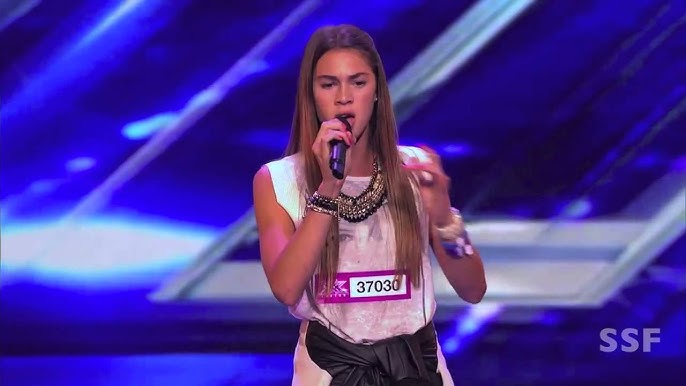
When sixteen-year-old Celine Polenghi stepped onto The X Factor USA stage, she brought with her a quiet assurance that felt both natural and practiced. Her outfit — a sleek, modern dress with a flash of metallic trim that caught the bright stage lights — suggested someone who knew how to present herself without shouting for attention. She smiled easily as she walked out, not with bravado but with a calm that made you want to listen. Behind her, family and a best friend waved and mouthed encouragement, small gestures that cut through the showbiz gloss and made the moment feel intimate: this wasn’t just another audition, it was a teenager staking a claim on a carefully imagined future.
Celine didn’t waste time on patter. She met the judges’ eyes and spoke plainly about what she wanted — a career, not just a moment — and that clarity mattered in a room full of hopefuls. It framed everything that followed. The choice of song itself was a statement: “When You Believe,” the anthem associated with Whitney Houston and Mariah Carey, is a number built for big voices and even bigger hearts. It asks a singer to balance tenderness with power, to navigate long arcs of emotion without losing control. For someone her age, picking a song like that was bold, the sort of move that separates timid auditions from ones that insist on being taken seriously.
From the first phrase, it was clear Celine understood what she was asking of herself. Her tone had a youthful clarity — bright, open, immediately appealing — but there was an unusual depth beneath it, a slight grain that gave color to sustained notes. She didn’t try to imitate the giants who had sung the song before her; instead she found a timbre that was authentically hers and let the lyrics do the work. On the verses she leaned into restraint, shading phrases with delicate dynamics so the quieter moments felt intimate; then she opened up on the choruses, letting her voice bloom without straining. Those contrasts were purposeful and satisfying to hear.
Small, concrete choices made a big difference. When a line called for vulnerability she would drop her volume and bring her head forward, as if confiding in each listener. Before a climactic phrase she took a deliberate breath, a micro-pause that read as preparation rather than hesitation. The arrangement supported her without crowding her — tasteful strings and backing harmonies swelled at the right moments and then pulled back so her voice remained the emotional anchor. The production, in short, allowed the performance to breathe.
Of course, tackling such a mammoth song live is risky, and the audition showed that. There were fleeting imperfections: a breath that came a beat late, the tiniest wobble on a long note, a place where adrenaline nudged the pitch. But rather than diminish the moment, those cracks made it human. They underscored the audacity of attempting something so demanding and highlighted the larger truth the judges would later articulate: Celine might not be a finished product, but she had raw star quality that could be shaped.
Those imperfections did nothing to dull the emotional impact. The audience leaned in, drawn by the sincerity of her delivery. You could see people in the crowd exchange looks — surprise, admiration, the soft kind of silence that suggests everyone knows they’ve witnessed something worth remembering. When she lifted into the biggest choruses, the room seemed to shrink; the performance felt like a conversation between singer and listeners rather than a one-way display of technique. That sense of connection is rare on audition stages, and it’s what transformed technical skill into something more potent.
The judges’ reactions reflected that mix of appraisal and affection. Simon Cowell, always the pragmatist, didn’t ignore the technical slips; he pointed them out with his trademark bluntness. Yet his critique was balanced by a deeper recognition: he could see a presence onstage, a spark that felt like the kernel of a pop star. Kelly Rowland praised Celine’s tone and the emotional truth she brought to the song, noting how she seemed to understand the lyric’s meaning rather than merely reproduce it. Paulina Rubio commented on charisma and style, observing that Celine’s look and delivery already hinted at marketability. Demi Lovato — who has grown up in the public eye and knows the pressures young artists face — urged her to keep taking risks while continuing to refine her technique. Their words blended encouragement with practical counsel, a combination that felt less like flattery and more like mentorship.
When the votes were cast, the judges delivered four enthusiastic yeses. Relief and joy washed across Celine’s face; she hugged her family and best friend, laughter and tears mingling in a way that made the TV gloss fall away for a moment. Walking offstage, there was a new spring in her step, a visible lift that hinted at both pride and the intoxicating promise of possibility.
In the days that followed, clips of the audition spread across social feeds and music blogs. Conversations centered less on perfection and more on potential — on a teenager who had the courage to choose a mountain of a song and the nascent talent to climb it. For Celine Polenghi, the X Factor stage became more than a one-off showcase; it felt like the first visible step on a path that many now agreed could lead anywhere, so long as she kept pushing, learning, and leaning into the bravery she had already shown.