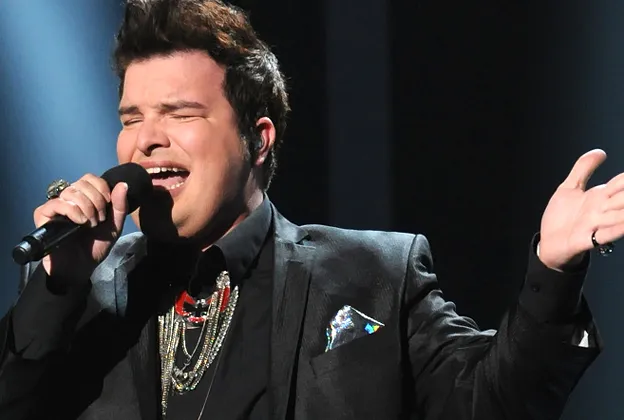
Jason Brock walked onto The X Factor USA stage like someone about to host his own opening night — sequined jacket gleaming under the studio lights, a theatrical swagger in his step, and a grin that suggested he already owned the encore. He introduced himself as a tech support worker from San Francisco and immediately set the room laughing with a colorful rant about his day job. With comic timing he explained how, on occasion, he’d sing to frustrated customers over the phone to calm them down — a charming little mercy that brightened otherwise tedious tech calls — but he made it clear he wasn’t willing to trade the rest of his life for a desk and a headset. The honesty was disarming, and his personality was impossible to ignore.
He didn’t just tell jokes; he painted little scenes. He described calming an irate caller by slipping into a soft, improvised lullaby about rebooting routers, how a five-minute serenade once turned an angry caller into a grateful, laughing customer who promised to never yell at tech support again. Those small, human moments made him relatable: he wasn’t pretending to be bigger than life — he was someone who used performance to connect even in the least glamorous spaces. That blend of humor and relatability set the stage for what felt like a carefully plotted reveal.
Then Jason painted a picture: a wildly ambitious vision of future stadium shows that read like a cross between a Broadway spectacle and a Las Vegas revue. He sketched out dramatic shadows sweeping across the stage, background dancers descending from above on harnesses at precisely choreographed moments, and literal glitter explosions timed to hit the crowd when the chorus hit full throttle. It was theatrical in the purest sense — a quick, vivid tour of what his ideal concert might look like, complete with a wink at the impracticality of it all. The panel chuckled, and a few eyebrows raised. Simon Cowell, ever the practical man, reacted the way he always does when confronted with grandiose claims: amused, but skeptical. He warned Jason to keep one foot on the ground and to prove that the voice behind the bravado could actually justify such ambitions.
When the opening chords to Billy Joel’s “New York State of Mind” began, whatever skepticism lingered in the room evaporated. Jason’s voice filled the arena with immediacy — warm, resonant, and rich in texture. It wasn’t just a big voice; it was a controlled instrument. He navigated the song’s phrasing with a musician’s sensitivity, finding places to breathe and choosing moments to swell in a way that gave the lyrics room to land. There were instances of remarkable restraint — a line held back just enough to let the next phrase mean more — and then surges of power that proved he could indeed deliver the big stadium moments he’d fantasized about.
Small details made the performance feel lived-in. He lingered on the line about “streets of New York” like someone recalling a memory, not rehearsing lyrics. A subtle turn of the head at a particular phrase made it feel conversational; a softening in tone on a quieter line let the audience lean in. And when he reached the song’s climactic moments, he didn’t overdo it — instead he added tasteful runs and a sustained note that landed clean and true. It was the kind of singing that suggested both technical training and an intuitive understanding of storytelling.
Beyond technicalities, what made Jason’s performance stand out was how he articulated the song’s emotional core. “New York State of Mind” isn’t merely a list of locations; it’s a mood, a longing for belonging. Jason captured that feeling with an authenticity that surprised some who had expected camp or mere showmanship. His phrasing hinted at lived experience; when he sang about streets and skylines, it felt like he had walked them. The theatrical elements were present but never took over; they enhanced rather than distracted, making the whole thing feel like a peek at the concert he’d promised rather than an unmoored bit of stagecraft.
The transformation in the room was immediate. Camera pans showed judges leaning in, losing their usual smirks; the studio audience, which had been indulgently polite during his pre-song patter, sat riveted. Jason’s ability to marry flamboyant personality with serious vocal chops created a compelling, almost irresistible combination. He was both entertaining and credible — a risky mix that, when it succeeds, produces stars.
When the last notes drifted away, the judges erupted into applause. Simon, who had teased him earlier about building a glitter cannon, raised his hand in a rare show of enthusiasm and admitted that he had completely misjudged Jason. He confessed that the performance had been so immersive he felt as though he’d actually been transported to Jason’s imagined concert. L.A. Reid praised the timbre and richness of Jason’s tone, calling it “a songwriter’s best friend,” and highlighting how Jason’s interpretations would serve songwriters and arrangers well on the road. Britney Spears, perhaps speaking for the pop world, lauded the audition as “flawless” and “magnificent,” a glowing endorsement that underscored how Jason’s blend of spectacle and substance had crossed genre lines.
There was playful banter, too. Simon, never one to fully abandon his blunt persona, joked about needing tickets to the glitter-filled shows Jason promised, while Jason returned the quip with a theatrical bow and an offer of front-row seats for the judges. But beneath the jokes, the message was clear: Jason had delivered something rare in a single audition — a fully formed artist who could headline a stadium while still connecting intimately with an audience.
The votes came in, and with them a unanimous chorus of approval. Four resounding “yes” votes turned Jason’s audition into a defining moment of the episode, and social media quickly followed suit. Within hours, clips of his theatrical opening and his powerhouse performance circulated widely, with viewers delighting in the juxtaposition between his comic confession and the sheer force of his vocal delivery. Many commenters marveled at how a tech support worker had the confidence and skill to imagine grand spectacles and then back them up with real musicality.
Backstage, Jason was all charm and humility, thanking mentors who had encouraged his flamboyant side and vocal coaches who taught him restraint. He spoke about wanting to give people joy — and, in doing so, he had already provided an evening’s worth of it, complete with laughs, chills, and a promise of more to come. In one audition, Jason Brock had traded in his headset for center stage, and for the moment at least, his glitter cannons felt not like a joke but like an inevitability.