
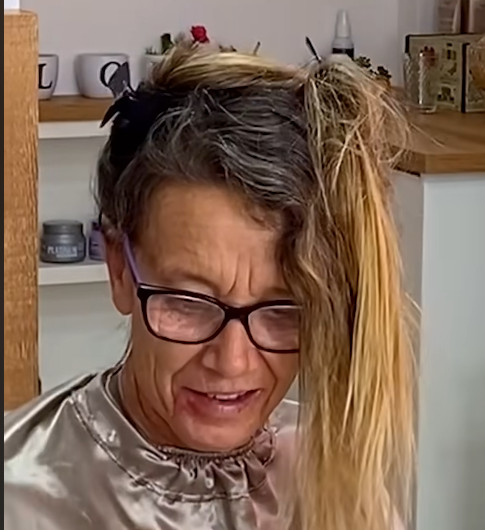
She walked into the room and for a second I didn’t know who she was. It wasn’t just that her hair had been cut shorter or that she’d swapped her heavy winter coat for a light, tailored jacket. It was the way she carried herself—head up, shoulders back, a quiet confidence that hadn’t been there before. People called it an “extreme makeover,” like it was a flashy television segment, but the change felt more intimate and layered than a before-and-after snapshot. She was, quite simply, unrecognizable.
When I first met her months earlier, she spoke softly, eyes often downcast, as if the world might bruise a little at her boldness. Her wardrobe leaned safe: muted colors, loose fits, things that blurred the lines of her shape rather than celebrated them. She joked about how a mirror would sometimes fail to reflect who she was on the inside. After the makeover, the mirror didn’t just reflect her—it seemed to be finally catching up to who she had always been, the parts that had been waiting politely to be seen.
The makeover itself wasn’t one dramatic instant but a series of small, deliberate decisions stitched together over weeks. There were professional consultations—hair stylist, makeup artist, and a stylist who insisted on asking difficult, oddly intimate questions: “What do you want to feel when you look in the mirror?” That question turned out to be the hinge. She started with a haircut that removed years from the face, a choppy bob that framed her cheekbones in a way messy long hair never had. The stylist added subtle layers that moved when she walked and recommended a color with warm, honey undertones. The change was technical, but what it did to her expression was practically alchemical.
There were also practical things: posture exercises and a few sessions with a personal trainer who taught her to stand from the core, not the chest alone. “Confidence is a muscle,” he said, demonstrating a simple squat that made her laugh. She went along not because she wanted to have a perfectly sculpted body but because moving differently started to feel like breathing differently. When she learned to take up more physical space, her shoulders relaxed rather than tightened; occupying space was not aggressive, just honest.
Makeup was another gentle revolution. The makeup artist wasn’t interested in covering her face so much as highlighting the parts that already told her story. A sweep of bronzer, a carefully shaped brow, and a lipstick shade that somehow matched the tone of her laughter. She told me later that the lipstick was the bravest part—choosing a color that said “notice me” without shouting. There was a moment she described as strange and tender: putting on the first bright color and realizing she liked how it looked. It was like learning to enjoy your own handwriting.
Beyond the physical, the makeover included a quieter, internal renovation. She began therapy with a clinician who helped her untangle the stories she’d been telling herself about worth, appearance, and safety. They worked through old assumptions—like how being small or quiet made you less likely to be hurt—and practiced new behaviors, like saying no without guilt, asking for what she needed, and accepting compliments without deflecting them. Those weren’t flashy changes, but they mattered every day, in every conversation. She kept a journal where she noted small victories: a teacher who complimented her presentation, a friend who asked for her opinion, a date where she felt seen. The entries looked like tiny flags marking new territory.
Friends and family reacted in uneven ways. Some cried happy, relieved tears, as if a sibling had returned from a long, necessary journey. Others were quieter, puzzled, and a little off-balance because the rhythm they knew had shifted. One cousin outright joked that she’d become “a different person,” which stung at first until she realized how much of her cousin’s discomfort came from not being included in the change. Ultimately, most warmed up once they saw the steadiness beneath the different haircut and bolder clothes—the person they loved was still there, just less cloaked.
What surprised me most was how small things carried such meaning: the way she now wore a ring on a particular finger because it reminded her of an aunt’s stubbornness; the way she chose to carry a tote that was practical but had a bright lining, a small secret to herself; the way she answered the phone with her name first, a tiny act of claiming. These details were proof that the makeover was not about erasing the past but about recommitting to presence.
At social events, people who hadn’t seen her in months did double-takes. “You look amazing,” they’d say, a sentence that could be perfunctory but, in this case, felt earned. She’d smile, sometimes surprised, sometimes amused, and rarely offered the throwaway response of deflection. Instead she might say, “Thanks—I’ve been working on some things.” That admission felt modest and honest and oddly courageous.
Unrecognizable, yes, but not in a frightening way. It was the kind of unrecognizable that comes from meeting someone who has shed a cloak and stepped into their own light. The makeover was extreme in the sense that it altered her surface and routines profoundly, yet it made visible something that had always been quietly fierce inside. In the end, being unrecognizable didn’t mean losing oneself; it meant finally being seen—and finally being able to see oneself back, fully and without apology.