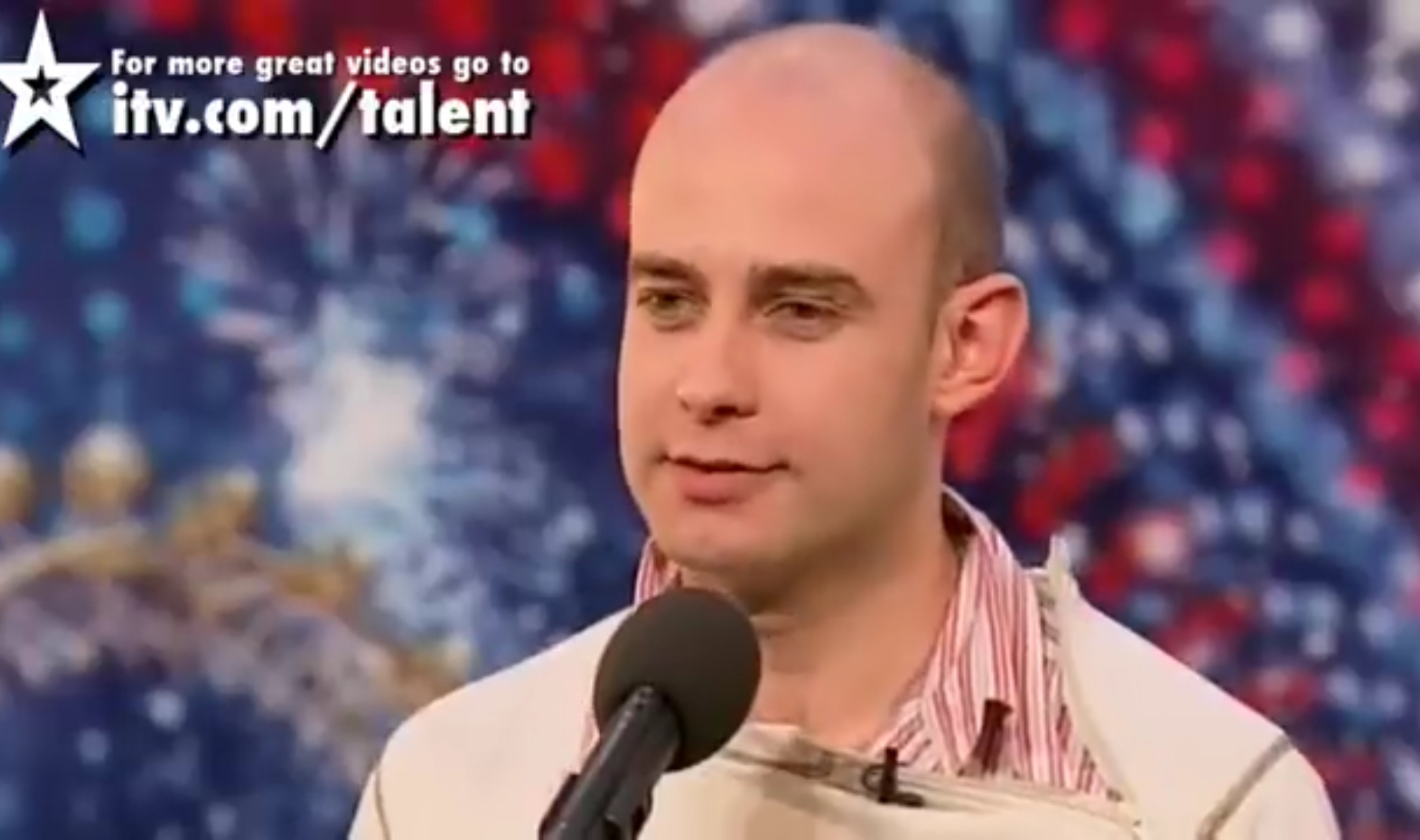
At twenty-eight, Christopher Stone could easily have been mistaken for any other young professional heading home from a long day at the office. He moved with the quiet certainty of someone used to routines—an accountant whose life revolved around ledgers, deadlines and the satisfying symmetry of numbers. His coat was neatly buttoned, his shoes polished, the kind of unremarkable exterior that made people assume stability and restraint. But on this particular evening he made a deliberate, disorienting swap: spreadsheets for spotlight, the soothing predictability of balance sheets traded for the glaring, unpredictable lights of the Britain’s Got Talent stage. It was a leap that felt enormous, partly because it stitched together private longing with public exposure.
Christopher admitted as much before he began, and his honesty landed in the room like an unguarded chord. He had entered the competition largely because his parents—there in the audience, faces lined with anticipation—had never stopped encouraging him to pursue a dream he’d kept folded away. Their presence was more than just moral support; it was a tether to every childhood recital, every time they’d nudged him toward piano lessons and voice practice. Seeing them now, watching from the seats, made the moment both warmer and heavier. Familiar faces in a sea of strangers are a comfort, but they can also sharpen the sense of expectation. For Christopher this wasn’t merely an audition; it felt like the culmination of gentle nudges, quiet familial hopes and the weight of obligation all converging on a single, exposed minute.
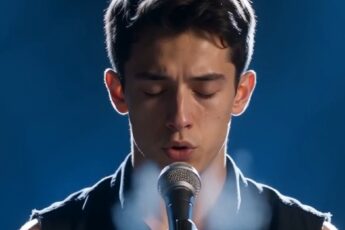
When he walked onto the stage you could see exactly how much the moment mattered. He looked neat and unassuming, the sort of person who might bring a briefcase to a social event and ask respectfully about budgets. From his first tentative breath, his nervousness was plain: his hands wrung together repeatedly, a little tic that betrayed the storm of anxiety beneath his composed exterior. He paused, laughed nervously at himself, and confessed aloud that this was “probably the scariest thing I’ve ever done in my life.” The line made the audience sit up and the judges lean forward. That admission didn’t undermine the performance; instead it framed it. It transformed the audition into a kind of human story—a gifted singer deliberately placing himself in a vulnerable position, showing a side he’d kept private while navigating a steady career.
Choosing “Maria,” a song with operatic leanings and emotional sweep, was a bold move. It’s the kind of piece that demands both technical control and fearless expression—no place to hide. At first, Christopher’s voice announced itself as something unexpected: rich, resonant and unmistakably trained. The opening lines hinted at a powerful instrument beneath the anxiety, a voice that could easily fill a concert hall on its own terms. But the contrast between the sound and his body language was striking. Where his tone suggested command, his posture suggested caution; the hands kept wringing, his shoulders hunched just slightly, as if physically trying to shield himself from the scrutiny of cameras and microphones.
Simon Cowell, never one to soften his comments, zeroed in on that tension. He pointed out what the performance lacked—conviction and self-belief—and called out the visible hand-wringing. It was raw feedback, brusque and potentially bruising, yet it also highlighted the central tension of the audition: a genuinely gifted singer wrestling with fear. Critiques like Simon’s can sting in the moment, but they also crystallize the practical steps needed to transform talent into presence. The judges weren’t denying his ability; they were advising him on how to let it fully exist onstage.
As the song unfolded, something subtle and unforced began to happen. Those initial moments of stiffness gave way to flashes of release—brief instances when Christopher seemed to forget the cameras and the judges, when the music carried him and he surrendered to it. In those seconds he opened up, eyes distant with concentration, mouth shaping the vowels with an ease that suggested hours of private practice. Piers Morgan, watching closely, noticed the shift and commented on the journey he was witnessing: from constriction to engagement, from fear to a visible, fragile enjoyment. It was in those fleeting passages that the possibility of transformation revealed itself—this wasn’t just a one-off bravado; it looked like the start of someone discovering his capacity for bravery and the simple joy of doing something he loved.
Amanda Holden captured the duality perfectly. She called the performance “brilliant,” praising the tone of his voice and underlining what was objectively impressive—his technical skill, his timbre, the emotional honesty in certain lines. Piers, too, took a sympathetic view, saying he’d enjoyed the arc of the audition. Even Simon, with his famously sharp tongue, conceded that Christopher had a “really, really good voice.” His critique about lacking “swagger” read less like dismissal and more like direction: certain material asks for not just notes but presence, for the kind of confident body language and eye contact that convinces an audience to surrender fully.
In the end, the judges’ decisions reflected that balance between critique and recognition. They couldn’t ignore the undeniable quality at the heart of Christopher’s audition. The three “yeses” he received felt like vindication—not only of the talent he’d kept tucked away, but of the courage it took to stand in front of thousands and sing while petrified. The applause that followed wasn’t simply for the notes he hit; it was for the small, human victory of showing up, of taking a risk and letting himself be seen.
Walking off the stage, Christopher carried more than a pass to another round. He left having faced a quiet crossroads: to remain defined by caution and routine or to pursue an uncertain dream. His parents’ smiles, the judges’ mixed-but-approving reactions, and the steady quality of his voice all suggested, for now, a choice to move forward. It was a modest triumph, but a meaningful one—a reminder that sometimes the bravest thing we do is simply to step into the light and let ourselves be heard.