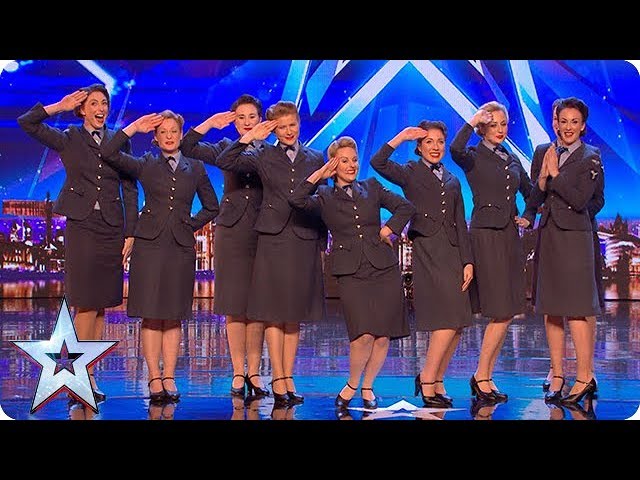
When the wartime choir The D-Day Darlings stepped onto the Britain’s Got Talent stage, there was an immediate sense that this wouldn’t be a standard audition. At first glance they looked like a nostalgic tableau: rows of singers in vintage military-style uniforms, carefully coiffed hair, and the kind of props that conjured sepia-toned photographs. But it wasn’t just costume — it was intention. They’d come prepared to carry a memory, to summon an era, and to do it with the sort of reverence that makes history feel living instead of distant.
The audience’s response began as polite curiosity. People leaned forward, phones were raised to capture the scene, and judges exchanged glances that said, “This could be interesting.” Then, as the first notes of “We’ll Meet Again” rose, something subtle and profound happened. The room exhaled and then held its breath. The song itself is practically an heirloom of wartime sentiment — a tune that conjures both the pain of separation and the fragile hope that sustains people through hard times. In the hands of The D-Day Darlings, it became more than a cover; it was a bridge to the past.
Their harmonies were immaculate, but it was the emotional texture underneath the technical skill that made the performance unforgettable. There was a tenderness in the lead lines, a close-knit blending of voices that suggested lives shaped by shared stories. The vibrato that lingered on certain syllables felt less like affectation and more like memory resurfacing. When the chorus swelled, it didn’t feel manufactured for applause — it felt like the sound of resilience, of communal courage translated into music. Members of the choir closed their eyes at moments, as if they were listening to a recording only they could hear, and that private engagement made the performance feel honest.
Small details deepened the authenticity. The choreography was minimal — just a tilt of a head here, a synchronized step there — but those small movements amplified the narrative. A veteran in the audience wiped his eyes; a child in the front row pressed a hand to their lips; a judge who rarely showed vulnerability appeared visibly moved. You could see the strands of individual reaction weaving into a single fabric of response. Even the stage lighting seemed to cooperate, bathing the singers in a warm, sepia glow that mimicked old photographs and helped transport the viewers to another time.
There’s a unique potency to performances that draw on shared cultural memory. “We’ll Meet Again” carries decades of context: rationing, distant battlefields, telegrams that never arrived, and the daily bravery of ordinary people keeping a fragile normalcy. The D-Day Darlings didn’t need to narrate all that history; they simply embodied it through tone and presence, inviting the audience to supply their own recollections. For those with direct ties to the war — grandparents, great-grandparents, letters kept in trunks — the song unlocked a vault of emotion. For younger viewers, it offered a visceral introduction to a chapter of history that otherwise exists in textbooks or museums.
The judges’ reactions punctuated the moment. Britain’s Got Talent panels are accustomed to spectacle, to novelty acts and polished showmanship, but this was quieter, more dignified. Comments exchanged during the judges’ deliberation weren’t just about vocal ability; they touched on the importance of preserving memory and honoring the past. One judge spoke about how the performance had made them think of family members they’d lost, another remarked on the power of songs to bend time. Those reflections elevated the audition from a contest of talent to a conversation about collective identity.
Outside the studio walls the impact rippled quickly. Clips circulated on social media, not only praised for their musicality but shared as moments of remembrance. Viewers left comments about their own wartime ancestors, posted photos of medals and black-and-white portraits, and used the performance as a reason to tell stories that might otherwise have remained unsaid. In an age when attention is fragmented, the choir re-centered the conversation on continuity — on the importance of making sure younger generations know where they came from.
Perhaps that is the real achievement of The D-Day Darlings’ performance: they didn’t just sing a song; they created a space for empathy. For the minutes they were on stage, the audience stopped being a crowd and became a listening community. They allowed themselves to be present with an emotion that is at once sorrowful and hopeful, and that duality is what makes wartime ballads so enduring. When the final chord faded, there was applause, of course, but also an aftertaste of something quieter — a kind of communal nod to the past and an appreciation for those who keep its memory alive.
Moments like that linger. They remind us that talent shows can do more than entertain; they can educate, heal, and bind people together through shared feeling. The D-Day Darlings stepped onto a stage and, for a handful of minutes, the past returned as if summoned. What followed wasn’t just surprise or admiration — it was gratitude, the kind that arrives when a story you thought was fading is given new voice.