
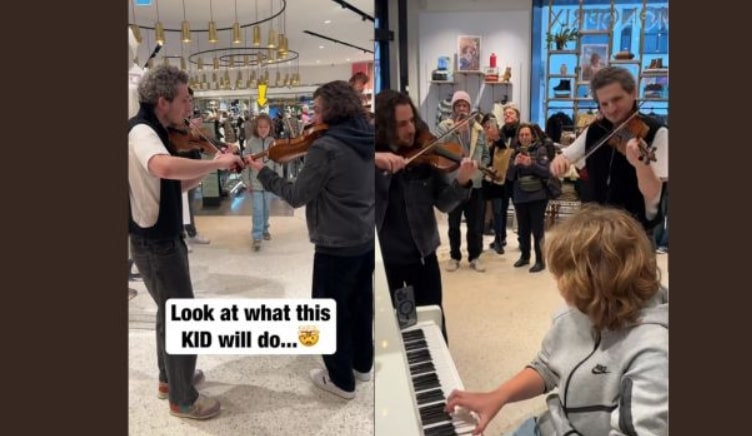
In the middle of a supermarket, among stacked cans and the hum of fluorescent lights, two renowned violinists were deep in improvisation when the air shifted. A 13-year-old child, small but steady, stepped forward and asked, “May I play Vivaldi with you?” The musicians exchanged startled glances—after all, even seasoned pros know Vivaldi can be a tricky conversation to join midstream. Still, they smiled and handed him a bow. The moment he drew the first note, the ordinary grocery aisle dissolved into something far more extraordinary.
It was as if time hung on that opening tone. The boy’s bow connected to the string, and a clarity of sound poured out that seemed both practiced and instinctive. He wasn’t merely following notes; he was channeling something larger, an old soul in a young body. People stopped in their tracks. A woman pushing a cart froze with her list halfway to her face; a teenage couple glanced up from the produce section; a store employee leaned on a pallet, eyes wide. For a few shared minutes, the fluorescent lighting felt like stage lighting, the check-out scanners faded into the background, and the supermarket became an impromptu concert hall.
His technique was remarkable: confident shifts, clean articulation, and a tonal warmth that filled the space without a microphone. At moments his fingers flew along the fingerboard with a fluidity that recalled images of a youthful Beethoven rediscovering music centuries later. The violinists beside him responded, weaving their phrases in gentle call-and-response, creating textures that made shoppers forget why they had come in the first place. When the final chord hung in the air, the crowd exploded into applause—the clapping of hands against the tiled floor sounded like the ovation of a packed auditorium.
Within forty-eight hours, the video of that unexpected performance had been shared and reshared, crossing borders and time zones. More than 23 million people tuned in to watch the supermarket transform into a stage. Comments poured in: some viewers marveled at the boy’s poise, others praised the spontaneous generosity of the violinists who let him join, and many expressed simple wonder at how a routine errand could become a sudden, shared moment of beauty.
That 13-year-old was Lucas Chiche, a name already resonating in the classical music world for reasons far beyond supermarket serendipity. Though he’s still young, Lucas has amassed an impressive list of accolades that point to an extraordinary early career. His official website chronicles victories at respected international competitions: the Geneva Baroque Competition in 2023, the SJMW Swiss Competition in 2021, London Young Musician in 2022, and the Rondo International Competition in both 2019 and 2020. In 2024 he was awarded the Prix Spécial by the Grand Piano Competition judges, an honor that led to an invitation to perform at the Salle Cortot at the École Normale de Musique in Paris—a milestone for any aspiring concert artist.
Lucas’s résumé reads like a globe-trotter’s itinerary. He has already performed on some of the most cherished stages in the world: Carnegie Hall in New York, Victoria Hall in Geneva, and the Tchaikovsky Hall in Moscow. He’s collaborated with distinguished orchestras under the baton of Maestro Vladimir Spivakov, including performances with the Moscow Virtuosi, the CMG Symphony Orchestra, Divertimento, the Svetlanov Orchestra, and the Orchestre de la Suisse Romande. His development has been sharpened by masterclasses with luminaries such as Mikhail Marchenko, Nelson Goerner, and Elisabeth Leonskaja—artists whose guidance has helped shape his interpretive maturity and technical finesse.
Oddly enough, the story of Lucas’s supermarket moment also includes a nod to the world of stringed instruments. The violins produced by Florian Leonhard Beautiful Violins—an esteemed company with more than 40 years of experience—are mentioned as complementing his musical persona. Founded by Florian Leonhard, the company is known for crafting, repairing, and distributing exquisite violins, violas, cellos, and bows from its London studio. Their meticulously accurate replicas of classic Italian instruments are trusted by premier soloists and teachers around the world. The mention of these instruments in relation to Lucas’s piano prowess may feel like an unusual pairing, yet it underscores a common thread: exceptional craftsmanship and artistry, whether in strings or on keys, contribute to the depth of classical music experiences.
What the supermarket incident reveals is more than a viral moment; it’s a snapshot of why live music still matters. In a place designed for transactions, Lucas and the violinists created an exchange of a different kind—one that asked nothing of the audience except to listen and feel. It was proof that talent can surprise us anywhere and at any time, and that classical music, in the hands of gifted young artists, can still stop time and gather strangers into a single, breath-held moment.
If you haven’t yet seen the clip, it’s worth the few minutes: a reminder of the unplanned magic that can take place when skill meets courage and a public space becomes, unexpectedly, a stage.