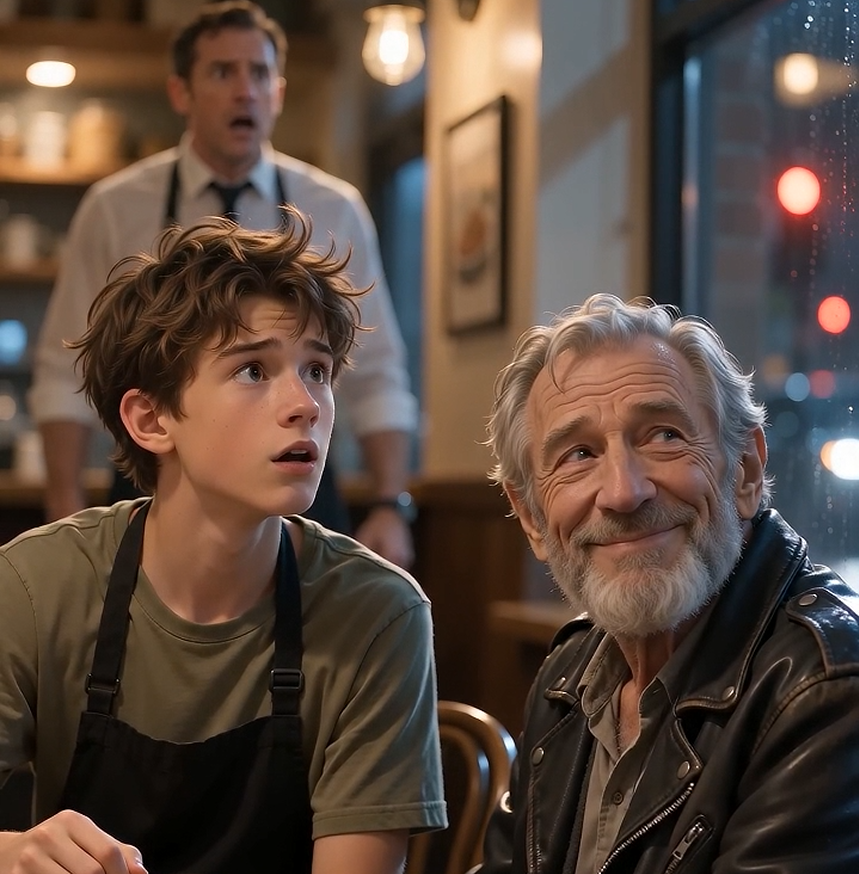
Rain covered the windows of Carter Street Café in long, trembling lines.
Inside, the evening rush continued as if nothing in the world could interrupt it. Coffee machines hissed, plates clattered, and customers complained about delayed rides while staring at their phones.
Eighteen-year-old Ethan Carter moved between the crowded tables with a gray cleaning tub pressed against his hip.
He was exhausted.
Every morning, he worked at a grocery store. In the afternoons, he attended community college. Every evening, he worked at the café to help his mother pay rent and medical bills after a factory accident had injured her hand.
His manager, Walter Briggs, knew Ethan was struggling.
He simply didn’t care.
“Table nine,” Briggs shouted.
“I’m coming,” Ethan replied.
“And mop the entrance again.”
“I just cleaned it.”
“Then do it twice.”
Ethan lowered his eyes and continued working. He needed the job too badly to argue.
Then the café door opened.
A tall, exhausted man stood outside beneath the awning.
He looked to be in his late fifties. His gray hair was tied into a wet ponytail, and his short beard was soaked with rain. He wore a black leather jacket, faded jeans, and heavy boots covered in road dust.
He looked like a biker who had been walking for hours.
The man placed one hand against the glass.
Then his knees suddenly buckled.
He collapsed onto the wet pavement.
Several customers turned toward the window.
A woman gasped.
A young man raised his phone and began recording.
But no one moved.
Ethan dropped his cleaning cloth.
“That man fell,” he said.
Briggs stepped in front of the door.
“Call an ambulance.”
“He’s right outside.”
“And you’re staying inside.”
Ethan stared at him.
“He needs help.”
“He could be drunk.”
“He could be sick.”
“That’s not our problem.”
Ethan looked through the glass. The stranger was struggling to breathe.
“I’m going outside.”
Briggs’s voice became cold.
“If you walk through that door, don’t come back to work.”
Ethan froze.
He thought about the rent.
His mother’s medicine.
The college payment due at the end of the month.
Then he looked at the man lying helplessly in the rain.
“I’m sorry,” Ethan whispered.
And he opened the door.
Cold rain struck his face as he ran outside.
He knelt beside the stranger.
“Sir? Can you hear me?”
The man opened his eyes slightly.
“Can you sit up?”
“Maybe,” the stranger whispered.
Ethan helped him onto a metal chair beneath the awning. He took a sealed bottle of water from his pocket and handed it to him.
“Drink slowly.”
The man’s hands trembled as he took the bottle.
Inside the café, everyone watched.
Briggs stood in the doorway with his arms crossed.
“You’re fired!” he shouted.
The words carried through the rain and into the crowded café.
Ethan slowly removed his black apron.
He walked back to the entrance and handed it to Briggs.
The manager accepted it without emotion.
“Pick up your final check next Friday.”
Ethan nodded.
Then he returned to the stranger.
Briggs stared at him.
“You’re staying out there?”
Ethan sat beside the man.
“Yes.”
“You don’t work here anymore.”
“I know.”
The stranger took another sip of water.
“You just lost your job,” he said quietly.
Ethan looked toward the café window.
“And you almost lost your life.”
The man studied him.
“Why did you help me?”
Ethan glanced at the customers watching from inside.
“Because everyone else was watching.”
The stranger lowered his eyes.
For a moment, neither spoke.
Then he extended his hand.
“My name is Marcus.”
“Ethan.”
They shook hands.
Marcus’s grip was weak.
But a few minutes later, his breathing became steadier.
He reached inside his leather jacket and pulled out a sleek black phone.
Ethan frowned.
“Who are you calling?”
Marcus looked through the glass at Walter Briggs.
“People who work for me.”
He pressed one button.
“Bring everyone to Carter Street Café.”
He paused.
“No. Don’t come inside until I tell you.”
Then he ended the call.
Ethan looked confused.
Before he could ask another question, headlights appeared through the rain.
One black SUV turned onto the street.
Then another.
Then a third.
All three vehicles stopped directly in front of the café.
Their windows were dark.
Their engines remained running.
Inside, customers stood from their tables.
Phones came out again.
But this time, nobody was laughing.
Walter Briggs slowly stepped away from the entrance.
The stranger beside Ethan looked at him.
“Now,” Marcus said quietly, “we’re going to find out what kind of place this really is.”
Part Two: The Man Behind the Leather Jacket
The first SUV door opened.
A woman in a charcoal suit stepped into the rain carrying a large umbrella. Two men followed her. One carried a medical bag.
The woman hurried toward Marcus.
“Mr. Reed!”
Ethan looked at the stranger.
“Mr. Reed?”
The medical officer knelt beside Marcus and began checking his pulse and blood pressure.
“What happened?”
“Dehydration and exhaustion,” Marcus answered.
“You collapsed.”
“I noticed.”
“You need a hospital.”
“In a few minutes.”
The woman looked at Ethan’s soaked clothes.
“Who is he?”
Marcus glanced at Ethan.
“The only person who came outside.”
The woman turned toward the café.
Her expression changed when she saw the gold plaque beside the register.
OPERATED BY REED HOSPITALITY GROUP
Ethan noticed it too.
He looked at Marcus.
“Wait.”
Marcus said nothing.
“You own this café?”
“Technically.”
Ethan gave a short, bitter laugh.
“You let him fire me?”
Marcus looked down.
“I didn’t know he would.”
“You could have told him who you were.”
“Yes.”
“But you didn’t.”
Marcus took a slow breath.
“I wanted to see how people treated someone they believed had no power.”
Ethan stood.
“So this was a test?”
“No.”
“You stayed quiet while I lost my job.”
Marcus did not argue.
“Yes,” he said. “I did.”
Ethan shook his head.
“You had the power to stop it. I didn’t.”
The words struck Marcus harder than Ethan expected.
The woman in the suit stepped forward.
“Ethan, Mr. Reed—”
Marcus raised a hand.
“He’s right.”
Then Marcus opened the café door.
The bell rang.
Every conversation inside stopped.
Walter Briggs stood behind the counter, suddenly pale.
“Mr. Reed,” he said nervously. “I didn’t know you were visiting.”
“I wasn’t visiting.”
“I would have prepared something.”
“That’s the problem,” Marcus replied.
Briggs swallowed.
“I was following company policy.”
“What policy?” Marcus asked.
“The employee abandoned his station.”
“To help a man who collapsed outside your door?”
“I told him to call emergency services.”
“You told him not to leave.”
Briggs looked toward Ethan.
“He became argumentative.”
Marcus’s expression hardened.
“He became useful.”
The café was silent.
Marcus looked at the customers.
“How many of you saw me fall?”
Almost every hand rose.
“How many called for help?”
No one moved.
One man slowly lifted his hand.
“I was going to.”
Marcus nodded.
“How many waited for someone else to move first?”
Nobody answered.
Marcus turned toward Ethan.
“One person acted.”
Ethan looked uncomfortable. He didn’t want applause. He didn’t want to be treated like a hero.
He wanted his job back.
And he wanted to know why helping someone had been considered a crime.
Marcus faced Briggs.
“Rehire him.”
Briggs immediately nodded.
“Of course. Ethan, you can return to your shift.”
Ethan looked at him.
“No.”
Briggs blinked.
“What?”
“I don’t want my job back just because you discovered who Marcus is.”
Marcus watched him carefully.
Ethan continued.
“If he had been homeless, would you still have apologized?”
Briggs had no answer.
Ethan turned toward Marcus.
“You only changed your mind because you’re afraid of him.”
Marcus nodded slowly.
“That is true.”
The woman in the suit introduced herself as Dana Pierce, the company’s chief operating officer.
She opened a folder.
“Mr. Reed has requested a full review of this location.”
Briggs stiffened.
“A review?”
“Emergency response procedures, staffing, employee complaints, payroll practices, and management conduct.”
Briggs looked at Marcus.
“You can’t make a decision based on one emotional incident.”
Marcus shook his head.
“I’m not.”
Dana read from the folder.
“Eight months of customer complaints. High employee turnover. Unpaid overtime concerns. Employees threatened with reduced hours. And multiple reports of unsafe staffing.”
Briggs’s face reddened.
“Those are operational decisions.”
Marcus looked around the café.
“People are not numbers.”
Briggs tried to speak again.
Marcus stopped him.
“You are suspended pending investigation.”
Dana held out her hand.
“Your keys.”
Briggs stared at her.
For the first time, he looked afraid.
Slowly, he removed the keys from his pocket and placed them in her hand.
Then he untied his apron.
As he passed Ethan, their eyes met.
There was anger in Briggs’s face.
But beneath it was fear.
Ethan recognized that fear.
He had felt it himself when he thought losing the job might destroy his family.
Briggs walked out into the rain.
The café door closed behind him.
Marcus sat at a table near the window.
Dana placed another folder in front of Ethan.
“We would like to reinstate you with back pay.”
Ethan shook his head.
“That’s not enough.”
Marcus leaned forward.
“What would be enough?”
“Real changes.”
“Such as?”
“Emergency training for every employee.”
Marcus nodded.
“Continue.”
“Managers shouldn’t receive bonuses just for cutting hours.”
Dana began writing.
“Continue.”
“Employees shouldn’t be punished for helping someone who is hurt.”
Marcus looked at him.
“You understand that this affects eighty-three locations?”
Ethan shrugged.
“Then eighty-three locations need to change.”
Dana glanced at Marcus.
Marcus smiled faintly.
“You’ve created a much bigger problem than you realize.”
Ethan looked toward the rain-covered window.
“Good.”
That night, someone uploaded the video of Ethan running into the rain.
The clip showed Briggs firing him.
It showed the three black SUVs arriving.
And it showed Marcus Reed, the founder of one of the largest hospitality companies in the region.
The caption spread across social media:
TEEN CAFÉ WORKER FIRED FOR HELPING A STRANGER—THEN THIS HAPPENED.
By midnight, the video had been viewed more than two million times.
By morning, reporters were waiting outside Carter Street Café.
But then Walter Briggs gave an interview.
And everything changed.
Part Three: The Truth Comes Out
The headline appeared at 7:12 the next morning.
FIRED MANAGER CLAIMS CAFÉ INCIDENT WAS STAGED
Walter Briggs stood on his front porch wearing a wrinkled shirt.
He looked angry.
He claimed Marcus had deliberately dressed like a struggling biker to test the employees.
He said Ethan had known Marcus’s identity.
He suggested the entire incident had been created to generate publicity for Reed Hospitality Group.
“It was theater,” Briggs told the reporter. “I was the only person who wasn’t given a script.”
The accusation spread quickly.
People who had praised Ethan the night before now called him an actor.
Some said the SUVs had arrived too quickly.
Others claimed Ethan had been paid to help Marcus.
Strangers searched Ethan’s social media accounts.
They found pictures of his injured mother and accused the family of using her condition for sympathy.
Ethan sat at the kitchen table staring at his phone.
His mother, Rachel, took it away.
“Stop reading.”
“They’re lying.”
“I know.”
“They’re saying I faked everything.”
Rachel looked at her injured hand.
“People who don’t know us cannot rewrite our lives.”
“They’re doing it anyway.”
She sat beside him.
“Because if they believe what happened was real, they have to ask themselves what they would have done.”
A knock sounded at the door.
Reporters were waiting outside.
Ethan looked toward the window.
“I only gave a man some water.”
Rachel placed her hand over his.
“And sometimes people become angry when a simple act shows them who they are.”
At the same time, Reed Hospitality’s board gathered in a glass conference room.
Marcus sat at the head of the table.
Dana presented the public reaction.
“Investors are asking for an independent review,” she said. “Several directors want you removed from daily operations.”
Charles Wynn, one of the senior board members, leaned back.
“This is what happens when a billionaire plays undercover.”
Marcus looked at him.
“I did not play anything.”
“You collapsed outside one of your own businesses and allowed a teenager to be fired.”
“I should have intervened sooner.”
Wynn smiled.
“At least you admit it.”
Marcus looked around the table.
“I had power and delayed using it. That was wrong.”
The room became quiet.
Dana placed a document on the table.
“Walter Briggs is claiming the incident was staged.”
“Then release the footage,” Marcus said.
“Legal counsel is concerned about customer privacy.”
“Blur their faces.”
“The full footage also shows you remaining silent while Ethan was fired.”
“I know.”
“That could make you look manipulative.”
Marcus stared at the table.
“It would be dishonest to hide it.”
Ethan was later asked to make a public statement.
Dana visited his apartment through the rear entrance to avoid reporters.
“We need you to explain that you didn’t know who Marcus was.”
“I didn’t.”
“And that nobody arranged the collapse.”
“Of course nobody arranged it.”
Dana hesitated.
“We also need you to support the reforms.”
Ethan looked at her.
“Have the reforms happened?”
“We have begun the review.”
“That’s not the same thing.”
Dana sighed.
“Hundreds of employees could be affected if Marcus loses control of the company.”
Ethan thought about the cook who had worked with a cut finger.
The dishwasher who had fainted in the storeroom.
The waitress who was never allowed a full break.
“What happens if Marcus loses?” he asked.
“Charles Wynn becomes interim chief executive.”
“Does he support the reforms?”
“No.”
Ethan looked at Dana.
“Then release everything.”
“Everything?”
“The footage. The complaints. The staffing records. The payroll records.”
“That could damage the company.”
“Maybe the company needs to be damaged before it can be repaired.”
That evening, Reed Hospitality released the complete security footage.
The video showed Marcus collapsing.
It showed Ethan running outside.
It showed Briggs blocking the door.
It showed Marcus remaining silent while Ethan was fired.
Alongside the footage, Marcus released a statement:
“I did not stage my collapse. I did, however, fail to identify myself quickly enough when an employee’s livelihood was threatened. Ethan Carter helped me without knowing my name. I had the power to stop the situation and delayed using it. That was wrong.”
The statement changed public opinion.
Not everyone forgave Marcus.
But people respected his honesty.
Then the company released three years of internal records.
The documents revealed that employee turnover at Carter Street Café was nearly four times higher than the company average.
Briggs had received bonuses for reducing labor hours.
Employees had repeatedly reported exhaustion and unsafe staffing.
Those complaints had been closed without investigation by a regional manager connected to Charles Wynn.
Soon, workers from other locations began speaking out.
A waitress in Ohio described being ordered to finish a shift after cutting her hand.
A dishwasher in Pennsylvania said he had been fired for calling an ambulance for a coworker.
A hotel cleaner in Michigan said she had been disciplined for helping an elderly guest who had fallen.
The story was no longer only about Ethan.
It was about a company that had rewarded efficiency while ignoring humanity.
The board scheduled a final vote.
Marcus would either retain control or be removed.
The night before the meeting, Ethan returned to Carter Street Café.
The café was closed.
Marcus sat alone at the table near the window.
Without his leather jacket, he looked older and more tired.
Ethan sat across from him.
“Why were you walking that night?” Ethan asked.
Marcus looked toward the rain.
“My brother died last month.”
Ethan said nothing.
“We built the first café together,” Marcus continued. “It had twelve chairs and one broken espresso machine. He cooked. I served tables.”
“What happened?”
“We grew too quickly. He believed we were losing sight of the people who worked for us.”
“Was he right?”
Marcus nodded.
“Yes.”
“Did you apologize?”
“Not before he died.”
The silence became heavy.
Marcus looked around the empty café.
“I walked for two hours that night because I didn’t know what to do with the company anymore.”
“And you ended up outside one of your own cafés.”
“I didn’t even recognize it at first.”
Ethan looked at him.
“How can you own eighty-three places and not recognize one?”
Marcus gave a sad smile.
“That was exactly what my brother was trying to tell me.”
The next morning, Ethan entered the boardroom wearing his only button-down shirt.
His mother had ironed it for him.
Twelve directors sat around the table.
Charles Wynn spoke first.
“Mr. Carter, do you believe Marcus Reed handled the incident correctly?”
“No.”
Several directors looked at Marcus.
Marcus remained silent.
Ethan continued.
“He should have told Walter Briggs who he was before I was fired.”
Wynn leaned forward.
“Do you believe Marcus’s actions endangered the company?”
“Yes.”
Wynn smiled.
“Thank you.”
“I’m not finished.”
The smile disappeared.
Ethan looked around the table.
“Marcus made a mistake because he had power and waited too long to use it.”
He paused.
“But Walter Briggs made a different mistake. He believed that someone without power did not matter.”
No one moved.
“One mistake lasted a few minutes,” Ethan continued. “The other had been built into this company for years.”
Wynn interrupted.
“You have no understanding of corporate operations.”
“That’s true,” Ethan replied.
Then he looked directly at him.
“But I understand a locked door.”
The boardroom became silent.
“My manager believed the door was a line. Inside were customers worth protecting. Outside was a man he could ignore.”
Ethan took a breath.
“This company built that line.”
He looked at Marcus.
“I don’t know whether he should remain in charge. But whoever leads this company should be willing to lose money before asking workers to lose their humanity.”
The vote began.
Five directors voted to remove Marcus.
Five voted to keep him.
One abstained.
The final vote belonged to Evelyn Shaw, the company’s oldest director.
She looked at Marcus.
“Your brother warned you.”
“Yes.”
“You ignored him.”
“Yes.”
“You nearly lost the company.”
“Yes.”
Then she turned to Ethan.
“Do you trust Marcus Reed?”
Ethan thought carefully.
“I trust what he does next.”
Evelyn nodded.
She voted against removing him.
Marcus kept control by one vote.
Charles Wynn was suspended pending investigation.
But Marcus did not celebrate.
He stood before the board.
“This company will no longer reward managers solely for cutting labor costs,” he said. “Every location will receive paid emergency training. Employees who help people in distress will be protected. Staffing levels will be reviewed. Complaints will be investigated independently.”
A director asked, “What will this cost?”
Marcus answered:
“Less than becoming a company unworthy of existing.”
Part Four: The Door Opens Both Ways
That night, Walter Briggs disappeared.
His wife reported him missing.
His car was found two blocks from Carter Street Café.
His phone went directly to voicemail.
Marcus told Ethan to stay home.
But Ethan refused.
“He lost his job. The whole city hates him. His face is everywhere.”
“That doesn’t make you responsible for him,” Marcus said.
“No.”
Ethan put on his jacket.
“But someone should look.”
They searched nearby streets, alleys, bus stops, and parking lots.
Near midnight, Ethan noticed a thin line of light beneath the rear door of the café.
The building was supposed to be empty.
He tried the handle.
It opened.
Inside the dark kitchen, a small light glowed above the storeroom.
Ethan heard breathing.
Walter Briggs sat on the floor beside several flour bags.
His shirt was wrinkled.
His apron lay beside him.
A bottle of alcohol stood near his foot.
When he saw Marcus and Ethan, he looked away.
“Get out.”
“We’ve been looking for you,” Ethan said.
“I didn’t ask you to.”
“Your wife did.”
Briggs lowered his head.
“She’ll be better without me.”
Ethan stayed several feet away.
“Are you going to hurt yourself?”
Briggs’s eyes filled with tears.
“I already destroyed everything.”
“That’s not what I asked.”
Briggs stared at the floor.
“I don’t know.”
Marcus quietly contacted Dana and emergency responders.
Ethan remained seated across from Briggs.
“You fired me,” Ethan said.
Briggs gave a bitter laugh.
“You came here to remind me?”
“No.”
“Then why?”
“Because you’re sitting on the floor.”
Briggs looked at him in confusion.
“You hate me.”
“I don’t know you well enough to hate you.”
“You ruined my life.”
“You fired me for helping someone.”
“You made me look like a monster.”
Ethan’s voice remained calm.
“You did that yourself.”
Briggs covered his face.
After a long silence, he whispered:
“I gave this company twelve years.”
Marcus moved closer.
“And it taught you fear.”
Briggs looked up.
Marcus sat on an overturned crate.
“I built the system that rewarded what you became.”
“So it wasn’t my fault?”
“No.”
Marcus shook his head.
“Your choices are still yours. But blame can be shared without being erased.”
Briggs looked at Ethan.
“I threatened your livelihood.”
“Yes.”
“I would have let that man lie outside.”
“Yes.”
“I don’t deserve your help.”
Ethan remembered the rainy pavement.
The locked door.
The customers watching.
Then he said:
“Help isn’t something people earn while they’re falling.”
Briggs began to cry.
The bottle slipped from his hand.
A few minutes later, paramedics entered the storeroom.
Briggs agreed to be taken for psychiatric evaluation.
Before the ambulance doors closed, he looked at Ethan.
No words came.
Ethan nodded once.
It was not forgiveness.
It was not friendship.
It was acknowledgment.
Sometimes, that was enough to keep someone from disappearing.
One Year Later
Carter Street Café reopened under a new manager.
The changes were quiet but real.
Every employee received emergency training.
Staffing levels were increased.
Breaks were protected.
A first-aid station was installed near the kitchen.
Workers were allowed to pause service when someone appeared to be in distress.
A simple sign was placed near the entrance:
NO ONE IS OUTSIDE OUR RESPONSIBILITY.
Ethan returned as assistant floor coordinator.
He initially refused the promotion.
“I’m only eighteen.”
The new manager smiled.
“You notice people. That’s the qualification we need.”
Ethan accepted after the company offered him tuition support and reasonable hours.
He continued community college and began studying emergency management and hospitality operations.
Marcus changed too.
He began visiting company locations without announcing himself.
But he no longer disguised his identity.
He spoke with dishwashers, cleaners, cooks, and cashiers.
He asked what made their jobs harder.
And he listened when the answers were uncomfortable.
Walter Briggs spent several weeks in treatment.
Later, he wrote Ethan a letter.
He did not ask for his job back.
He did not defend himself.
He apologized for firing Ethan.
He admitted that he had confused control with leadership.
And he thanked Ethan for entering the storeroom when walking away would have been easier.
Ethan kept the letter in a drawer.
Months later, he replied with one sentence:
What you do next matters more than what you say now.
Briggs understood.
He began working with a community program that trained restaurant managers in mental health awareness and ethical scheduling.
He was never rehired by Reed Hospitality.
But his life did not end with his worst decision.
One year after the rainy evening, Marcus returned to Carter Street Café.
He wore the same black leather jacket.
Rain tapped against the windows.
Customers crowded the tables.
Ethan moved between them in a clean black apron.
Marcus sat near the window.
Ethan placed a sealed bottle of water in front of him.
Marcus looked at it.
“Planning ahead?”
“Company policy.”
Marcus smiled.
At that moment, a woman carrying grocery bags stopped beneath the awning.
She looked pale and unsteady.
Before Ethan could move, a customer stood.
Another opened the door.
A barista brought a chair.
A college student called for medical assistance.
Three people helped the woman inside.
No one waited for permission.
No one took out a phone first.
Ethan watched quietly.
Marcus looked at him.
“Do you see that?”
“Yes.”
“Does it feel different?”
Ethan nodded.
“The door opens faster now.”
The woman recovered after drinking water and resting for several minutes.
The café returned to its normal rhythm.
Espresso hissed.
Cups touched saucers.
Rain continued against the glass.
The moment never became a viral video.
No black SUVs arrived.
No one was fired.
That was what made it meaningful.
Marcus looked at Ethan.
“I never paid you for the bottle.”
“It cost two dollars.”
Marcus reached for his wallet.
Ethan shook his head.
“That’s not what it cost.”
Marcus understood.
The bottle had cost Ethan his job for one night.
It had cost Marcus control of the story.
It had cost Briggs the illusion that authority made him right.
It had cost the company its comfortable denial.
But it had also opened something.
A door.
A conversation.
A different way of measuring success.
Marcus raised the bottle.
“To expensive water.”
Ethan laughed.
“To better managers.”
“Fair.”
Later that evening, the three black SUVs arrived again.
This time, nobody was frightened.
Marcus had moved the company’s quarterly meeting from the headquarters to the café.
The board sat at ordinary wooden tables.
Coffee replaced conference-room water.
Employees joined the first hour.
Dishwashers spoke before directors.
Servers discussed scheduling.
Cooks proposed safety improvements.
Ethan presented a new emergency-response partnership with local community colleges.
When he finished, Marcus stood.
“One year ago, I collapsed outside that window.”
He pointed toward Ethan.
“One person came outside.”
Marcus paused.
“We used to believe the lesson was that people should be brave.”
Ethan shook his head.
“No.”
The room became quiet.
“The lesson,” Ethan continued, “is that a decent system should not require bravery for someone to help.”
The board approved the partnership unanimously.
After the meeting, Ethan helped clear the tables.
Marcus picked up cups beside him.
“You know we have staff for this,” Ethan said.
“I’m aware.”
“You own the company.”
“I’ve heard.”
They carried the dishes toward the kitchen.
Outside, the rain weakened.
Ethan stopped near the entrance.
“That night, I thought losing my job was the worst thing that could happen.”
Marcus stood beside him.
“What do you think now?”
Ethan looked through the glass at the place where Marcus had fallen.
“I think the worst thing would have been staying inside.”
Marcus nodded.
The café door opened as a delivery driver approached carrying two heavy boxes.
Ethan held it open.
The driver thanked him.
It was a small action.
Ordinary.
Unrecorded.
But that was how the café had changed.
Not through speeches.
Not through headlines.
Not through luxury SUVs arriving in the rain.
It changed because people began noticing one another.
A barista learned to pause.
A customer learned to stand.
A manager learned that responsibility did not stop at the door.
A powerful man learned to use power sooner.
And an eighteen-year-old busser learned that one act of kindness could cost him everything he thought he needed—
and still return something far more valuable.
A place where no one had to prove they mattered before receiving help.
This is a fictional story created for entertainment purposes.