
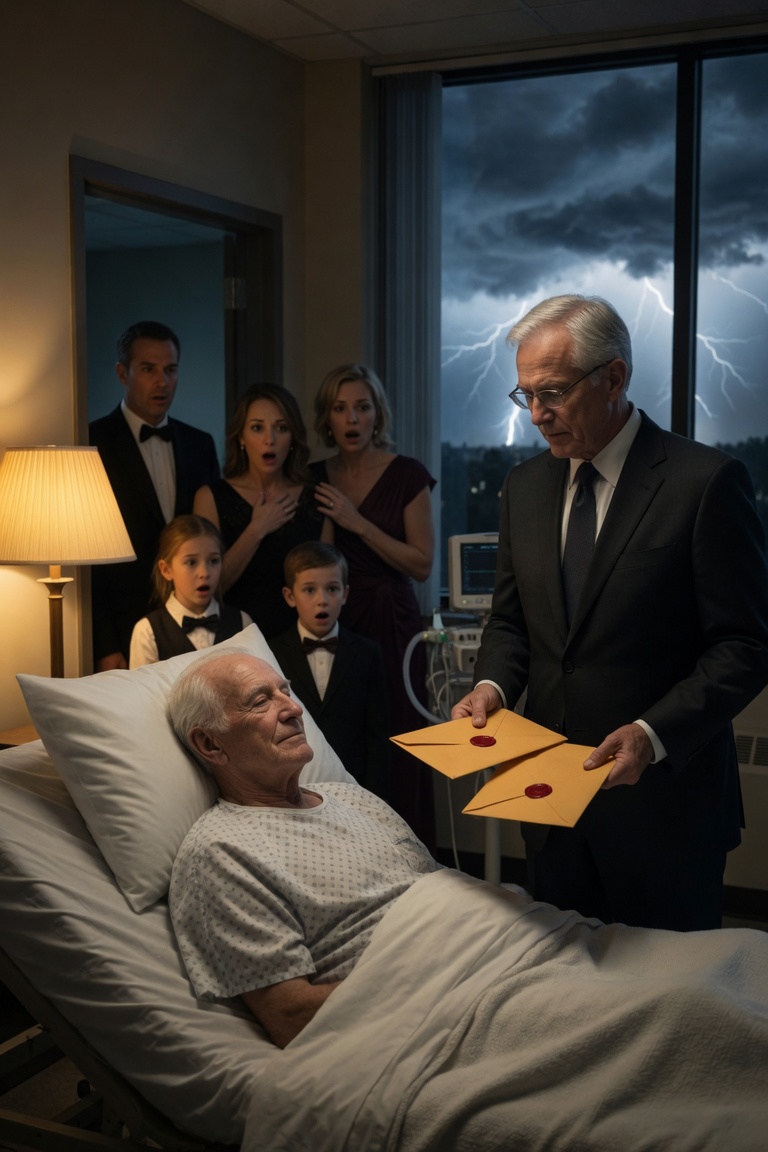
“Leave the lamp on, dear,” Mr. Harold Beaumont murmured, his voice thin as paper. “My children promised they’d come tonight.”
I stood by the switch in Room 12 of Willow Creek Assisted Living, just outside Charleston, South Carolina. Rain hammered the window in restless sheets. The clock on his nightstand read 11:40 p.m.
I’d heard this exact sentence from him almost every night for the past year.
Harold had three children. Preston, a hotshot real estate developer whose face plastered half the billboards downtown. Vivian, a socialite known for her elaborate charity galas. And Grant, the youngest, who’d once knelt beside his father’s hospital bed and sworn he’d never let him be alone.
It was Grant who’d brought him here eighteen months ago. “Just until the renovation’s done, Dad,” he’d said, carrying a single suitcase and an old fishing hat. Harold had believed him completely.
Eighteen months later, the suitcase still sat unopened. The visits had dwindled to nothing but excuses.
Three days ago, I’d overheard Vivian on speakerphone, her voice ice-cold: “If his heart gives out, don’t waste money on a hospital transfer. Just let it happen there.”
Harold had been standing right behind me.
He didn’t cry. He simply asked for legal paper and his reading glasses.
Tonight, headlights swept across the parking lot. Three cars had just arrived.
A man in a dark coat stepped through the door, carrying three sealed envelopes.
“Let them come,” Harold whispered, closing his eyes. “It’s time they learned the truth.”
Continued in the c0mments 👇
The man was Marcus Whitfield, a senior estate attorney from a firm downtown, and the moment he stepped into Room 12, the air itself seemed to change temperature.
“Mr. Whitfield,” I said, my voice barely above a whisper. “Mr. Beaumont asked for you specifically?”
“Three weeks ago,” Marcus said, setting his briefcase on the small table by the window. “He called my office and said he had exactly one thing left to do before he died, and he wanted witnesses to see it done properly.”
Voices echoed down the hallway — clipped, irritated, rehearsed with fake concern. The door swung open.
Preston entered first, tall and polished in an expensive blazer, his phone still glued to his ear as he wrapped up a call. Vivian swept in behind him, dressed in pearls and a black dress clearly chosen for how it would photograph. Grant slipped in last, looking pale and nervous, clutching a folder against his chest like armor.
They froze when they saw Marcus standing at the foot of the bed.
“Dad,” Grant said, forcing warmth into his voice. “We came as fast as we could. The storm—”
“Don’t,” Harold said, his voice suddenly sharp despite his frailty. “Don’t perform grief for a father you couldn’t be bothered to visit.”
Preston lowered his phone slowly. “What is this? Who’s the lawyer?”
“My executor,” Harold said. “And the man delivering exactly what each of you has earned.”
Harold’s breathing grew shallow. He looked toward me one last time, something like gratitude flickering in his tired eyes. Then his chest stilled.
The monitor let out a long, flat wail.
11:58 p.m.
Vivian gasped theatrically, pressing a manicured hand to her chest. “Oh, Daddy—no, no, this can’t be—”
“Save it,” Marcus said, his voice cutting through her performance like a blade. “Sit down. All three of you. Your father left very specific instructions, and I intend to carry them out exactly as written.”
Preston bristled. “This is a family matter. You need to leave.”
“I am the family matter,” Marcus replied evenly. “I drafted your father’s will four months ago, after two independent physicians confirmed his full mental competency. He anticipated you’d say exactly that.”
He picked up the first envelope, marked with a bold number one, and handed it to Preston.
Preston tore it open impatiently, expecting nothing more than a formality. Within seconds, his face went ash-white.
“This is impossible,” he stammered. “This can’t be right.”
“Your father knew, Preston,” Marcus said, “that your entire real estate portfolio was financed using a fraudulent power of attorney over his old warehouse property downtown — the one you claimed had been demolished years ago. It wasn’t demolished. Your father quietly sold it to a redevelopment group last month. The proceeds you’ve been counting on as collateral for your current projects no longer exist. Your bank has already been notified.”
Preston’s legs nearly buckled. He gripped the footboard of the bed, staring at his father’s still face as though seeing him for the first time.
Marcus turned to Vivian next, holding out the second envelope. She backed away instinctively.
“I don’t want it,” she said quickly. “I just want to grieve in peace.”
“Take it,” Marcus said, “or I read it aloud in front of the staff.”
Trembling, she opened it. Bank statements. Wire transfers. Photographs of luxury vacations paid for through what should have been her father’s retirement account.
“How did he get these?” she whispered.
“He hired a forensic accountant six months ago,” Marcus said. “For four years, you’ve siphoned funds from his accounts to finance a lifestyle you presented publicly as the result of savvy investments and charitable success. Your father decided that instead of pressing criminal charges, he’d simply expose the truth to the charity boards you sit on — unless you sign over your beach house and liquidate your investment accounts, with every dollar going to Willow Creek’s veteran outreach program by Friday.”
Vivian sank into the armchair by the window, sobbing — not for her father, but for the collapse of an image she’d spent years constructing.
Finally, Marcus turned to Grant, who was already backing toward the door.
“Going somewhere?” Marcus asked.
“I don’t need whatever’s in that envelope,” Grant said, gripping his folder tighter. “I have power of attorney. I control the house sale, the assets, everything. Whatever games he’s playing, it doesn’t touch me.”
“The house you sold six months ago,” Marcus said calmly, “using a document your father signed while heavily sedated after his hip surgery — believing he was authorizing a simple medical release. He found out through a neighbor three months later. He knew exactly what you’d done with the proceeds, too. The gambling debts. The men who came looking for you at your apartment.”
Grant’s face drained of color. “How could he possibly—”
“Because he loved you enough to find out everything, even after you stopped visiting,” Marcus said. “And instead of turning you in for elder fraud, which carries a mandatory prison sentence in this state, he bought out your debt directly. Which means, as of tonight, you don’t owe dangerous men money anymore.” Marcus paused. “You owe your father’s estate five hundred thousand dollars, repayable over the next twelve years through garnished wages from verifiable employment. Miss one payment, and the original fraudulent documents go straight to the district attorney.”
Grant collapsed into the chair beside his sister, the folder sliding from his hands.
Marcus finally turned to me, his expression softening for the first time all night.
“Clara,” he said gently. My name — but not mine, part of me thought, then remembered this wasn’t a story anymore, this was simply happening, unfolding in real time in front of me.
He handed me a small envelope with my actual name written in shaky, elegant handwriting.
Inside was a cashier’s check for the exact cost of the nursing program I’d mentioned to Harold months ago, in a quiet moment I hadn’t thought he’d remembered.
A note beneath it read: You listened for footsteps that never came. Go become the nurse practitioner you were always meant to be. Thank you for never turning off the light. — Harold.
Six months later, I stood at his gravesite under a pale Charleston sky, a tin of shortbread cookies resting against the headstone.
Preston now managed a modest property office two towns over, his empire quietly dismantled. Vivian had disappeared from the charity circuit entirely. Grant worked construction on the coastal highway project, a portion of every paycheck disappearing into a fund for elderly outreach services, exactly as his father had arranged.
I adjusted the new badge on my scrubs — Clara, Nurse Practitioner Candidate — and smiled at the stone.
“Still keeping the light on,” I whispered. “Just like you asked.”