
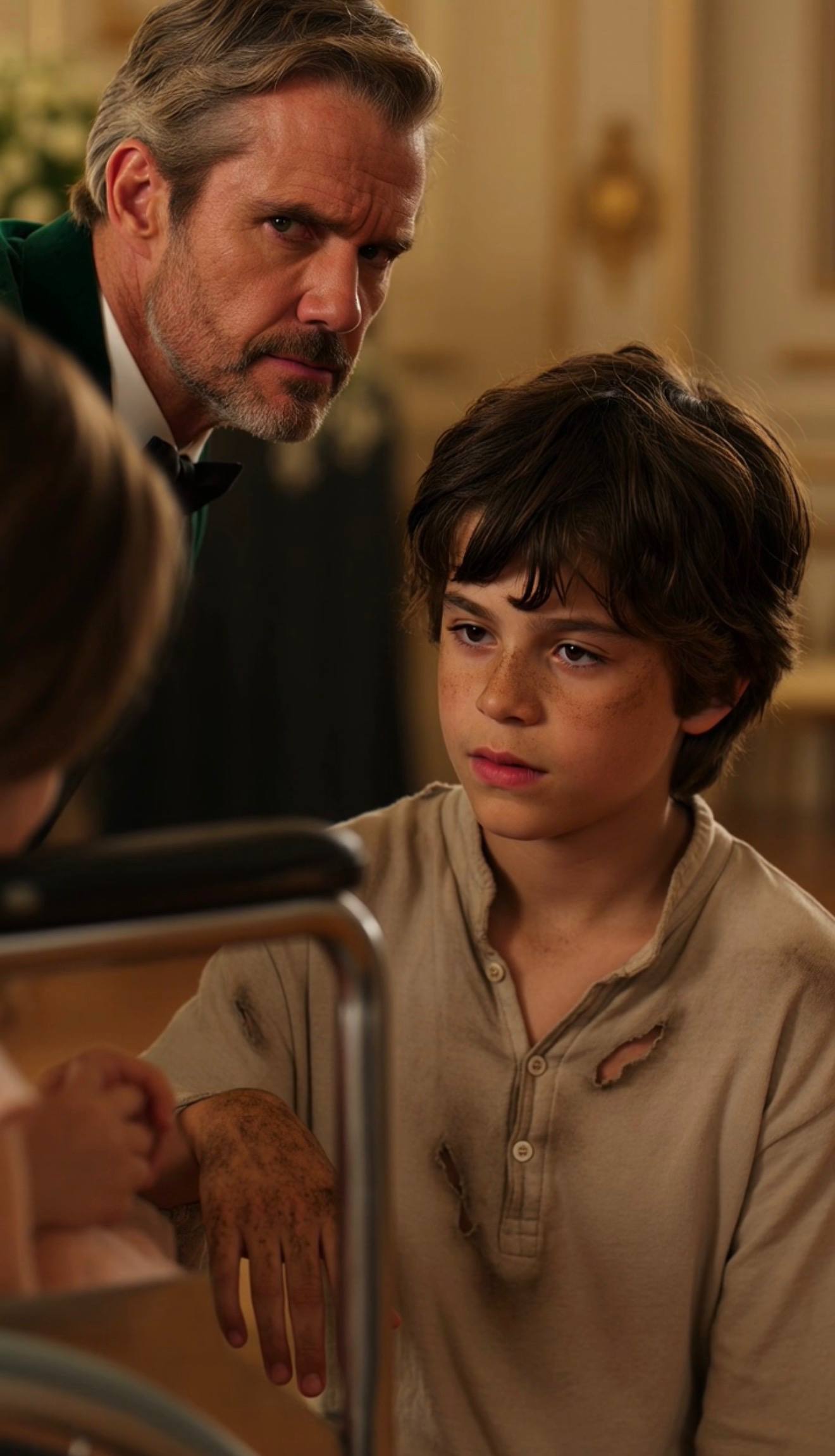
James had built his entire life around protecting Grace.
Ever since the accident three years ago, ever since the doctors said the word “permanent,” he had made it his personal mission to shield her from anything that could hurt her further — including hope.
So when a filthy, barefoot boy walked straight toward her wheelchair at his own charity gala, James stepped between them without hesitation.
“Stay away from my daughter,” he said, low and sharp.
The boy didn’t flinch. “I won’t hurt her,” he said quietly. “Can I ask her something?”
James didn’t move. But Grace, six years old and tired of being spoken over, leaned around her father’s leg.
“What?” she asked.
The boy crouched to her eye level, ignoring the stares of two hundred guests in tuxedos and gowns.
“Do you want to try?”
Grace’s eyes filled instantly with tears — not sadness this time, but something she hadn’t felt in three years.
The boy held out his dirty hand.
James whispered, “No. Please don’t.”
But Grace was already reaching back.
Continued in the c0mments 👇
The room had gone completely silent. Two hundred guests, mid-conversation, mid-sip, frozen with champagne glasses halfway to their lips as a barefoot street child took the hand of Senator James Whitfield’s paralyzed daughter.
James’s mind raced through every doctor’s report he’d memorized by heart. T11 spinal injury. Incomplete but severe. Eighteen months of physical therapy with no measurable improvement. The specialists in Geneva had been the last ones to try, and even they had eventually stopped returning his calls.
“Please,” James said again, quieter now, more desperate than commanding. “She’s been through enough disappointment.”
The boy looked up at him — not defiant, not scared, just steady. “I’m not going to disappoint her,” he said. “I’m just going to ask her to remember.”
“Remember what?”
The boy didn’t answer. He turned back to Grace instead.
“Put your hands on the armrests,” he said gently. “Like you’re about to push yourself up. Just like you used to.”
Grace’s small hands, still gripped in his dirt-streaked fingers, trembled as she placed them where he’d said. James took an involuntary step forward, ready to catch her, ready to catch the fall he was certain was coming — the fall that would break something in her that no cast could fix.
“Grace, sweetheart, you don’t have to—”
“Dad.” Her voice cut through his, firmer than he’d heard it in years. “Let me try.”
James stopped. He’d spent three years being told by every doctor that trying wouldn’t matter, that her body simply couldn’t respond, that hope without medical basis was its own kind of cruelty. But looking at his daughter’s face in that moment — fierce, focused, more alive than he’d seen her since the accident — he found he couldn’t say another word.
The boy’s voice dropped to something between them, almost a whisper only Grace could hear. James caught fragments. Something about muscles not being broken, just quiet. Something about her legs still remembering how, even if her mind had learned to stop asking.
“On three,” the boy said. “One.”
Grace’s arms tensed.
“Two.”
Her knuckles went white on the armrests, jaw set with a determination James hadn’t seen since before the accident, back when she used to climb the oak tree in their backyard despite every warning to be careful.
“Three.”
She pushed.
For one agonizing second, nothing happened, and James felt his heart break all over again, felt himself already preparing the words of comfort he’d need to offer, the promise that it was okay, that trying was enough—
And then Grace’s legs straightened.
She rose from the wheelchair on her own trembling power, the boy’s hand steadying her elbow but not lifting her, not carrying her weight — just there, just present, as she stood fully upright for the first time in three years.
The gasp that went through the ballroom was audible, a collective intake of breath from two hundred people who would spend the rest of their lives telling this story.
James was at her side in an instant, hands hovering, afraid to touch her, afraid this was a dream he’d wake from. “Grace—”
“I’m standing, Daddy.” Tears streamed down her face, but she was laughing too, a sound James hadn’t heard in years. “I’m standing.”
He wrapped his arms around her, careful, disbelieving, sobbing openly in front of senators and CEOs and everyone whose opinion he’d spent his career carefully managing. None of that mattered now. Nothing mattered except the solid, impossible weight of his daughter standing in his arms.
When he finally looked up to thank the boy, to ask him who he was, how he’d known, what miracle he’d just performed — the boy was already turning toward the door, slipping quietly back into the night as if he’d never been there at all.
“Wait,” James called. “Who are you?”
The boy paused at the threshold, glancing back with a small, knowing smile.
“Just someone who remembered what she forgot,” he said.
And then he was gone.