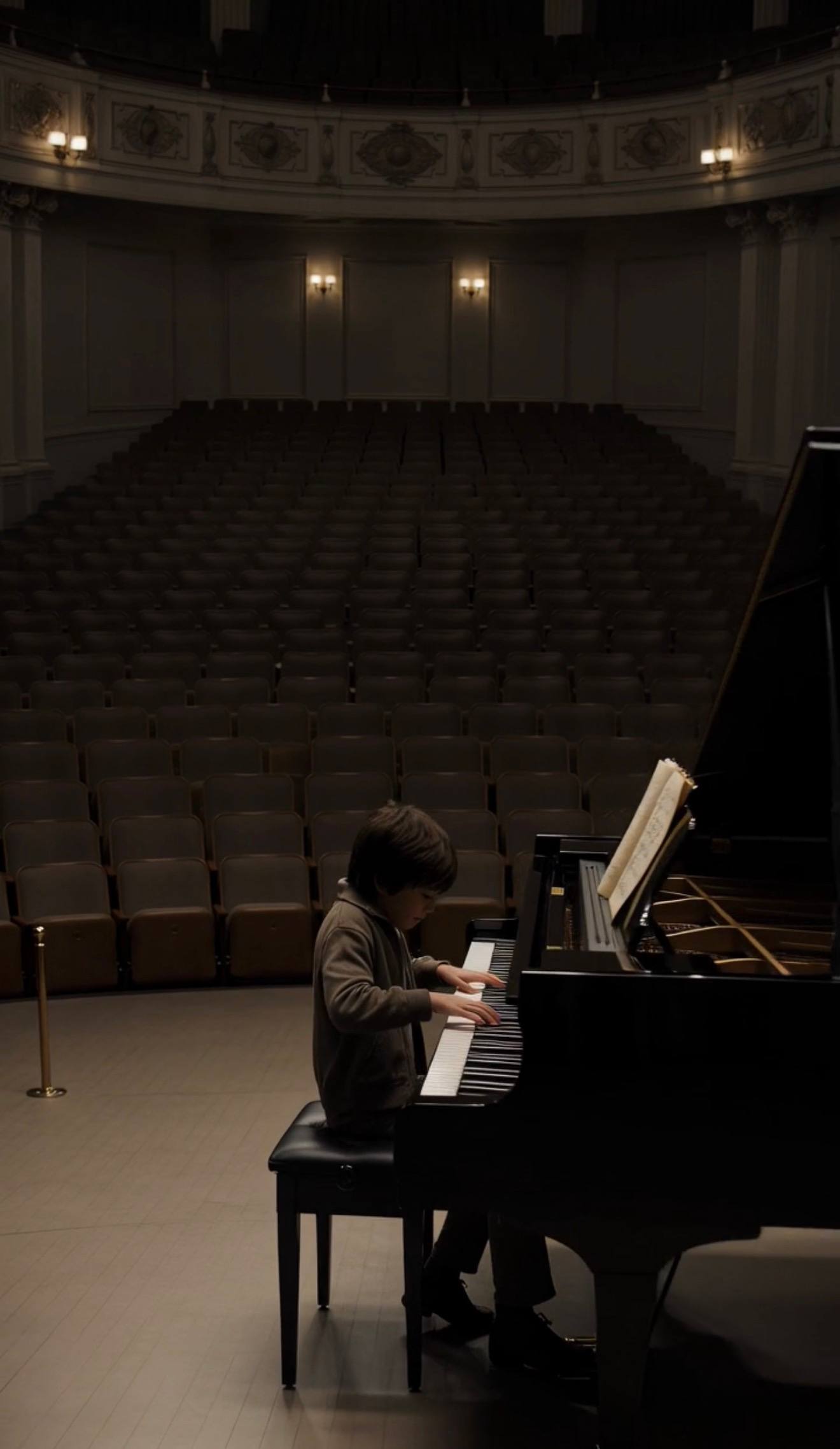
The concert hall was empty except for the cleaning crew.
Rosa had brought her son Mateo to work again — no babysitter, no other option. Ten years old, quiet, carrying that beat-up backpack everywhere. He knew the rules: sit in the back row, do homework, touch nothing.
But tonight, the grand piano was uncovered on stage.
A Steinway. Nine feet of polished black. The orchestra had rehearsed late, and someone forgot to lock the lid.
Rosa was three floors up cleaning the balcony when she heard it.
Music. Real music — not someone plunking keys. Rachmaninoff, rolling through the empty hall like a storm.
She dropped her rag and ran for the stairs, heart pounding. If security heard this, she’d lose her job. They’d both be out.
“Mateo!” she hissed, bursting through the doors. “Get away from—”
She stopped.
Because standing in the aisle, frozen in his coat, was Maestro Vidal himself — the conductor, who had come back for his forgotten glasses.
He was staring at her son.
The music stopped. Mateo’s hands hovered over the keys, terrified.
The Maestro walked slowly toward the stage.
“Who,” he said quietly, “taught you that?”
Mateo swallowed hard.
“Nobody. I watch through the door during rehearsals.”
Continued in the c0mments 👇
The Maestro didn’t speak for a long moment. He climbed the stage steps slowly — a man in his sixties who had conducted in Vienna, in London, in every hall that mattered — and stood beside the piano, studying the ten-year-old boy in the secondhand jacket sitting at his Steinway.
“You watch through the door,” he repeated.
“During rehearsals. When Mom cleans the east wing.” Mateo’s voice was barely above a whisper. “I’m sorry. I know I’m not supposed to touch anything. Please don’t fire her. It’s my fault, not hers.”
Rosa had reached the front of the hall by then, breathless, ready to apologize, to beg, to promise it would never happen again. The Maestro raised one hand without looking at her — not dismissive, just asking for a moment.
“The passage you were playing,” he said to Mateo. “The second movement. You changed the fingering in the descending run. Why?”
Mateo blinked, confused that this was the question. “My hands are too small for how the lady plays it. So I found another way. It sounds the same. Almost.”
“Show me.”
Mateo hesitated, glancing at his mother. Rosa stood frozen in the aisle, one hand pressed to her mouth, no idea whether her son was in trouble or in the middle of a miracle.
Mateo played.
Not just the run — the whole second movement, from memory, a piece he had never seen sheet music for, never had a single lesson on, learned entirely through a crack in a rehearsal door while his mother emptied trash cans two hallways away. His fingering was unorthodox everywhere — small hands finding impossible workarounds, self-taught solutions a trained pianist would never think of because a trained pianist would never need to.
When he finished, the hall stayed silent.
The Maestro sat down slowly on the edge of the stage, suddenly looking less like a legend and more like a tired man who had just been reminded why he’d given his life to music in the first place.
“Señora,” he said finally, turning to Rosa. “How long has your son played piano?”
“We don’t have a piano,” Rosa said quietly. “We’ve never had a piano.”
“Then where does he practice?”
“There’s a paper keyboard,” Mateo answered for her, embarrassed. “I drew it. On cardboard. I practice the fingers on that, and I hear the notes in my head.”
The Maestro closed his eyes for a moment.
“A cardboard keyboard,” he repeated softly. “Dios mío.”
What happened over the next hour, Rosa would replay for the rest of her life. The Maestro called the hall’s director at home. Then he called the conservatory. Then he sat with Mateo at the piano for forty-five minutes — not testing him anymore, just playing with him, four hands, laughing at one point in a way that echoed through the empty hall.
Before he left, he crouched to Mateo’s eye level.
“Every Saturday morning, nine o’clock, you come here. Not through the rehearsal door — through the front door. I will teach you myself. No charge. On one condition.”
Mateo nodded quickly, afraid to breathe.
“Someday, when you are standing where I stand, and a child appears who has nothing but the music inside them — you do for them what I am doing for you. That is the payment. That is the only payment that matters.”
The conservatory accepted Mateo on full scholarship eight months later, the youngest admission in eleven years. The audition committee’s notes, Rosa was told, included a line she keeps folded in her wallet to this day:
“Technique unconventional. Musicality unteachable — in the truest sense: it cannot be taught. It can only be born, and then found.”
Rosa still cleans the concert hall three nights a week. She’s been offered better hours, other buildings.