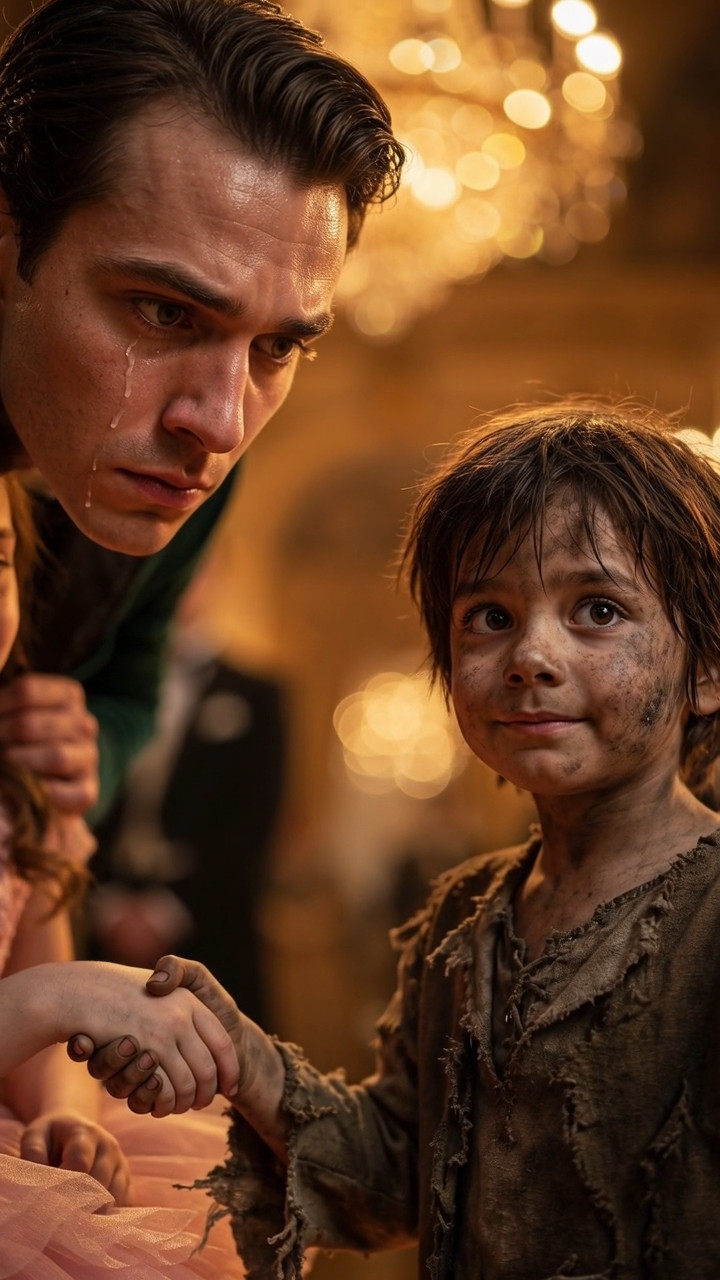
The Winter Gala was a place of perfection, where only the flawless were invited. Clara sat in her silver-plated wheelchair, a “broken princess” in a world of marble and gold. Her father, the Duke of Sterling, stood behind her like a stone wall, guarding her from the world’s pity—and from the world itself.
When the boy walked in, the music almost stopped. He was covered in the soot of the coal mines, his clothes held together by grit and hope. He walked straight past the millionaires and the guards, stopping right in front of Clara.
“May I have this dance?” he asked, his voice steady.
The Duke’s face reddened. “Don’t touch her!” he hissed, his hand tightening on Clara’s chair. “She can’t dance. She hasn’t walked in five years. Leave now before I have you thrown out.”
The boy didn’t move. He looked Clara in the eyes—the only person in the room who didn’t look at her with sadness. “Maybe she just needs someone to believe she can try,” he whispered.
The room went silent as he reached out his hand. Clara’s heart hammered against her ribs.
Continued in the c0mments 👇
The Duke was about to call the guards, his voice already rising in a roar of indignation. But then, something happened that silenced even the heartbeat of the room.
Clara’s hand, pale and trembling, lifted from her lap. She didn’t look at her father. She didn’t look at the shocked socialites whispering behind their silk fans. She looked at the boy’s hand—rough, calloused, and extended in a gesture of pure equality.
Her fingers brushed his. He didn’t pull her; he simply waited, providing a steady anchor in a sea of doubt.
“Clara, no,” her father whispered, his voice cracking. He remembered the accident, the twisted metal of the carriage, and the five years of specialists who all said the same thing: permanent nerve damage.
But the boy, whose name was Leo, wasn’t a specialist. He was a dreamer. He had seen Clara through the window of the palace every day for a year, not as a tragedy, but as a girl who looked like she was waiting for a reason to move.
Clara felt a spark—a phantom warmth she hadn’t felt since she was six years old. It started in her fingertips and surged down her spine. With a low, determined grunt, she pushed against the armrests. Her legs, thin and weak, shook under the weight of her body.
The Duke’s hand flew to his mouth. He moved to catch her, but Leo caught his eye and shook his head. Let her do this.
Clara stood.
It was a slow, agonizing process, like a flower blooming in slow motion. When she was finally upright, standing on her own two feet for the first time in half a decade, a collective gasp echoed through the ballroom. The Duke fell to his knees, not out of protocol, but out of sheer, overwhelming shock. Tears streamed down his face, ruining the perfection of his velvet tuxedo.
“How?” the Duke choked out.
Leo smiled softly. “The mind is a fortress, your Grace. Sometimes, the gates only open when someone knocks with love instead of pity.”
They didn’t dance a waltz. They didn’t spin across the floor. They simply stood there, swaying slightly to the rhythm of their own breathing. To Clara, it was more exhilarating than any gallop through the countryside.
But as the night went on, the true story came out. Leo wasn’t just a random coal boy. He was the son of the lead engineer who had built the Sterling estate. His father had been blamed for a construction accident and died in poverty, a victim of the Duke’s legal team. Leo hadn’t come to the gala for revenge; he had come to prove that the “broken” things the Duke discarded—whether it was his own daughter’s potential or a poor family’s reputation—were capable of miracles.
The Duke realized his sin. He hadn’t just been protecting Clara; he had been imprisoning her in his own guilt.
That night, the wheelchair was left in the center of the ballroom, a hollow shell of a past that no longer existed. The Duke cleared the name of Leo’s father and established a foundation for children with spinal injuries, led by the best doctors money could buy, but guided by Leo’s philosophy of faith.
Clara never returned to that chair. It took months of painful physical therapy, but every time she felt like giving up, she would look at the small, soot-stained ribbon Leo had left her.
Years later, when people asked Clara about the “Miracle at the Gala,” she would always say the same thing. “It wasn’t magic, and it wasn’t a doctor. It was the first time someone saw me instead of my chair. It’s amazing what the body can do when the soul finally feels invited to the party.”