
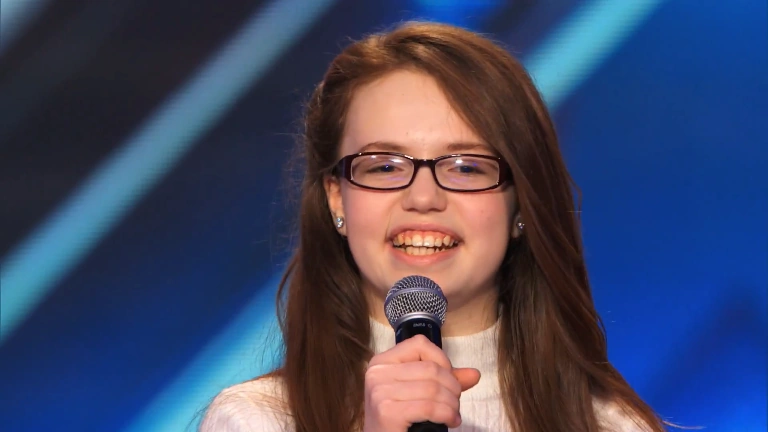
When Mara Justine stepped onto the America’s Got Talent stage, there was a softness about her that instantly read as familiar — the shy smile of a child used to staying in the background, the slight nervous tuck of her fingers when she waited for the music to begin. At just 11 years old and one of five children in a bustling New Jersey household, Mara’s life was full of ordinary rhythms: school mornings, homework, and the steady background hum of siblings. Yet those everyday moments hid a remarkable truth. She’d grown up turning chores into practice sessions, belting out songs while she scrubbed floors or folded laundry, and both the mundane and the music had shaped a confidence that few expected to see when she first walked under the bright lights.
The audition began unassumingly. You could almost imagine her mother watching at home, thinking, “There she is — my girl.” Mara’s younger brother, who sometimes shushed her at home when she sang too loudly, would have hardly suspected the transformation that was about to occur. The first notes were tentative, a whisper of a voice finding its place in the soundscape. Then, as if a switch had flicked, Mara blossomed. Her posture straightened, her eyes focused, and the voice that filled the auditorium was far bolder than anyone could have guessed from that initial, nervous entrance.
What made the moment so arresting wasn’t simply the power of her voice, but the maturity behind it. There was professional precision in her phrasing and a controlled intensity in how she shaped each line. Where many young performers rely on volume to impress, Mara demonstrated musicality: she knew when to soften, when to hold a note a fraction longer for emotional emphasis, and when to unleash a startlingly full-throated belt that rippled across the room. Those crescendos felt earned, not manufactured, and they landed with real emotional weight. Listeners weren’t just impressed by technique; they felt the story in the song.
The transition from shy child to commanding performer unfolded in a way that made the audience lean in collectively. You could see people exchange looks — surprise first, then an almost reverent quiet as everyone acknowledged they were witnessing something special. Judges who are used to rapid-fire auditions suddenly found themselves still, listening rather than reacting. When the final phrase settled, the silence that followed was heavy with recognition. Then the room erupted: a standing ovation that seemed to originate from every corner at once, cheers, and whistles that validated the raw, rare talent they had just witnessed.
Their responses were immediate and emphatic. Each judge offered praise that went beyond polite encouragement; they spoke about being genuinely moved and about the way Mara’s performance set a bar that felt new for the competition. Their words reflected a shared understanding: this was not merely a charming child with a good voice, but an artist who could carry an audience and convey real feeling. The four “yes” votes were a formality at that point — a unanimous endorsement that matched the roar of approval from the crowd.
Beyond the stage, the story of Mara’s audition took on a life of its own. Clips of the performance spread across social media, with viewers stunned by the contrast between her youthful appearance and the mature sound she produced. People were quick to note the relatability of her background: a big family, household chores, and the kind of ordinary practice that doesn’t look glamorous but builds skill over time. Fans shared anecdotes of their own childhoods — singing in kitchens, rehearsing in bedrooms — connecting to the idea that extraordinary things often grow out of everyday moments.
There was also a tenderness to the public reaction. Many commenters expressed pride and a sense of protectiveness, recalling how a national spotlight can be both thrilling and overwhelming for someone so young. That awareness only seemed to deepen the appreciation for what Mara had managed to do: take a personal habit, something she might have done in private for years, and transform it into a public declaration of talent without losing the core of who she is. She didn’t try to fake experience; she revealed it in the one way she knew how — through honest, unguarded singing.
For Mara, the immediate consequences were obvious: a place in the next round, an influx of attention, and the kind of validation that can shift a young life. But the broader resonance of her performance lay in what it represented. It was a reminder that age is not a definitive boundary for artistry and that confidence can be nurtured in the most ordinary environments. The standing ovation and unanimous judges’ praise were proof that the world still responds powerfully to authenticity, especially when it arrives from an unexpected corner.
In the end, Mara Justine’s audition was memorable for many reasons: the jaw-dropping contrast between appearance and ability, the technical control of her delivery, and the emotional truth she brought to the stage. Yet perhaps the most enduring impression was simple and human — an 11-year-old girl who had practiced between chores, who had been told to hush at times by a younger sibling, and who chose to stand up and sing in front of millions. For a few breathless minutes, she reminded everyone watching that great talent often begins in small, private moments and, when given the chance, can shine brightly enough to stop the world.