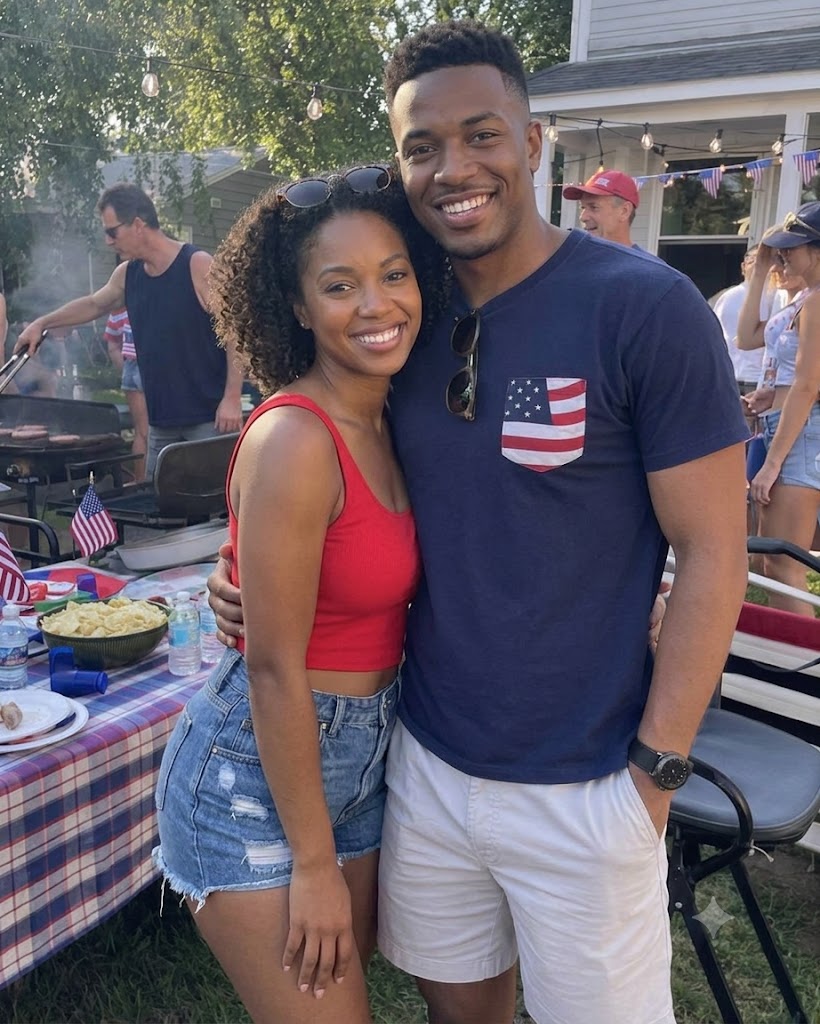
Labor Day cookouts had been a fixture in our family for eleven years — the whole block showed up, my husband Russell manned the smoker for six hours straight, and by evening everyone crowded onto the deck to watch the neighborhood fireworks.
Our daughter Priya, twenty-three, called that week practically vibrating with excitement.
“I want you both to meet someone,” she said. “His name’s Theo. I think this one’s real, Mom.”
I spent two days looking forward to it.
The gate creaked open just as I was carrying a tray of corn out to the table. Priya walked through first, laughing at something, her hand laced with a tall young man in a faded varsity jacket.
Stitched across the chest, in block letters, was a name I hadn’t seen in fifteen years: KOWALSKI.
The tray tilted in my hands. I caught it against the railing before it hit the ground.
Across the yard, Russell turned, saw the jacket, and went the color of the paper plates.
I crossed the patio fast and grabbed his arm.
“That’s Daniel’s son,” I whispered. “That has to be Daniel’s son.”
Continued in the c0mments 👇
Fifteen years earlier, Russell and Daniel Kowalski had built a small engineering firm together out of Daniel’s garage — a water-filtration design Daniel had sketched on napkins for two years before Russell came aboard with the business sense to make it real.
When the patent finally sold to a national manufacturer, the payout was enormous. Enormous enough that Russell restructured the ownership paperwork six months before the sale closed — paperwork Daniel, deep in his wife’s cancer treatment at the time, signed without fully reading, trusting his partner completely.
Daniel’s share dropped from forty percent to eight.
Daniel found out after the money had already moved. He fought it for two years, spent what savings he had left on lawyers, and lost — the paperwork was airtight, even if it wasn’t right. He died of a heart attack four years later, weeks before what would have been his fiftieth birthday, still working two jobs to cover his wife’s remaining medical debt.
We had told Priya, when she was old enough to ask, that “the partnership just fell apart” and left it there.
Theo introduced himself with an easy handshake and a warm smile that made the whole thing worse.
“Good to finally meet you both,” he said. “Priya talks about your cookouts nonstop.”
I shook his hand because refusing would have raised questions I wasn’t ready to answer in front of forty guests.
We got through the afternoon on autopilot. Theo helped kids launch water balloons, complimented Russell’s brisket, mentioned — casually, devastatingly — that he was finishing an engineering degree “kind of in my dad’s memory, I guess.”
Russell’s hand went rigid around his tongs.
That night, after the last guests left, I pulled the old filing box down from the attic closet where it had sat untouched for over a decade.
Inside were the original partnership agreements — the real ones, from before the restructuring — alongside the amended paperwork Russell had drawn up, correspondence with the lawyers, and a letter Daniel had written to Russell two years before he died, which Russell had never answered.
I read it that night for the first time.
Russell — I’m not asking for everything back. I’m asking you to just tell me the truth about how the ownership got rewritten while I was sitting in a hospital waiting room. I think I deserve that much, after everything we built together.
He never sent a reply.
The next morning, I asked Priya and Theo to come by before they left town.
Priya looked wary the moment she sat down. “If this is some kind of interrogation—”
“It’s not about you,” I said. “It’s about us. About your father and me, and about Theo’s father.”
Theo went very still.
Russell laid it out plainly — the garage, the patent, the paperwork signed during Daniel’s wife’s illness, the restructured ownership, the lawsuit Daniel couldn’t win, the letter that never got a reply. He slid the old box across the table.
Theo read through it slowly, methodically, the same way, I imagine, his father once reviewed blueprints.
“I always knew something happened,” he said finally, voice steady. “My dad wouldn’t talk about it. Just said he trusted the wrong person once and paid for it the rest of his life.”
“That person was me,” Russell said.
Priya’s face had gone pale. “You built this house on his idea.”
“Yes,” I said. There was no version of that sentence that didn’t sound as bad as it was.
Theo stood, and for a moment I thought he’d walk straight out the door. Instead he looked at Priya.
“I need some time,” he said. “Not from you. From this.”
She stood with him immediately, without hesitation, the way children do when they finally understand which side of a story they belong on.
“I’m coming with you,” she said, and they left together.
Russell sat at the table for a long time afterward, staring at his own signature on paperwork fifteen years old.
The following week, I called a lawyer of our own — not to fight anything, but to calculate exactly what Daniel’s rightful share would have been worth, with reasonable growth, across fifteen years. The number was larger than either of us expected. Russell sold his half of a second business venture without argument. I sold the vacation property my parents had left me.
We didn’t ask Theo what would make it right. We asked our lawyer to calculate it, and we paid it in full, plus more, into a trust in his name.
Theo didn’t ask for the extra. When we told him about it, he said only, “Put it toward something that helps someone else start over. That’s what my dad would’ve wanted done with it.”
So we did — a small grant fund at the state university’s engineering department, for students building on an idea with nothing but a napkin and no one backing them yet.
Priya kept seeing Theo. He came around slowly, carefully, never quite at ease in our house, and I never pushed him to be.
By the next Labor Day, he showed up anyway — carrying a folding table for the fundraiser he and Priya were running that weekend.
“Leg’s loose on this one,” he said to Russell. “Help me fix it?”
They flipped it over by the garage. Russell held the frame. Theo tightened the bolts.
“That should hold,” Theo said when they finished.
He meant the table.
I understood not to ask him to mean anything more than that. Not yet.