
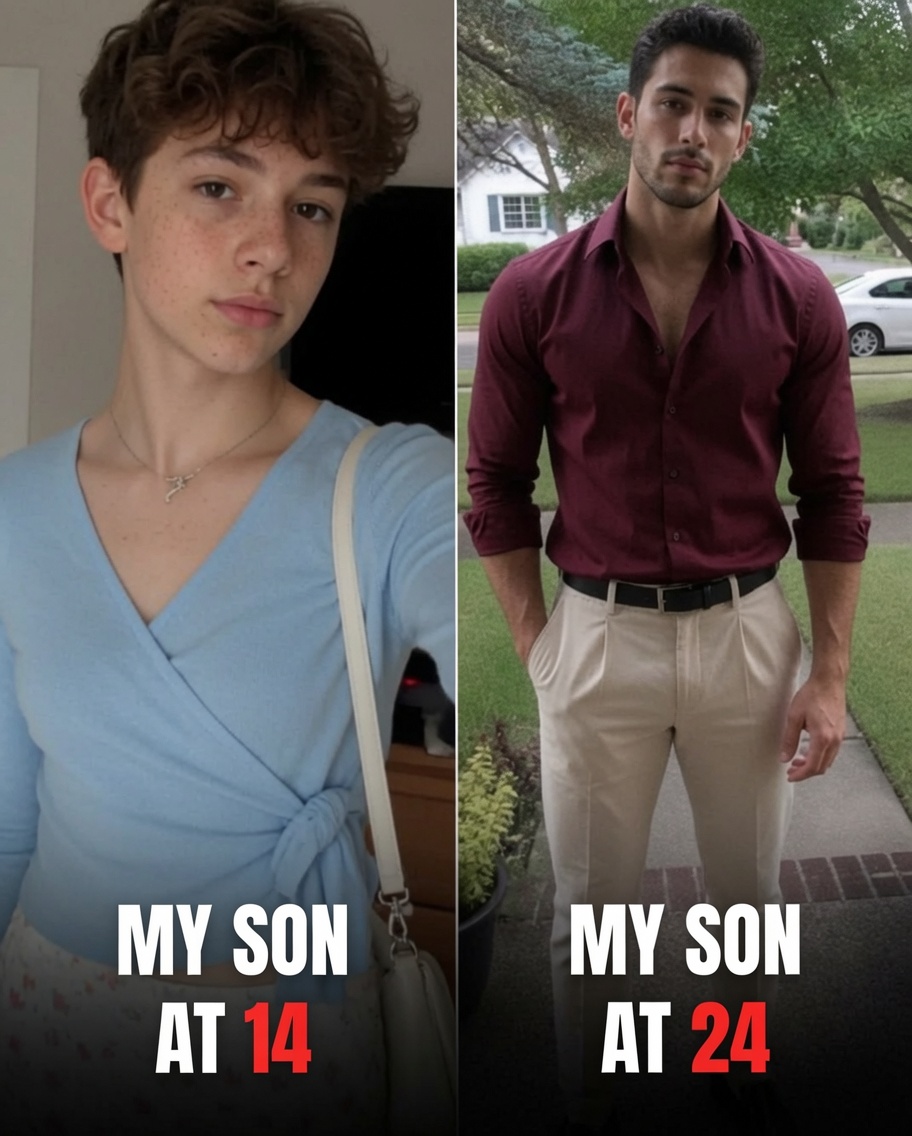
I raised my son, Nathan, alone after his father died of pancreatic cancer when Nathan was nine. He was a gentle, artistic boy who filled sketchbooks with watercolors of the lake behind our house in northern Wisconsin. By the time he was thirteen, he had started painting his fingernails soft colors and wearing long silver earrings his aunt had given him. I never loved him any less.
When Nathan was fifteen, I remarried a man named Gregory, a retired accountant I met at my church’s grief support group.
Gregory was polite in public and rigid at home. He believed there was only one way to be a young man. He mocked Nathan’s paintings, his clothes, his voice, his friends. He told him art was for people “who couldn’t handle real work.” He kept saying Nathan needed to “toughen up” and study business “like a serious young man.”
The night of Nathan’s high school graduation, everything blew apart. In front of our whole family, Gregory told Nathan his art school scholarship was “an embarrassment” and that no stepson of his would waste his life “finger-painting for tips.”
Nathan left the dinner table without a word.
The next morning, his bedroom was empty. On his pillow was a folded note.
Mom. I love you. Please do not look for me. I just need to breathe.
He was eighteen. Legally an adult. The police said there was nothing they could do.
Seven years passed.
I searched for him in every crowd, every gallery, every coffee shop I visited on trips through Milwaukee and Minneapolis. Every Christmas, I set an extra plate. Every birthday, I baked his favorite lemon cake. Gregory kept telling me to move on. “He made his choice, Marilyn.”
Last Tuesday morning at 6:40, I was pouring coffee when the back door opened.
A tall young man stood there in a paint-stained denim jacket. Short dark hair. My late husband’s green eyes.
“Nathan?” I whispered.
He nodded once. His face was calm, but his hands were shaking.
I moved to hug him.
He lifted one hand gently.
“Mom, wait. I did not come back for a reunion. I came back because Gregory needs to tell you the truth. Today. Before I leave this kitchen.”
Then he looked past me into the hallway, right where my husband had just appeared in his robe.
Gregory’s coffee mug slipped and shattered on the tile.
Part 2 in the comments 👇👇
Gregory stood frozen in the hallway, coffee spreading around his slippers.
“Nathan,” he said. “You should not be here.”
Nathan did not move.
“Sit down, Gregory. You have seven years of lying to undo.”
I looked between them. My heart was hammering.
“What is going on?”
Nathan pulled a battered leather folder out of his backpack and set it on the kitchen table.
“Mom, please sit down.”
I sat.
Gregory did not.
Nathan opened the folder. Inside were dozens of printed screenshots. Text messages. Emails. Some going back to the summer before his eighteenth birthday.
He slid the first page across the table to me.
The messages were from Gregory to Nathan. Sent the night of the graduation dinner, less than an hour after Nathan left the table.
Do not come back tonight. Your mother has cried enough because of you.
She married me to have peace. You are the storm.
If you actually love her, disappear. Give her the normal life she deserves.
She will always choose me. Do not make her say it out loud.
Every day you stay, you take a year off her life. Do the math.
I could not breathe.
Page after page. For years. Even after Nathan left, Gregory had kept messaging him from a number I never knew existed.
She is finally sleeping through the night. Do not ruin it.
She has stopped crying on Sundays. Stay gone.
If you contact her, I will tell her the truth about why you left. And I promise you, she will never forgive you.
I looked up at my husband.
“Gregory. Tell me these are fake.”
He said nothing.
Nathan spoke quietly.
“Mom. I stood at the bus station that night for two hours. I almost came home three times. Then his messages started. I read them over and over. I believed him. I thought I was giving you back your life.”
His voice cracked for the first time.
“Every birthday, I wrote you a letter. I never sent one. Every Mother’s Day, I picked up the phone. I put it down. I kept hearing his words.”
I turned to Gregory. My hands were shaking so hard I had to press them flat on the table.
“You watched me cry every single Christmas.”
He looked at the floor.
“You held me at his empty grave marker at the memorial garden. You told me to let go.”
Silence.
“You watched me put an extra plate on the table for seven years.”
“Marilyn,” he finally said, “I did what I thought was best for our marriage.”
“Our marriage?”
I stood up so fast my chair scraped the tile.
“You stole my son. For seven years. To make your life quieter.”
“He was tearing this house apart. Every argument, every neighbor, every stare at church. I wanted a normal family.”
Nathan let out a short, tired laugh.
“There it is.”
I looked at Nathan. My beautiful, gentle boy, now twenty-five years old, standing in my kitchen with paint under his fingernails and his father’s eyes.
“Where have you been, sweetheart?”
He swallowed.
“Minneapolis, mostly. I waited tables for three years. Then I got into a small art program on scholarship. I have a studio apartment above a bookstore. I sell paintings at farmers’ markets on weekends. I have a cat named Biscuit. I am okay, Mom. I am really okay.”
Tears were streaming down my face.
“Why did you come back now?”
He reached into his jacket pocket and pulled out a folded piece of newsprint. A small article from a Minneapolis paper. A photograph of a woman at a gallery opening, smiling at one of Nathan’s watercolors of the lake behind our old house.
The woman was my sister Ellen.
“Aunt Ellen walked into my show three weeks ago by accident,” Nathan said. “She was in the city for a conference. She saw the painting of the lake and she knew. She hugged me for twenty minutes in the middle of the gallery. Then she told me you never stopped looking. That you still bake the lemon cake. That you still cry on my birthday.”
He looked at Gregory.
“She told me exactly what he had been telling you for seven years. And I finally understood he had been lying to both of us.”
I turned to Gregory. Something inside me had gone very still and very cold.
“Go upstairs. Pack a suitcase.”
“Marilyn, please—”
“Pack a suitcase. Today. My lawyer will contact you about the rest.”
“We can talk about this.”
“There is nothing to talk about. You erased my son from my life. You do not get to negotiate that.”
He stood there for a long moment. Then he walked slowly upstairs. We could hear drawers opening and closing.
I turned to Nathan.
“Can I hug you now?”
He smiled through his tears.
“You never had to ask, Mom.”
I wrapped my arms around my son. He was taller than I remembered. He smelled like turpentine and coffee. He held me so tight I could feel his heartbeat against my shoulder.
“I am so sorry,” I whispered. “I should have seen it.”
“You were lied to, Mom. By someone you trusted. That is on him. Not you.”
Twenty minutes later, Gregory came down with a suitcase. He paused at the front door.
“I did love you, Marilyn.”
I looked him straight in the eye.
“If you had loved me, you would have loved my son.”
He walked out.
I closed the door behind him. The house felt lighter than it had in seven years.
Nathan stayed for two weeks. We drove out to the old lake house. He painted every morning on the dock. I baked lemon cake three times because I could. My sister Ellen drove up from Milwaukee and cried in my arms for an hour.
Nathan went back to Minneapolis, but this time with a phone number I could call. This time with weekends already planned on the calendar. This time with one of his lake paintings hanging above my fireplace where Gregory’s fishing photo used to be.
Last Sunday, I drove down to see him. Biscuit the cat sat on my lap for two hours. Nathan made me pancakes and showed me his newest series of watercolors.
He signed one of them and handed it to me.
“For the kitchen wall, Mom. So you always know where I am.”
I framed it that same night.
The empty chair at my table is gone.
My son is home.