
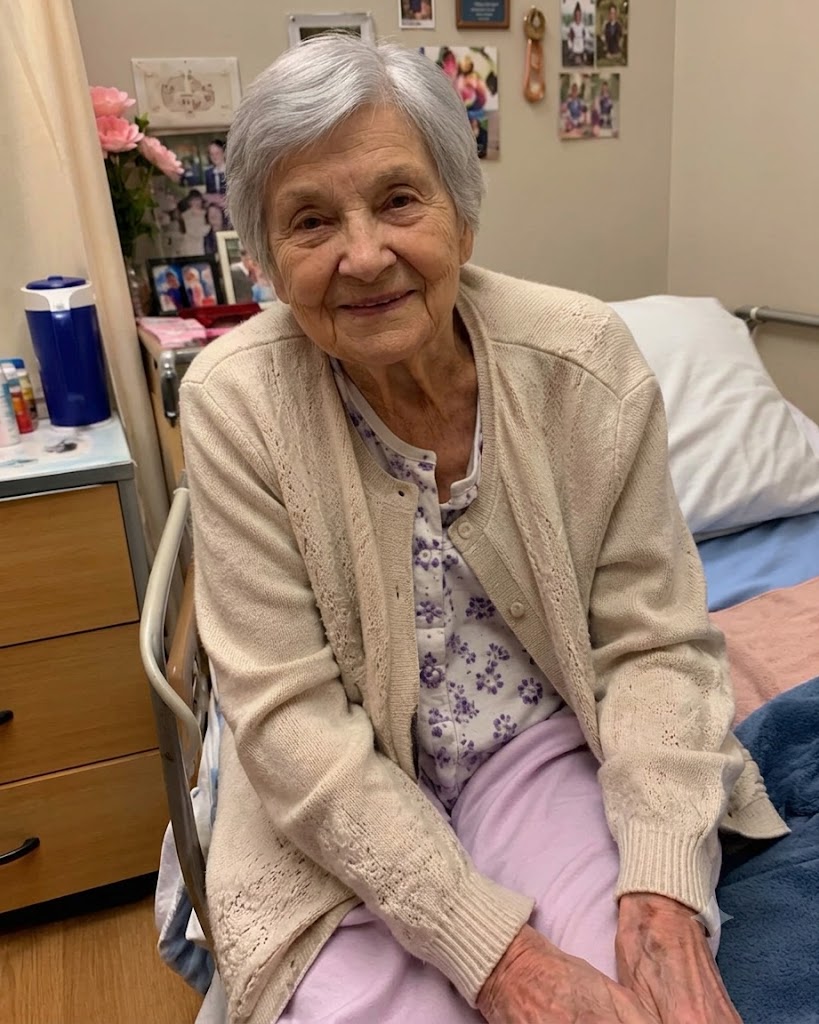
My grandfather, Walt, is the gentlest man I know.
At least, that’s what I would have told you before last Thursday.
He’s 79, broad-shouldered but slow-moving now, and he still tips his hat to strangers out of habit from a different decade. After my grandmother died three years ago, he moved into Cedarbrook, an independent-living community with a shared garden plot he’d claimed almost immediately — his one condition for agreeing to move in at all.
“I need dirt under my nails,” he told my mother. “A man without something growing goes soft in the head.”
Nobody argued. He’d farmed forty acres for thirty years before retiring; the garden was the only thing that made the move feel like less of a defeat.
He became something of a fixture there. He taught two teenage volunteers how to stake tomatoes properly. He shared his tools without being asked. He grew a corner bed of sunflowers just because the woman two doors down, Ruth, had mentioned once that they reminded her of her late husband.
Ruth was 81 and, according to the staff, in the early stages of dementia. Some days she remembered everyone’s name. Other days she believed she was still running the flower shop she’d owned in the 1970s.
Walt was patient with her. When she asked the same question three times in ten minutes, he answered it three times, gently, like it was new information each time.
Then, last Thursday, my phone rang while I was at work. It was Walt.
The moment I answered, I heard him crying — something I’d genuinely never heard before, not even at Grandma’s funeral.
“They’re banning me from the garden,” he said. “And from the building after nine at night.”
I sat up so fast I knocked over my coffee.
“Grandpa, what happened?”
“I made a mistake, sweetheart. A bad one.”
Continued in the c0mments 👇
I drove straight to Cedarbrook, already composing the argument I planned to give the property manager. My grandfather didn’t break rules. He returned library books early. He apologized to inanimate objects when he bumped into them.
I found him in the garden shed, sitting on an overturned bucket, still in his gardening jacket, staring at his hands.
“Tell me what happened,” I said.
He wouldn’t look at me at first.
The property manager, a woman named Denise, found us there a few minutes later. Her expression wasn’t angry — it was worried, in a way that scared me more than anger would have.
“Can I show you something?” she asked. “Before you decide how upset to be.”
She walked us to the security office and pulled up footage from the exterior camera near the garden gate — timestamped 4:12 a.m., three nights running that week.
In the grainy footage, Walt let himself out through the side gate — a keypad exit meant only for staff — using a code he had no business knowing. He crossed the dark garden, knelt at Ruth’s sunflower bed, and began digging. Methodically. For nearly forty minutes each night.
“He’s been digging up her flowerbed at four in the morning,” Denise said. “Three separate nights. We only caught it because a night nurse noticed the gate ajar.”
I stared at the screen. “Digging up — why?”
“We don’t know. He wouldn’t tell us. We were also concerned because Ruth’s room has a door that opens onto that same garden path, and that door’s alarm has been going off intermittently — we now believe he disabled it.”
My stomach dropped. “He disabled her door alarm?”
“With electrical tape over the sensor. Twice.”
I turned to my grandfather, who was still staring at the floor of the shed.
“Grandpa. Why would you tamper with an elderly woman’s door alarm?”
His voice, when it came, was barely above a whisper. “She kept telling me the shop was failing. That she needed to get to the flower shop before the frost killed the stock in the cooler. She was so frightened, Emma. Every single night she was frightened.”
“So you were letting her out?”
“No,” he said, shaking his head hard. “No — I was trying to stop her from needing to.”
I didn’t understand.
“I remembered where she said the shop cooler used to sit — in her mind, I mean, from what she’d describe. So I started digging up bulbs from my own bed and replanting them into hers, arranging them the way she always says the shop windows looked. I thought — I thought if her garden looked enough like what she was picturing, she’d stop feeling like she had to go find it. I thought I could bring the memory to her instead of her going out looking for it in the dark.”
“And the alarm?”
He flinched. “She kept trying the door herself, on the nights I wasn’t fast enough. I taped over the sensor so the alarm wouldn’t panic her further if she tried it and it blared in her face at 3 a.m. I thought I was protecting her from being frightened twice.”
“Grandpa, she could have walked straight out that door herself while it was disabled. Anyone could have.”
He nodded slowly, tears finally slipping down. “I know that now. I only thought about tonight. I never thought about the night I wasn’t watching.”
I sat down beside him on the overturned bucket.
“This isn’t really about Ruth, is it,” I said quietly.
He was silent for a long moment.
“Your grandmother,” he finally said, “in her last year — she’d get so scared some mornings. Thought she’d missed opening the farm stand, thought the tomatoes were rotting on the vine while she just lay there in that hospital bed. I used to tell her the stand was fine. I used to lie to calm her down. I couldn’t fix it. I could only lie.”
“And with Ruth, you thought you actually could fix it.”
He nodded, crying harder now. “I thought if I just built it for her — the thing she was afraid of losing — I wouldn’t have to just stand there useless again.”
A nurse appeared at the shed door. “Ruth’s granddaughter is here. She’s asked whether she could speak with Walt.”
He went pale. “I don’t think I can face her.”
“You don’t have to,” I said.
“I nearly let a woman with dementia wander into the dark because I couldn’t stand feeling helpless twice in my life.”
He faced her anyway.
Ruth’s granddaughter, a young woman named Priya, listened to the whole story without interrupting. When Walt finished apologizing, she was quiet for a long moment.
“My grandmother’s flower shop closed in 1979,” she finally said. “She still describes the cooler, the ribbon spool, all of it, like it happened yesterday. I’ve spent three years trying to correct her, gently, every time. It’s exhausting, and it never works.”
“I’m so sorry,” Walt said. “I had no right—”
“No,” Priya said. “You didn’t. But I want you to know — this week, for the first time in longer than I can remember, she woke up and said the shop ‘finally looked right.’ She was calm. She slept through the night twice.”
Walt looked up, startled.
“That doesn’t excuse the door alarm,” Priya added firmly. “That part terrifies me, genuinely. But the flowers — I think you found something none of us figured out. I just need you to find a way to do it that doesn’t risk her safety.”
Walt was moved to a unit on the opposite side of the building — no garden access after dark, no keypad privileges — but Denise, after hearing Priya’s account, agreed to let him continue the flowerbed project during supervised daytime hours, with a staff member present.
He hated the restriction for exactly four days.
Then he and Ruth spent an entire supervised afternoon arguing cheerfully over ribbon-colored zinnias, and I watched my grandfather laugh — really laugh — for the first time since the funeral.
“She’s impossible,” he told me afterward, shaking his head fondly.
“So are you,” I said.
He smiled, tired but lighter somehow.
“I thought love meant fixing what scared someone,” he said. “Even if I had to break a rule to do it.”
“What do you think now?”
He considered it a long moment, watching Ruth through the window, arranging pebbles along a garden border with the careful concentration of someone building something that mattered.
“Now I think love means staying close enough to catch the mistake before it costs someone something.”