
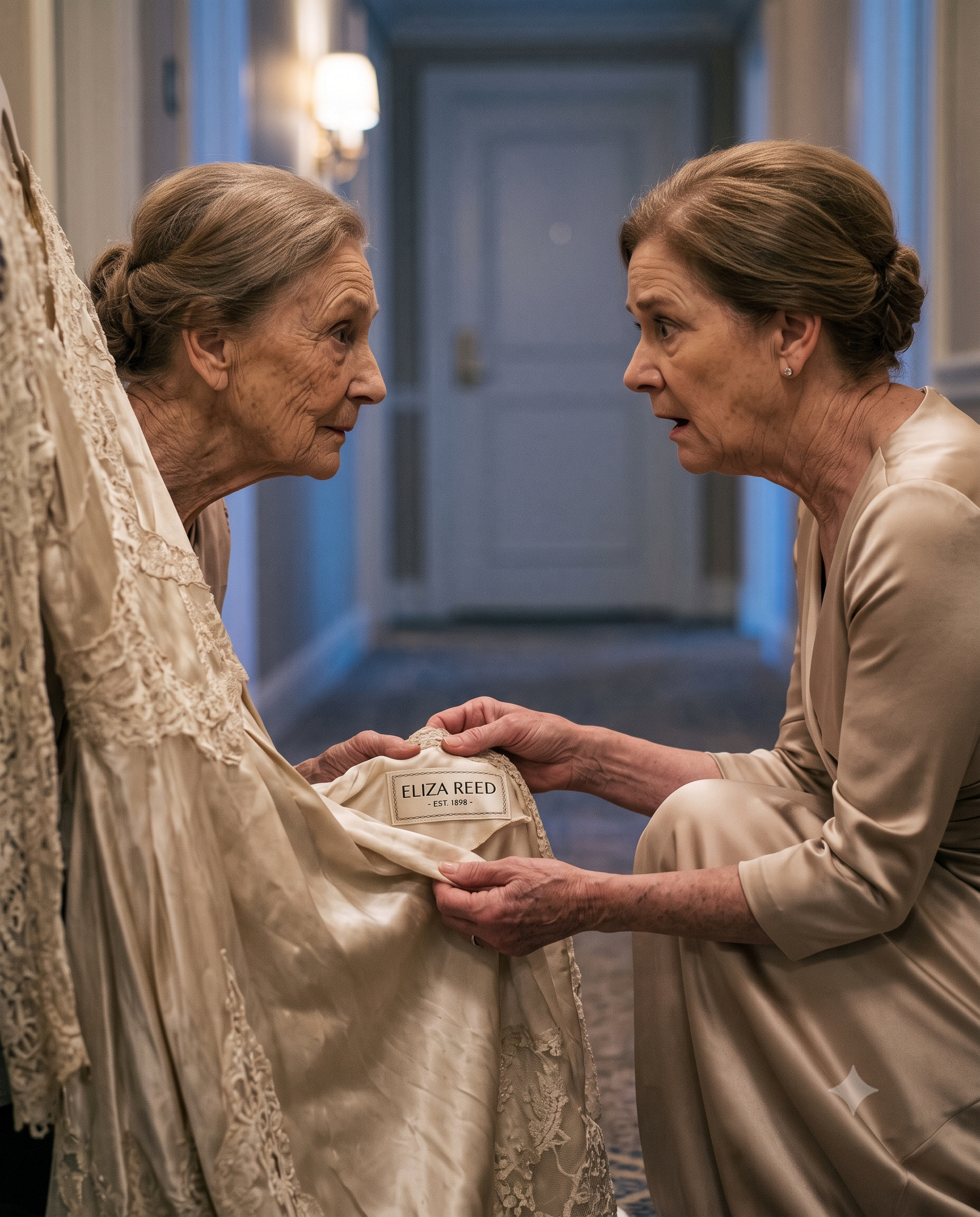
I’d met Patricia exactly twice before her daughter’s wedding, and both times she’d looked at me the way people look at furniture they’re deciding whether to keep.
So when her daughter’s hem tore forty minutes before the ceremony, and someone remembered I used to “do a little sewing,” I wasn’t surprised to find myself kneeling in a hotel hallway with a needle between my teeth while Patricia hovered above me.
“Quickly, please,” she said, checking her watch. “We don’t have all day. I don’t know why they didn’t just hire someone competent for this.”
“I’m almost finished,” I said.
“You people always say that.” She sighed, smoothing her own dress — pale champagne silk, thirty years out of fashion but still stunning, still exactly as I remembered stitching it. “This gown belonged to my mother. Priceless. I’d hate for amateur hands to be anywhere near delicate fabric like this.”
I looked up at the silk. At the specific double-seam I’d used on the bodice, a technique I’d only ever taught one apprentice, back when I still signed my work.
“Priceless,” I repeated quietly. “You have no idea.”
Patricia frowned. “Excuse me?”
I reached into the gown’s hidden inner pocket, exactly where I always sewed a small label, and turned it toward the light.
Continued in the comments 👇
Stitched into the inner seam, small and neat, was a label I hadn’t seen in three decades: V. Marchetti, 1994.
Patricia stared at it, then at me, her face slowly losing its color.
“That’s not possible,” she said. “That gown was made by Vivienne Marchetti. It’s one of only twelve she designed before she disappeared from the industry. My mother paid more for it than for her first house. It’s practically a museum piece.”
“I know,” I said, standing slowly, my knees protesting after thirty minutes on a hallway floor. “I made it.”
“You — what?”
“My name is Vivienne. Vivienne Marchetti. I stopped using it professionally after my husband died and I needed to raise our son alone. Dressmaking on a byline doesn’t pay the same as dressmaking that keeps a low profile and takes cash jobs on the side. I kept the name for myself. Everyone else just knew me as Viv, the woman who does alterations.”
Patricia’s hand went to her throat. “You’re the Marchetti collection. I’ve read about you in three different bridal retrospectives. There’s an entire chapter about you in a book on my shelf. I thought you were dead.”
“I get that a lot,” I said. “It’s easier than explaining I just got tired of being someone’s discovery.”
Down the hall, my son Marcus appeared in the doorway, adjusting his cufflinks, his face breaking into a grin the moment he saw the two of us standing there.
“Mom, they said you were helping with a hem — “ He stopped, noticing Patricia’s stunned expression. “Everything okay?”
“Your mother,” Patricia said slowly, “is Vivienne Marchetti.”
Marcus looked between us, confused. “Yeah. That’s her name. Vivienne. I mean, everyone just calls her Viv, but—”
“No,” Patricia said, “you don’t understand. This woman is one of the most celebrated bridal designers of the last fifty years, and I have spent the last twenty minutes speaking to her like she was hired help.”
Marcus’s expression shifted slowly from confusion to something quieter — recognition of a story I’d never fully told him, because I’d never needed him to be proud of who I used to be. I only ever wanted him to be proud of who I was.
“Mom,” he said carefully, “is that true?”
“It’s true,” I said. “It was a long time ago. I didn’t think it mattered anymore.”
“It matters,” Patricia said, and to her credit, her voice had changed entirely. “I called you ‘the seamstress’ in a hallway like you were beneath this wedding.
You designed the dress my own daughter is standing in an hour from now, and I never once thought to ask your name properly before deciding what you were worth.”
“You’re not the first,” I said. “You won’t be the last. People see gray hair and a sewing kit and stop looking any further. I stopped minding a long time ago.”
“I mind,” she said. “On behalf of every version of myself who’s ever done exactly what I just did to someone.” She looked down at the gown, running her fingers over the hem I’d just repaired. “Would you consider coming to the reception as a guest? Not staff. Guest. I’d like to introduce you properly this time.”
I considered her for a long moment. Not every apology needs to be accepted immediately, and not every mistake deserves an easy forgiveness. But there was something honest in the way she’d asked, none of the performance I usually saw from people once they realized who I used to be.
“I’ll think about it,” I said. “For now, your daughter’s hem is fixed, and she has a wedding to get to.”
Marcus walked me back toward the family seating himself, his hand steady on my elbow the way it had been since he was old enough to worry about me.
“Why didn’t you ever tell me?” he asked quietly.
“Because you never needed a famous mother,” I said. “You needed a mother who showed up. I decided a long time ago that mattered more than a name in a bridal magazine.”
He squeezed my arm. “You could’ve had both.”
“Maybe,” I said. “But I only ever wanted one.”
I sat through the ceremony in the third row, in a plain navy dress I’d made myself, watching Patricia’s daughter walk down the aisle in a gown I’d stitched three decades before either of us knew we’d end up standing in the same hallway.
Some things you make outlive the moment people forget who made them.
Eventually, someone always turns the label over and reads the name.