
My father didn’t raise a daughter. He raised an asset.
Every conversation in our house eventually circled back to “positioning” — how my marriage would consolidate two shipping empires, how the right last name attached to mine would “secure the next twenty years.” He’d been grooming me for a merger disguised as a wedding since I was sixteen.
“Love is a luxury for people without responsibilities,” he told me over dinner the week he announced the engagement he’d arranged without asking me. “You have responsibilities.”
I left the table, left the house, and walked until my heels gave out.
That’s when I found the food truck parked at the edge of the marina lot — a guy about my age, flipping something on a flat-top grill with the kind of unhurried focus that made the whole chaotic evening feel briefly quiet.
“Excuse me,” I said, my voice not quite steady. “This is going to sound insane. I need a husband. Today, if possible.”
He looked up, spatula still in hand. “You buying a taco or a marriage license?”
“I’m serious. It’s not real — I mean, it doesn’t have to mean anything. I just need my father to believe I’m not available anymore.”
He studied me for a long moment, wiped his hands on his apron, and finally said, “Name’s Silas. You’ve got exactly the kind of crazy energy that gets people into trouble.” He paused. “I’m in.”
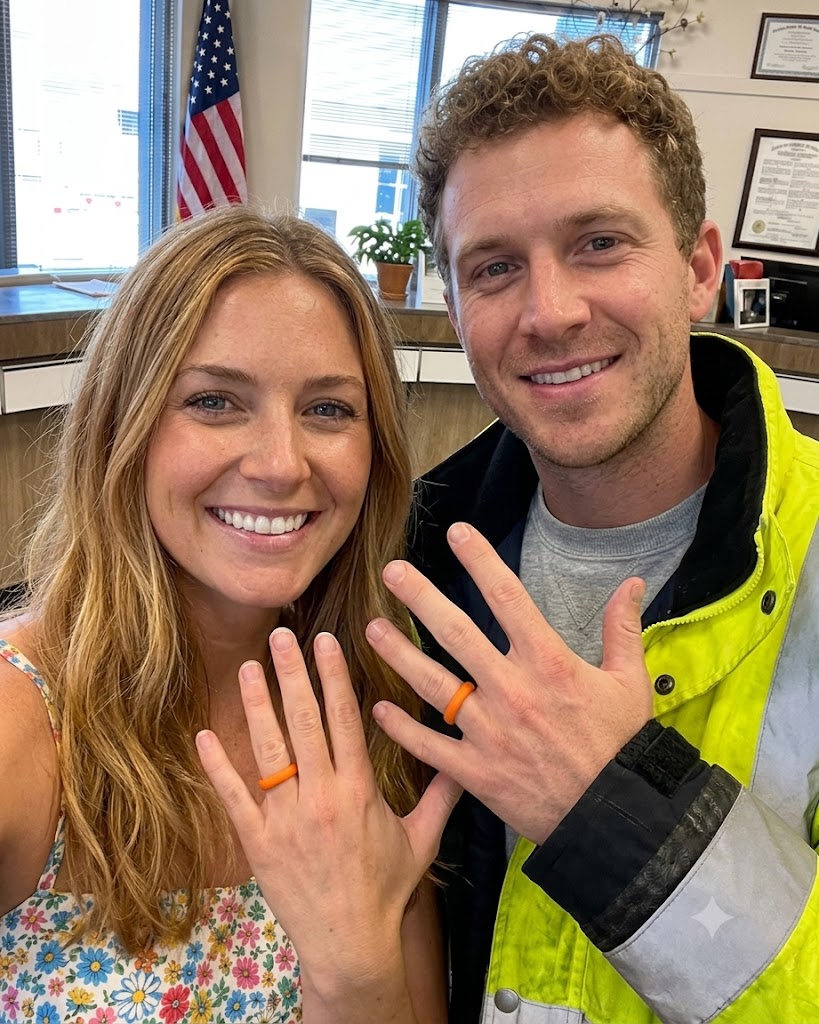
We were married by a justice of the peace forty minutes later. No flowers. No guests. Just a signature and a very confused clerk.
“Well,” Silas said outside, grinning. “Guess we’re business partners now, Mrs. Reyes.”
I laughed for the first time in months. I had no idea the marriage would eventually bring my father to his knees — or why.
Continued in the c0mments 👇
My father found out three days later and called me eleven times in a row.
“A food truck cook?” he said when I finally answered. “Do you understand what you’ve thrown away? I want to meet this person. Tomorrow. My house.”
I braced myself and brought Silas the next evening.
My father opened the door in a tailored suit, looked Silas up and down — the flour still faintly ground into the creases of his hands, the worn boots — and didn’t bother hiding his contempt.
“So you’re the one who married my daughter for a story to tell your friends.”
“No, sir,” Silas said evenly. “I married her because she asked, and because the more I got to know her, the more I meant it.”
My father scoffed. “Cute. You have any idea what she’s worth?”
“I know what she’s worth. It’s not a number.”
My father’s jaw tightened. “And what would a truck cook know about worth?”
Silas held his gaze. “I know what it looks like when someone builds their whole life back up from nothing. My mother did it. Twice.”
Something shifted in my father’s face — a flicker, there and gone.
“What was your mother’s name?” he asked, too quickly.
“Deborah Okafor,” Silas said. “Before she remarried and I took my stepfather’s name. She used to run supply logistics for a shipping company here. Small operation, twenty years ago. Until her business partner restructured the ownership paperwork while she was in the hospital with my little sister and cut her down to almost nothing.”
My father went very still.
“She lost the house within a year,” Silas continued, voice steady but harder now. “Worked two jobs to keep me and my sister fed. Never badmouthed the partner by name in front of us. Just said ‘a man I trusted found a way to make it legal.'”
“Deborah,” my father said, barely audible, like the name had knocked the air out of him.
“You remember her, then.”
My father sat down heavily on the stairs, suit and all, and put his face in his hands.
“I was twenty-eight,” he said. “The business was failing. I told myself I’d fix it for her eventually. I never did.”
“She didn’t need you to fix it,” Silas said. “She needed you not to take it in the first place.”
The silence that followed was the longest I’d ever sat through in that house.
Finally my father looked up at me. “Anna—” He caught himself. “I built everything I gave you on choices I’ve never once accounted for. I thought if I just kept building forward, none of it would matter.”
“It mattered to someone,” I said quietly. “It just wasn’t ever going to be me who told you that.”
He didn’t argue. He didn’t defend himself. He just sat there on his own staircase, looking, for the first time in my life, like an ordinary man instead of an empire.
A week later, my father arranged to meet Deborah in person — the first time in twenty years. I wasn’t in the room for that conversation, and neither was Silas; some reckonings aren’t ours to witness.
But afterward, my father set up a private fund, quietly, without press releases or self-congratulation, covering what Deborah had lost with interest calculated over two decades — and folded a scholarship for young entrepreneurs rebuilding from financial ruin into the company’s foundation, named for no one, publicized to no one.
He never asked Silas or me for credit, and we never offered it. Some debts, once you’ve spent twenty years running from them, don’t need an audience to finally get paid.