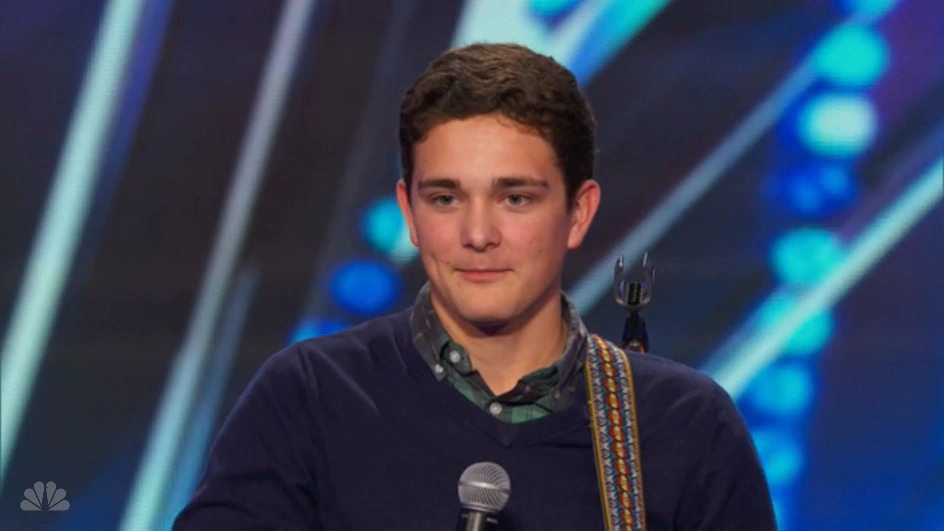
When Jaycob Curlee walked onto the stage of America’s Got Talent, there was an immediacy to his presence that was hard to ignore. At eighteen, he carried himself with the quiet steadiness of someone who had learned early how to hold on to hope. The bright stage lights caught the edge of his guitar and the line of his jaw; more striking than any costume or bravado, though, was the way his eyes searched the room as if making sure this new moment was real. For a young man who had spent most of his childhood moving through the foster care system after being abandoned by his biological parents, this felt like more than a performance — it was proof that the life he had been carving out for himself, piece by piece, was beginning to stick.
Music, Jaycob has said in interviews and implied through the way he plays, was his refuge. He learned to shape melody the way some people learn to breathe — instinctively, as a way to survive and to find meaning. The guitar, worn at the edges from hours of practice, seemed almost like an extension of his arm, a companion that had listened through sleepless nights and carried him through long stretches of uncertainty. When he tuned the strings on stage and drew the first notes out into the auditorium, it was easy to imagine a teenage boy in a quiet room, practicing until the early morning, using song to translate feelings that were otherwise too big and messy to name.
His choice to perform a John Mayer classic carried its own weight. Mayer’s songs, with their confessional lyrics and gentle guitar lines, often dwell in the space between vulnerability and strength — a perfect match for what Jaycob needed to say without saying it directly. From the first line his voice slipped into, there was no pretense. The tone was not polished for a record label; it was honest. There were small, human imperfections — a catch in his throat, an airy note that lingered — that made the performance feel immediate and authentic. Those imperfections invited the audience in; they made listeners feel as if they were witnessing something intimate rather than simply being entertained.
As the song unfolded, the auditorium seemed to collectively lean in. The usual murmurs and rustling faded into silence, replaced by the steady sound of his chords and the soft intake of breath from the crowd. You could see people drying their eyes with the back of a hand, whispering to a neighbor, or simply looking up at the stage with rapt attention. The camera occasionally cut to a shot of his adoptive mother in the wings — her hands clasped, proud and a little stunned, tears tracing the lines on her face. That small focus on her reaction added another layer to the moment: this wasn’t just a personal triumph for Jaycob, it was a family moment played out in public, a private victory made communal.
The judges, who have seen thousands of acts, were visibly affected, too. Their reactions weren’t about dramatic gestures or manufactured suspense; they were quiet and sincere. Some covered their mouths, others wiped their eyes, and a few simply sat back and listened with expressions that mixed admiration and empathy. The feedback after the final chord was overwhelmingly positive — praise for his vocal tone, for the emotional honesty he brought to the song, and for the way his life experience seemed to inform, rather than overshadow, his talent. They spoke to his potential and authenticity, qualities that are often rarer than technical perfection.
For viewers at home, the clip went viral not simply for the quality of the performance but for the story it encapsulated. Social media filled with comments from people who saw in Jaycob’s journey a reflection of their own struggles or the struggles of loved ones. Messages of support poured in from strangers moved to offer encouragement, to celebrate his resilience, or simply to say thank you for sharing something so real on a national stage. The moment functioned as a reminder that art can turn pain into connection, and that a single performance can uplift not only the performer but also the people who bear witness.
What stayed with many people after the cameras stopped rolling was not just a note held perfectly or a line sung with power — it was the sense of belonging that finally seemed to have landed on Jaycob. The adoptive family who now surrounds him, watching from the wings and cheering in the audience, represent more than a support system; they are the place where a frightened kid could become a young man allowed to heal. His performance, then, wasn’t only a demonstration of musical skill but a public declaration of gratitude and a testament to what can happen when someone is finally given a chance to belong.
In the days after the show, the video circulated widely, inspiring conversations about foster care, adoption, and the ways communities can lift up young people who have faced hardship. Jaycob’s performance remains a powerful example of resilience — not the flashy, overnight kind, but the slow, steady endurance that music can help sustain. For an eighteen-year-old who once had little more than a guitar and a dream, stepping off that stage meant more than applause. It meant being seen, being heard, and being loved — a rare and precious fulfillment of what so many of us hope for one another.