
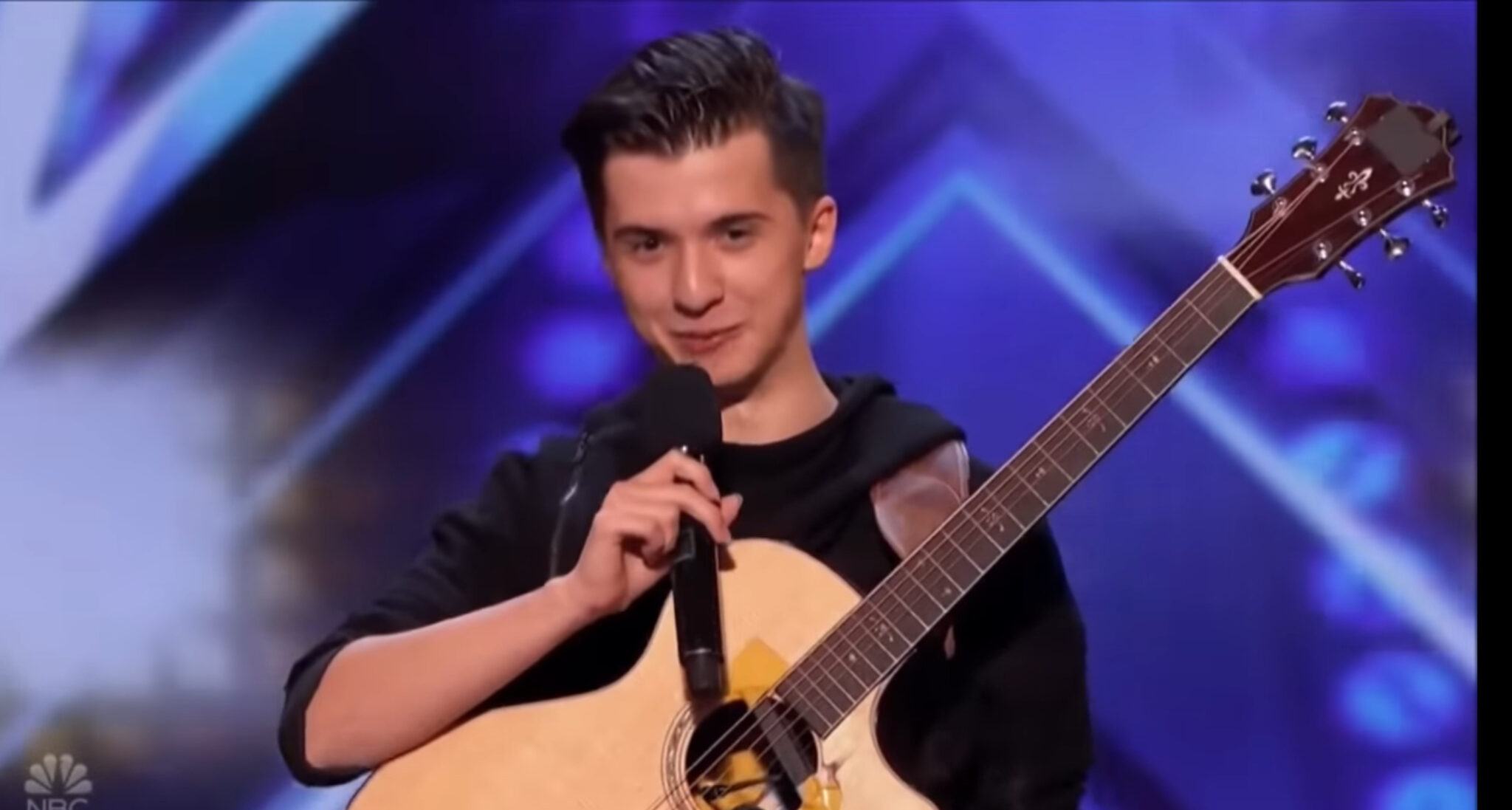
When Marcin Patrzałek, an 18-year-old guitarist from Poland, walked onto the America’s Got Talent stage, he carried himself with a calm confidence that immediately suggested he wasn’t there to play it safe. Before he even touched a string he shared a small personal detail — that he’d been accepted to an American college — and that simple fact did more than fill a few seconds before the music began. It framed his appearance as part of a larger story: a young musician with plans, ambitions, and a willingness to build a life around his craft. For a solo instrumentalist, background matters. Without lyrics to connect listeners to his life, every choice on stage had to make the guitar speak like a complete voice, cinematic and immediate.
From the instant his fingers met the strings, it was obvious this would not be a garden-variety performance. Marcin didn’t simply strum chords or play a recognizably familiar tune. Instead he fused classical fingerstyle precision with a percussive approach that transformed the guitar into a self-contained orchestra. He used the top of the body as a drum, slapping and tapping to create snare-like beats; he thumped the lower bout to simulate bass accents; and with nimble plucking he carved out sparkling melodic lines. Watching him was like watching a one-man band where every limb had a role, and where the guitar itself had been reimagined as an ensemble of instruments strapped into a single wooden body.
The arrangement he chose did two important things at once: it showcased jaw-dropping technique and told an emotionally coherent story. He moved effortlessly between moments that required feather-light control — soft harmonics that chimed like distant bells, whisper-quiet trebles that hung in the air — to sections that exploded with rhythmic intensity, as if a full percussion section had suddenly appeared behind him. Those shifts weren’t jarring; they were cinematic. You could feel the arc of the piece, with rising tension and release, as if scenes were unfolding in the listener’s imagination. Small, almost invisible details amplified that effect: the precise angle of his right hand for a crisp slap, the split-second where his thumb anchored a steady bass while his fingers danced a treble counterpoint, the delayed intake of breath he took before a technically demanding run. Those tiny choices separated mere proficiency from true artistry.
What made the performance especially striking was the maturity behind it. At 18, Marcin played with the kind of command over tone, timing, and arrangement that typically belongs to musicians who’ve spent a decade or more refining their craft. His sense of rhythm was impeccable; complex syncopations landed with the same conviction as the melody, and his timing never wavered, even during the fastest, most intricate passages. The speed and clarity of his fingerwork were impressive on their own, but even more compelling was how everything fit together. Every harmonic, every percussive tap, every sustained note felt purposeful, contributing to a cohesive whole rather than calling attention to itself as a mere stunt.
The judges’ reactions mirrored that progression from curiosity to disbelief. Simon Cowell, who is rarely quick to lavish praise, appeared genuinely floored; his comments after the performance emphasized how uncommon it is to see a guitarist who can make the instrument feel both fresh and indispensable. He implied that many acts who pick up a guitar don’t fully grasp its potential, whereas Marcin seemed to reveal a whole new vocabulary for the instrument. Howie Mandel’s quip — “You didn’t play the guitar, you murdered the guitar” — came off as colorful, tongue-in-cheek admiration: a way of saying Marcin had pushed the guitar to its limits and emerged victorious. Those dramatic responses weren’t just about spectacle; they reflected a recognition that Marcin’s approach was rooted in genuine innovation and deep technique.
The audience response matched the judges’ enthusiasm in a visceral way. People leaned forward in their seats, eyes fixed, as the piece unfolded; you could almost feel the room breathe with him. At climactic moments the crowd erupted, not from surprise alone but from being pulled into an emotional arc crafted without words. When the final chord rang and the last percussive tap faded, the auditorium rose as one in a standing ovation — a rare achievement for a non-singing act. It was proof that he had managed to tell a compelling story and command attention purely through instrumental means.
Beyond the immediate spectacle, the audition hinted at a broader artistic identity. Marcin wasn’t showing off technical fireworks for their own sake; he was sketching a vision of what modern guitar playing could be — a synthesis of classical discipline, contemporary percussive technique, and the kind of theatricality that reads well on a big stage. That fusion suggested a musician thinking past genre boundaries, someone ready to translate the voice of his instrument into whatever context the moment demanded, whether a theater, a festival, or a college recital hall. When the judges unanimously hit “yes,” it felt less like a surprise than the natural conclusion to a performance that had already said so much: an 18-year-old redefining expectations and reminding viewers that innovation often sparks where tradition meets fearless experimentation.