
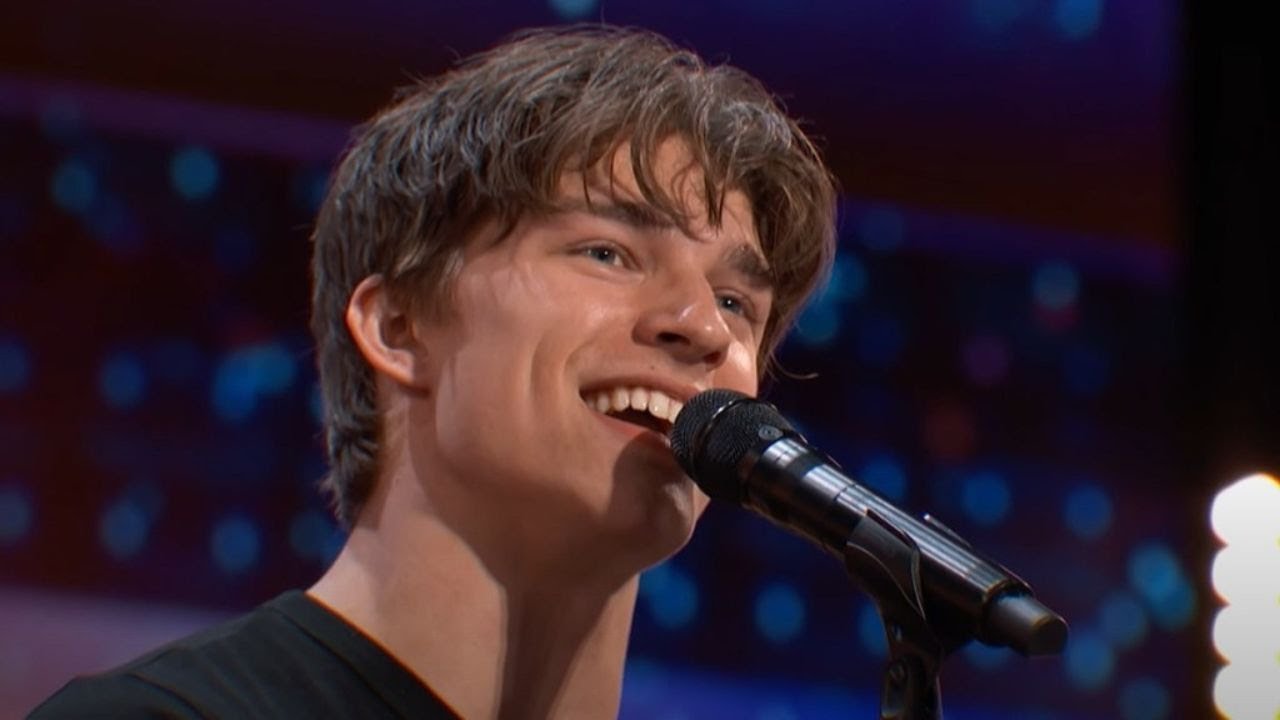
When Alex Sampson walked onto the Britain’s Got Talent stage, you could feel the contrast between his small-town roots and the gigantic room that was about to judge him. At 20 years old and hailing from Atikokan, a tiny community in northwestern Ontario where a grocery store conversation can feel like front-page news, Alex admitted to being terrified — and who could blame him? He even joked that there were probably more people watching in that theatre than lived in his whole town. That kind of self-effacing humor made him instantly likable, but it also underscored the risk he was taking: stepping out of a world where faces are familiar and into a spotlight that turns ordinary nerves into a national spectacle.
The risk started with his choice of material. Rather than picking a safe, familiar cover, Alex performed an original composition called “Pretty Baby.” On shows like this, originals can go either way — they’re either refreshing windows into an artist’s identity or they land flat because they feel unpolished. From the opening chords, though, it was clear “Pretty Baby” belonged to the first category. The song had a retro sheen, the kind that evokes vinyl records and neon diner signs: echoing guitar lines, warm, rounded melodies and phrasing that nodded to the 1950s and ’60s. Yet woven under that nostalgic surface was a modern sensibility — subtle lyrical twists and production choices that kept it from feeling like mere imitation. It felt curated, deliberate, and totally of a piece with the person singing it.
Simon Cowell’s reaction captured the essence of the song when he compared it to something you might hear in a vintage Martin Scorsese movie. That’s not an empty compliment; it speaks to the cinematic quality of Alex’s writing. You could imagine “Pretty Baby” underscoring a bittersweet montage — two characters parting at a train station, or an afternoon in a roadside café when everything feels poised on the edge of change. The arrangement felt deliberately classic: a pocket of rhythm that swung gently, a melodic line you could hum on the way home. But Alex’s phrasing and melodic choices made it feel lived-in, not like a costume.
Before he began, the camera lingered on his hands; they trembled slightly as he folded them, the kind of small motion that makes nerves visible. He gave a tight, self-conscious smile, the one people use when they’re trying to steady themselves. But the moment he sang the first line, something shifted. The tremor dropped away and his voice smoothed out, as if he’d moved from thinking about performance to inhabiting the song itself. There’s a rare kind of charisma in watching someone lose their fear and become present — it felt intimate, like being let into a private rehearsal rather than witnessing a polished act.
Each judge responded to that transformation in their own way. Sofia Vergara, with her warm, animated presence, highlighted the visual and emotional beauty of the performance, pointing out how Alex hid his anxiety through musicality. Heidi Klum picked up on the vulnerability, saying it made him feel “real.” Vulnerability on stage is a paradox: it can be terrifying, but it’s often what makes a performance relatable. Howie Mandel was more analytical, explaining that Alex had found a niche that didn’t really exist before — someone who channels retro soul without slipping into pastiche. He likened Alex’s vintage leanings to ’60s frontmen like Herman’s Hermits, but was quick to stress that Alex’s voice and songwriting gave the style a fresh identity. They weren’t just reviving an old sound; they were reimagining it.
Small details amplified the effect. Alex’s wardrobe was simple and unflashy — a plain shirt, jeans — clothes that spoke of a close-knit town where people dress to fit in. On stage, that simplicity read as authenticity. The audience’s response mirrored the arc of the song: polite curiosity at first, then genuine applause that swelled as the chorus landed. The chorus itself had a hook that stuck not because it was engineered to go viral but because it was thoughtfully crafted: lines that felt specific enough to be honest, yet universal enough to linger in your head.
By the end of his audition, skepticism had turned into enthusiasm. Judges who might have been wary of an original tune praised both his songwriting and his vocal presence. That combination — a distinctive original performed with the confidence to turn nerves into charm — is an effective way to stand out. Alex’s audition became a neat case study in how unique content and personal flair can cut through the noise: his small-town jitters and retro aesthetic could have been liabilities, but he used them as strengths.
In an era overloaded with covers and manufactured moments, Alex Sampson’s performance was a reminder that authenticity still matters. He didn’t try to be everything to everyone; he leaned into a specific sound and let his genuine voice carry it. The result was a moment that felt honest, memorable and entirely his — a young man from a tiny town stepping into a massive stage and proving that sometimes the most compelling performances are the ones that are unmistakably, quietly true.