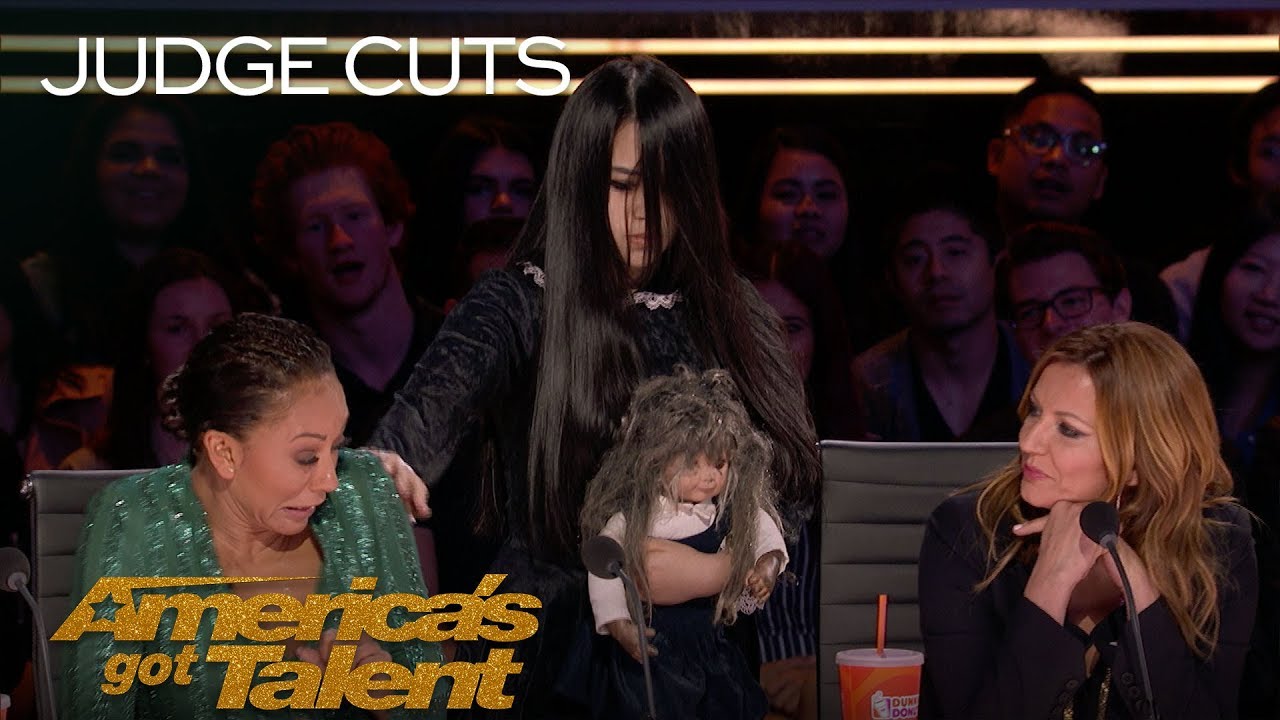
SHE’S BACK. The Sacred Riana returned to the stage with all the eerie poise she’s known for, and this time she didn’t just perform a trick — she conjured an imaginary friend that felt so real, it left the audience unsettled long after the lights went down. There’s something about her presence: the slow, deliberate movements, the whisper of her voice, the way she tilts her head as if responding to something only she can see. It’s that commitment to character that transforms a simple illusion into an experience that crawls under your skin.
When she invited Mel B to join her, the room held its breath. Mel B is no stranger to shock value; she’s seen wild acts and daring stunts before. But even she couldn’t hide the mix of curiosity and unease that crossed her face when The Sacred Riana began to speak to—then summon—this silent companion. It wasn’t just a puppet or a prop; the imaginary friend had personality. Riana interacted with it the way someone might react to a childhood confidant: tender one moment, quietly terrified the next. That emotional play made the scene feel intimate and, frankly, chilling.
The setup was simple: a dimly lit stage, a quieting audience, and Riana’s signature slow cadence. She asked questions into the empty space beside her, and the pauses stretched long enough that you started to wonder if something would actually answer. Small details intensified the illusion—a shoe left slightly askew as if someone had just stepped away, the faint dragging sound from backstage, and Riana’s eyes darting to corners of the stage where nothing appeared at first glance. These little touches made the invisible tangible. You could almost feel the imaginary friend’s presence, a ghostly shape at the edge of your perception.
What made it particularly unnerving was how Riana blended playfulness with menace. One moment she coaxed the imaginary friend as if it were a child, speaking in soft tones and inviting it to perform tricks; the next, her voice dropped, and a hush fell over the audience as if she had said something that shouldn’t be spoken aloud. Mel B’s reactions were priceless — she laughed nervously, leaned forward, then recoiled as if expecting something to leap out. Her body language mirrored our collective discomfort and fascination. That oscillation between amusement and fear is exactly what keeps viewers glued to the screen.
Specific moments stand out even after the act ended. There was a point when Riana handed Mel B an ordinary deck of cards and instructed her to shuffle. When Mel B followed the directions, a single card slowly floated from the deck and hovered inches above her hand before dropping gently to the floor. The room exhaled as if remembering to breathe. Another instant involved a childlike drawing appearing on a chalkboard that had been blank minutes earlier—crude, smiling stick-figure features that made the audience laugh at the absurdity, then fall silent at the way Riana’s expression turned stone-cold. Those concrete cues—floating cards, sudden drawings—are what transformed an abstract concept into an undeniable occurrence.
The audience’s reaction was a study in collective emotion. Some people screamed outright, others covered their mouths, and a few even stood up to get closer, propelled by curiosity stronger than their fear. On social media, clips of the moment spread like wildfire, accompanied by comments ranging from “genius” to “I can’t sleep tonight.” The Sacred Riana’s approach hits a sweet spot between theatre and psychology; she doesn’t rely on jump scares or flashy pyrotechnics. Instead, she crafts an atmosphere that invites your imagination to fill the blanks, and your imagination tends to be far more terrifying than any manufactured effect.
There’s also an interesting interplay between childhood nostalgia and adult anxiety in this act. Imaginary friends are usually associated with innocence and comfort, but when The Sacred Riana reclaims that trope and flips it into something sinister, it taps into a deeper, almost universal unease. Think about the childhood impulse to invent unseen companions, then imagine revisiting that world as an adult where those companions might have agendas of their own. It’s surprisingly effective—and it forces you to confront the weirdness that lives in the corners of remembered childhoods.
By the time the act concluded, you could feel the residual tension in the room like static. Mel B applauded, partly out of politeness and partly because the performance deserved it, but her smile didn’t quite reach her eyes. The Sacred Riana took her bow, eyes distant as ever, and the imaginary friend—if it had ever been there in any conventional sense—seemed to retreat back into the shadows. Whether you’re a skeptic or a believer, there’s no denying the craft of the performance. It’s a precise mix of character work, stagecraft, and psychological misdirection, and it left Mel B—and the rest of us—wondering what, exactly, was real.