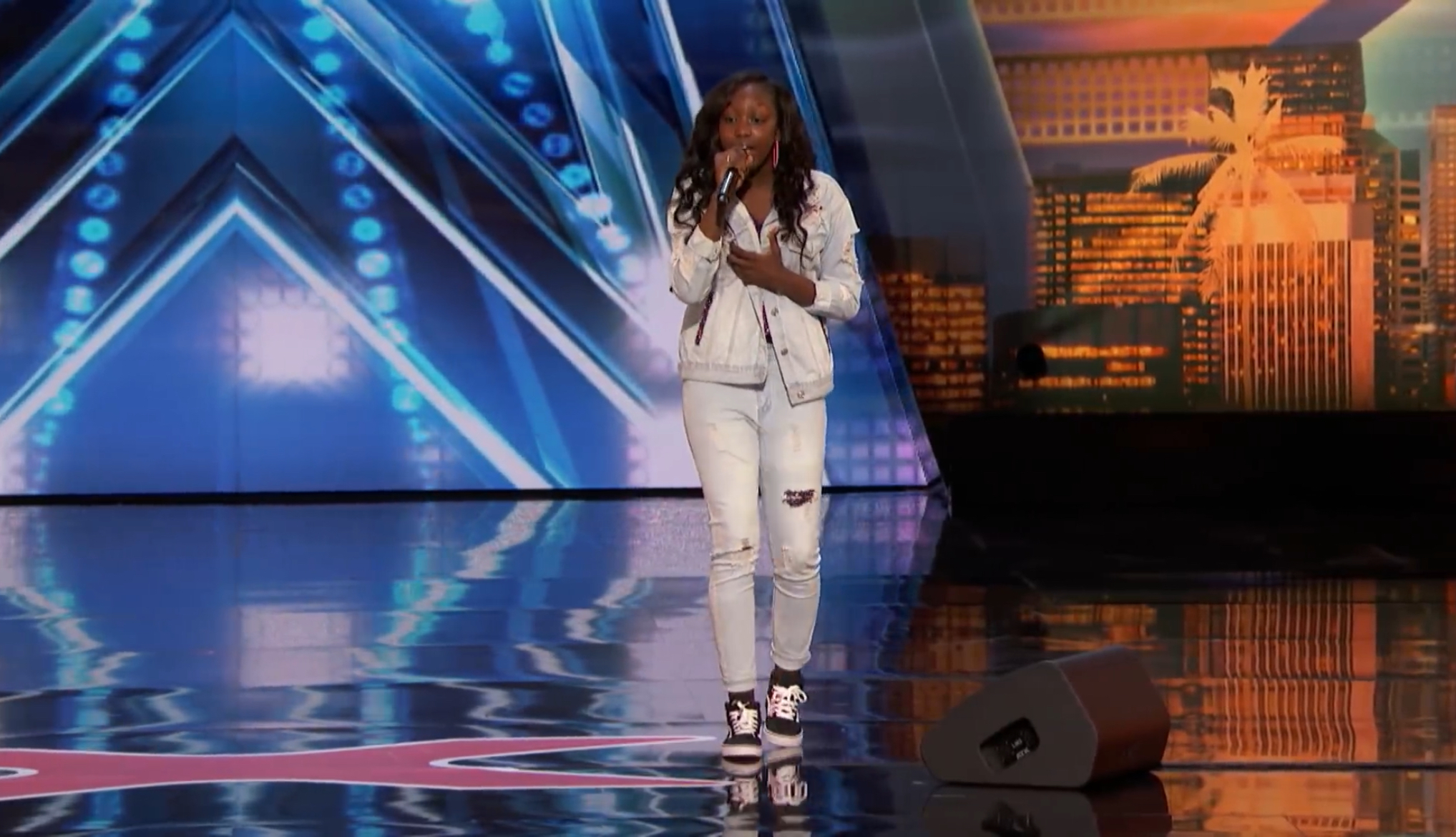
At just fourteen years old, Flau’jae walked onto the America’s Got Talent stage carrying more than a backpack full of nerves — she carried a family story and a mission. Hailing from Savannah, Georgia, she spoke with a quiet clarity about her father, a young man with dreams of his own in rap, who was killed before she was born. That absence, the unanswered questions, and the promise of a legacy she’d never get to meet became the fuel behind her decision to pursue music. More than trophies or TV spots, Flau’jae wanted to pick up the microphone and speak on behalf of a life that had been cut short; she wanted to use her platform to address the violence that had taken her father and so many others.
There’s an immediacy to a performance born of personal pain. Before she even launched into her song, you could sense the weight of the moment: a teenager, unafraid to channel grief into verse, standing in front of millions. She chose to perform an original piece about gun violence — not a cover, not a viral trend, but her truth in her words. The opening bars came with a steady, controlled breath and a confidence that belied her age. Then, before the audience could unconsciously bracket her as “just a kid,” she delivered lines with the cadence and conviction of someone who’d spent her life listening to rhythm as both memory and mentor.
Her flow was rapid-fire, crisp, and precise; each syllable landed with emphatic clarity. But technical skill was only part of what made the performance unforgettable. There was a rawness, a vulnerability threaded into the ferocity. She didn’t rap to show off speed; she rapped to be heard. The central line — a haunting refrain that cut through the electricity in the room — asked, “If you would have put that gun down, then he would have been here right now.” That repeating question was devastating in its simplicity. It transformed a private sorrow into a public indictment, a plea that invited listeners to imagine the human beings behind headlines and statistics.
Stagecraft amplified the message. Flau’jae moved with purposeful energy, not frantic theatrics. Her gestures were economical but expressive: hands clenched at times to underscore a painful memory, then opened outward when calling the audience toward empathy and action. The lighting seemed to follow her narrative arc, dimming to emphasize a reflective verse and flaring during the climactic chorus, when her exhortation to “put your guns down” landed like a bell. Audience members, who moments earlier had been politely attentive, now leaned forward, eyes fixed. Phones rose to capture what felt like more than a performance — a testimony.
The emotional resonance extended beyond the auditorium. Viewers at home, social media scrollers, and people who had lived similar losses could recognize something familiar in Flau’jae’s cadence and in the way she balanced anger and plea. Her lyrics avoided hollow sensationalism; instead, they favored concrete details that made the story human: an empty chair at a Thanksgiving table, a lullaby left unsung, a birthday without a father. These images turned abstract policy debates into scenes you could hold in your hands, and that is a rare and powerful thing for a young artist to accomplish.
The judges’ reactions captured that collective sense of stunned recognition. Heidi Klum, who has seen every sort of performance on that stage, was visibly moved, offering praise that felt informed by the heart as much as the head. Simon Cowell, often quick with a cutting line, set aside his trademark bluntness in favor of admiration. Though he admitted rap wasn’t his deepest expertise, he conceded that talent transcends genres and that what he was witnessing was the start of something significant. His comment — calling it a favorite audition and predicting a major career beginning — felt less like a showbiz platitude and more like a career-defining endorsement. When he and the other judges stood to give her four “yeses,” the moment read as validation not just of performance quality but of mission.
There’s an added poignancy in the fact that Flau’jae’s art serves both as personal catharsis and as social commentary. At fourteen, she is laying claim to a voice that demands attention from policymakers, neighbors, and peers alike. She speaks to those who have lost loved ones and to those who have the power to choose differently in split-second moments. By turning grief into lyric, she creates an invitation: listen, understand, and change.
The aftermath of such an audition is often a blur of interviews and offers, but the core of what happened on that stage remains simple and profound. Flau’jae used her platform to honor a father she never knew and to force the conversation about gun violence into a space where emotion and policy meet. Her performance was more than a display of precocious talent; it was a call — urgent and articulate — for people to consider the lives that hang in the balance of individual decisions. For a teenager from Savannah, stepping into the spotlight meant transforming personal loss into a public plea, and in doing so, she reminded everyone watching that art can be both beautiful and necessary.