
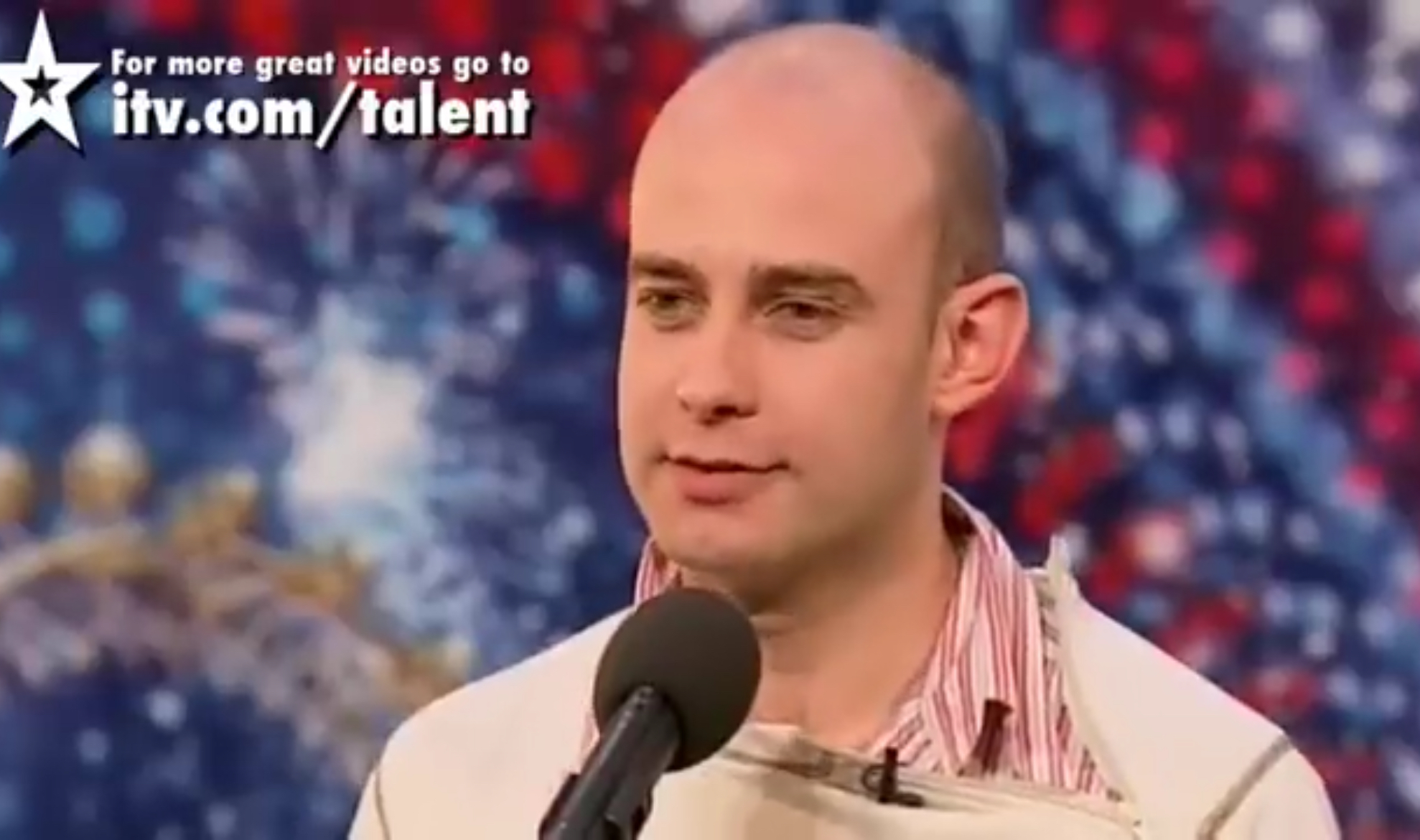
Twenty-eight-year-old Christopher Stone stepped onto the Britain’s Got Talent stage with a careful, almost tentative gait that made you immediately sense how much this moment mattered to him. By trade he’s an accountant — a job that suggests precision, routine, and perhaps a predisposition to staying safely within the lines — but he’d come to the spotlight largely because of the gentle, persistent nudging of his parents. They sat in the audience beaming with obvious pride, having quietly championed this day as the possible realization of a long-held dream for their son. Their presence felt like a soft anchor for Christopher, who admitted to the panel with a nervous laugh that he had primarily entered the competition at their encouragement. That honesty landed warmly; it humanized him before he even sang.
From the very beginning, Christopher made no effort to hide how frightened he was. “This is probably the scariest thing I’ve ever done in my life,” he said, words that were equal parts confession and plea for understanding. His hands betrayed him even as he tried to steady them; he wrung them together, smoothed invisible creases in his suit, and cast quick, searching looks at his parents as if to draw courage from their faces. Those small, physical details painted a picture of a young man trying to push past self-doubt to reveal something vital about himself. It set up the audition as not just a contest of vocal skill, but a personal test of nerve.
He chose a bold piece: “Maria,” the sweeping, emotive anthem from West Side Story. It’s a song that rewards not just technical clarity but conviction — a balance of operatic strength and theatrical presence. When Christopher began, the hall filled with a distinct, operatic timbre. The notes came with power and control; it was clear he possessed significant vocal talent. Yet, early on, the judges’ attention gravitated as much to his demeanor as to his tone. Simon Cowell, quick to pick up on the psychology of performance, immediately flagged Christopher’s lack of “conviction” and “self-belief.” He referenced the nervous handwringing and the small, closed-off posture, suggesting that for material as dramatic as “Maria,” the singer needed to project confidence outward as well as inward.
It was an astute critique. Watching Christopher at the microphone felt a bit like watching someone learning to swim in full clothes — technically competent, keeping afloat, but not yet gliding through the water with ease. The first verses showcased the beauty of his voice: clean phrasing, a warm, resonant lower register, and the kind of breath control that hinted at classical training. But the performance felt tentative, as if he were holding something back. Amanda Holden, who often looks for the emotional thread in a performance, praised his tone and called the overall outing “brilliant.” Her response underscored that the problem wasn’t a lack of ability, but a missing element of stagecraft.
Then something interesting happened as the song progressed. Piers Morgan observed a shift: Christopher began to loosen up, to lose himself in the music. Those tight shoulders gradually softened, the eyes stopped darting anxiously, and a kind of internal switch seemed to flip. Where there had been fear, a growing sense of enjoyment emerged — the slight smile that flickered at the corner of his mouth mid-phrase signaled he was starting to believe in the moment himself. Piers described it as a journey, and his encouragement suggested that the growth witnessed during the audition was meaningful. It was the sort of progression that can convince a judge not only of present talent but of teachability — the idea that with guidance, this performer could become genuinely compelling onstage.
Simon, while acknowledging the shift, was unflinching in his assessment of what Christopher still needed: “swagger.” For Simon, certain songs demand an exterior confidence that matches the vocal prowess. Even so, he was generous in recognizing Christopher’s raw vocal quality, calling it a “really, really good voice.” The exchange captured a central tension of competitive singing shows — raw talent must be married to performative confidence to reach the highest level. Amanda’s warm appraisal and Piers’ narrative of growth balanced Simon’s challenge with optimism.
In the end, the judges’ chairs reflected a consensus of encouragement: three resounding “yeses.” The applause that followed felt celebratory and sympathetic at once, applauding the voice and the personal triumph over fear. Christopher’s parents stood to embrace him as he stepped off the stage, and you could see how much the moment mattered to all of them. For Christopher, the vote meant more than advancement in a contest; it was an official nudge forward, a formal recognition that his talent deserved a chance to evolve beyond the spreadsheet-lined security of his everyday life.
Walking out of that audition room, Christopher had done something important: he’d taken a public step beyond a comfort zone that had long contained him. The judges had seen a singer with real vocal potential and the beginnings of stage presence; what remained would be for him to translate that inner voice into outward confidence. If this audition proved anything, it was that fear can be temporary — and that, with support, people can find their footing and let their voices carry them forward.