
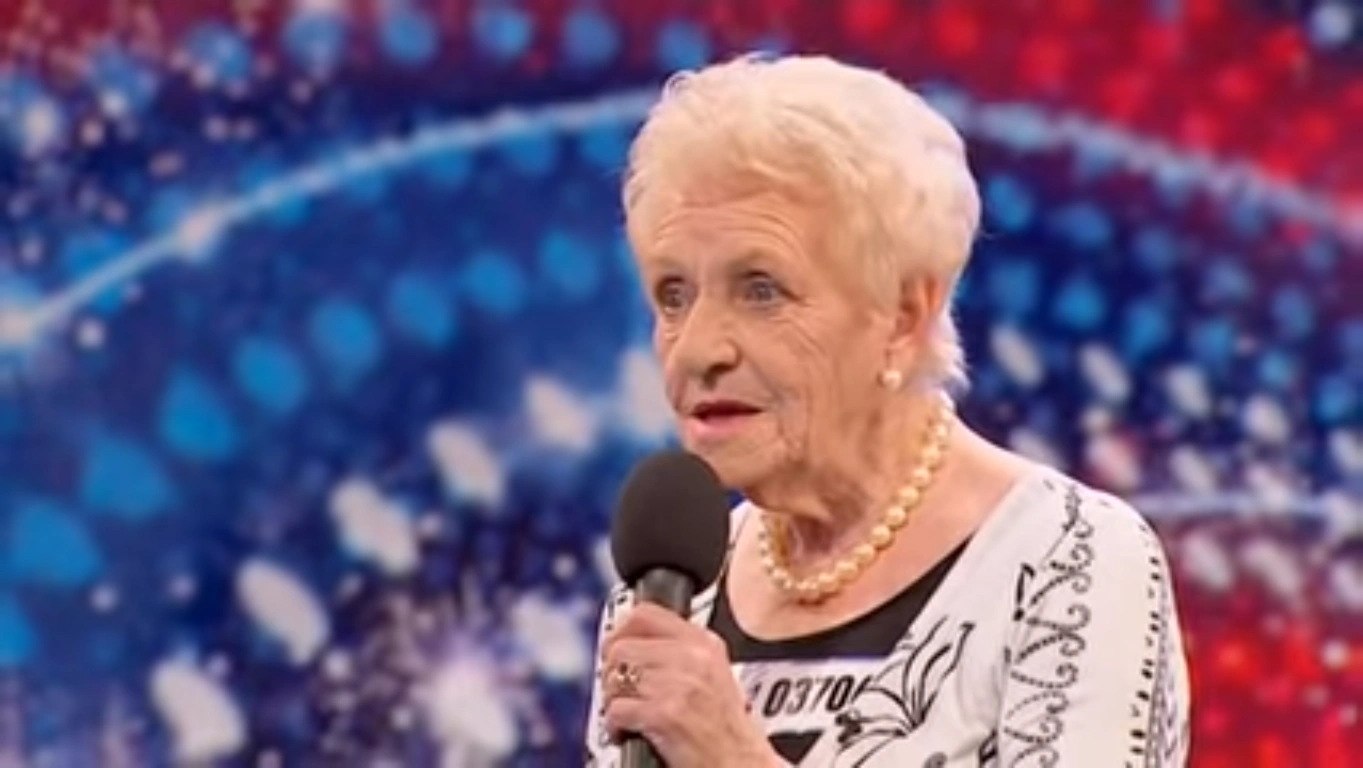
Eighty-year-old Janey Cutler from Scotland walked onto the Britain’s Got Talent stage with an easy smile and the kind of unassuming presence that made the room relax around her. In conversation with the hosts before she sang, she laughed as she explained that she was a mother of seven, a grandmother of thirteen, and—proudly—a great-grandmother of four. For someone who had spent much of her life caring for others, the bright lights and polished studio must have felt like a slightly surreal treat. She told the audience she’d been nudged to audition by friends who knew she loved to sing; there was no grand plan to become famous, only the simple joy of sharing a song she adored. Choosing Edith Piaf’s “Non, Je Ne Regrette Rien” was telling—a bold, theatrical number about living without regret, a choice that hinted at both courage and a life fully lived.
From the opening notes, it was obvious that Janey hadn’t come to make a polite performance; she had come to deliver. When the orchestra swelled and her voice joined in, the theatre seemed to swell with it. There was nothing tentative about her delivery. Her voice carried both warmth and steely control, a combination that suggested decades of singing in church halls, at family gatherings, or perhaps just in the privacy of her kitchen while making tea. The timbre of her voice held a surprising richness, and her pronunciation of Piaf’s French was earnest and expressive rather than self-conscious—an important distinction that made the song feel like Janey’s own emotional statement rather than a mere cover.
Watching her, you could see why age mattered only in the most superficial way. A tiny woman in modest clothes transformed with the first phrase into a commanding presence. Her gestures were measured but purposeful: a lifted hand at the right dramatic moment, a small step forward as the chorus swelled, an intimate glance that made even viewers at home feel included. She knew how to pace the song, allowing the tempo to breathe between lines, which gave her the space to sell each lyric as if it were a memory or a confession. There was a lifetime behind those words—hard-won wisdom, losses and joys intermingled—and it showed in the subtle shading of her dynamics. When she hit a sustained note toward the end, the audience reacted not just to the power of the sound but to the emotional truth it carried.
The reaction in the theatre was immediate and overwhelming. People who had been chatting or checking their phones fell silent. Faces that had been lined with polite curiosity opened into looks of genuine astonishment. By the time the final notes faded, the entire auditorium was on its feet, the sound of applause echoing long after the last phrase had died away. The standing ovation felt like a communal acknowledgment: here was someone who had come to the stage without pretense and had given everything in return. For many in the room, Janey’s performance wasn’t merely impressive; it was quietly moving, an affirmation that talent and passion don’t disappear with age.
The judges’ responses mirrored the astonishment in the crowd. Piers Morgan admitted, with characteristic frankness, that he hadn’t known what to expect when Janey walked up — and that he certainly hadn’t anticipated “a set of lungs on you like that.” His surprise captured the contrast between her slight physical presence and the full-bodied, resonant voice she produced. Amanda Holden, visibly moved, suggested with a smile that the royal family would be fans, a lighthearted yet sincere endorsement that underscored the performance’s universal appeal. Their praise never felt patronizing; instead, it felt earned and heartfelt. They recognized not just a strong vocal showing but also the bravery of someone stepping into the spotlight at that stage of life.
Janey’s success on the show was as much about inspiration as it was about technical skill. Her audition became a reminder that life doesn’t have to follow a narrow timeline and that new chapters can begin when least expected. Viewers at home likely pictured grandmothers and great-grandmothers they knew, imagining those relatives bravely auditioning for forgotten dreams. There’s a particular kind of joy in watching someone defy stereotypes—an older person proving that enthusiasm and artistry are not confined to youth. Janey’s performance offered a fresh perspective: age can add depth and resonance to expression, qualities that younger performers are still learning to develop.
When the judges pressed their “Yes” buttons, the outcome felt entirely natural. Janey moved on to the next round with three enthusiastic votes, and just as importantly, she had become an instant national treasure in the eyes of many. Her audition did more than win applause; it sparked conversation about representation, aspiration, and the timelessness of music. In a culture often obsessed with novelty and the next big thing, Janey Cutler’s moment on Britain’s Got Talent was a gentle but powerful reminder that greatness can arrive at any age — and that sometimes the most unforgettable performances come from those who’ve had the most time to learn how to hold a note and, more importantly, how to carry a life into a song.