
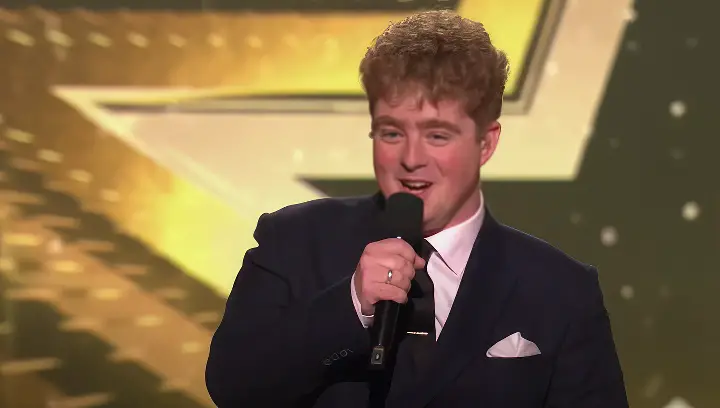
“Susan Boyle’s grandson!” Simon shouted, unable to hide his delight, leaning forward with a grin that lit up his face. It was the kind of exclamation reserved for moments that catch you off guard and refuse to let go — and it came after a breathtaking performance of a 1964 classic by a 23-year-old schoolteacher that sent the theatre into a stunned, reverent hush.
Tom Ball walked onto the stage carrying a quiet confidence tinged with nerves. At 23, he’s the kind of teacher who could easily blend into a staff room full of colleagues; he’d been careful to keep his singing ambitions from his pupils, worried that revealing them might make him seem less real in the classroom or expose him to disappointment if it didn’t pan out. Yet when he opened his mouth to sing Simon & Garfunkel’s “The Sound of Silence,” that reticence evaporated. The first lines floated out with a clarity and tenderness that made people stop shifting in their seats. Time felt to stretch — the usual murmurs and coughs faded, replaced by the pure, sustained silence the song’s title promises.
There was always a risk in choosing such a well-known song. It’s been covered and reimagined countless times, and in recent years Disturbed’s dramatic, orchestral version added a new and very different shadow to the track’s legacy. Tom’s choice could have been compared unfavorably or dismissed as treading familiar ground. Instead, his interpretation found a middle way: he honored the original’s plaintive melody while imbuing it with a warm, modern sensitivity that felt wholly his own. His voice carried a texture — a gentle rasp at the edges, a bright core — that suggested both polish and lived experience. It was the kind of tone that makes listeners imagine a backstory: late-night rehearsals, small gigs in local pubs, or quiet practices in the empty school hall after exams.
Small, human details made the performance feel intimate. He closed his eyes on certain lines, as if listening inward, and on the more tender phrases he softened his voice, drawing listeners closer. When the chorus swelled, he didn’t try to overpower the room; he let the emotion build naturally, like a tide that arrives slowly and convincingly. The camera occasionally cut to the judges, capturing their immediate, visceral reactions — Simon’s surprise and heartfelt pleasure, another judge’s hand at her throat, an expression of pure admiration from the bench. The audience’s reaction followed the trajectory on the stage: what began as polite interest quickly turned into astonishment, then moved to full-throated applause.
Tom’s background as a teacher added an extra layer of resonance to the moment. There’s something quietly heroic about someone who stands in front of a classroom every day, shaping young minds, and then steps onto a national stage to show a different side of himself. In the days after his performance, parents and pupils would speak of the pride they felt watching a familiar face on television, the kind of pride reserved for someone who represents both humility and audacity. For his students, Tom’s performance became a lesson beyond the curriculum: an example of pursuing passion, of risking vulnerability, and of showing that teaching and artistry can coexist.
After the final chord decayed, the reaction was immediate and intense. The theatre erupted into applause that carried both relief and admiration. The judges rose to their feet, some wiping at their eyes; Simon’s earlier declaration hung in the air like a playful, affectionate comparison to Susan Boyle — another unlikely talent who stunned a world used to underestimating people. For Tom, the moment was overwhelming: there was a visible intake of breath, a stunned smile, and the kind of disbelief that comes when something you’ve only dared to imagine becomes real.
Tom’s journey on Britain’s Got Talent — and later his appearance on America’s Got Talent: All-Stars — is a reminder that talent shows often serve as more than competition. They spotlight everyday people who harbor extraordinary gifts and give them a stage to share those gifts with a wider public. Even without winning the top prize, Tom advanced to the finals of Britain’s Got Talent and won the affection of the public. He returned to classrooms as something of a local hero, someone who had shown his students the value of persistence and courage by example.
On All-Stars, the stakes felt different — the show gathers standout performers from previous seasons, and the expectation is high. Tom’s choice to perform “The Sound of Silence” again, amid a field of unusual and bold acts, was a statement of trust in his own voice and artistic sensibility. He took a familiar song and made it his, offering a performance that was as much about emotional truth as about technical skill.
The clip of Tom’s All-Stars performance spread quickly, and viewers took to social media to applaud the teacher who dared to dream out loud. Comments ranged from praise for his vocal control to admiration for his humility and the gentle way he connected with the audience. In a culture that often rewards spectacle, Tom’s moment of quiet power felt refreshing — a reminder that sometimes the most profound impact comes not from volume or flash, but from honesty delivered with a steady heart.