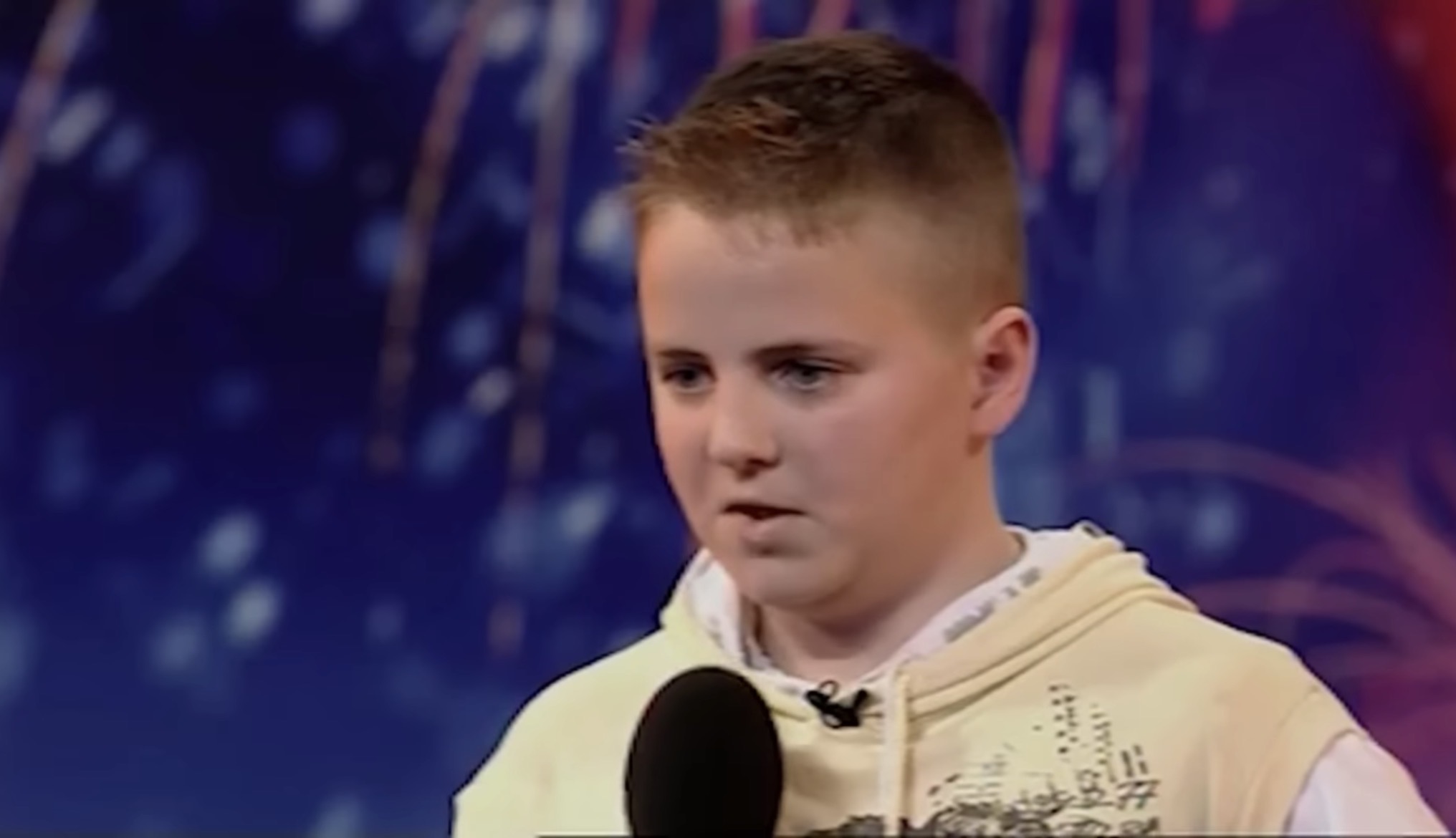
Thirteen-year-old Andrew Johnston walked onto the stage with a quietness that made him almost blend into the background, a skinny teenager in a simple shirt who looked more comfortable at a music stand than under bright studio lights. There was an obvious nervousness in the way he clasped his hands and glanced toward the judges, but that reserved exterior masked something entirely unexpected — a voice and presence that would soon fill the room with a kind of radiant confidence. For many in the audience, the contrast between the shy schoolboy and the sound about to emerge was the first of many surprises.
Before he sang, Andrew’s story spilled out in soft, candid sentences. He talked about his love of classical music in a way that made it clear this wasn’t a passing hobby; it was a refuge. He described how that passion set him apart from classmates, and how, instead of joining in the rougher pursuits around the council estate, he chose practice rooms and choir rehearsals. That decision came at a cost: he had been bullied and teased for his interests, singled out for not fitting the local mold. But there was something else there, too — not just a boy who loved beautiful music, but a teenager who’d decided his future wouldn’t be shaped by other people’s narrow expectations. Those details gave the audition a real emotional backbone; this was not just about a song, but about resilience and choice.
When the first notes of Pie Jesu began, it felt as if the stage itself held its breath. His voice broke the hush like light cutting through shade — pure, clear, and with an uncanny maturity for someone so young. The piece’s long, sustained lines require a control and breath management that can stump experienced singers, yet Andrew navigated them with the calm assurance of someone who had been coached carefully and had spent countless hours refining his instrument. He shaped phrases with gentle, intentional dynamics, never forcing volume where emotion would suffice. The high notes arrived with crystalline clarity, floating into the space rather than attacking it, and the softer passages were imbued with a tenderness that suggested he wasn’t merely reproducing notes but living the music.
Watching him, you could see how the melody moved people. Amanda Holden’s eyes glistened as the song unfolded; other judges leaned forward, as if trying to contain their disbelief. The audience, who had moments earlier been murmuring and shifting in their seats, grew completely still. In those minutes, the room shifted from polite curiosity to a communal witnessing of something rare — the moment when talent and heart align so precisely that applause seems almost secondary. The performance felt intimate despite the size of the venue; at its peak, it didn’t seem like Andrew was singing to judges or cameras, but directly to each listener, delivering lines with the kind of sincerity that sidestepped cynicism.
There were smaller moments that made the audition feel lived-in. Halfway through, he closed his eyes for a beat, chin lifted slightly as if reaching for a sound he’d been practicing for years. You could imagine a teenage boy practicing late into the night, breath control exercises and vocalises, the lamp on his desk casting a warm circle while the rest of the world slept. He didn’t use theatrics; instead, he conveyed emotion through subtle shifts in tone and timing — a softer consonant here, a slightly longer-held vowel there — choices that revealed a musical mind at work, not a performer relying on flash.
After the final note faded, the reaction was immediate and overwhelming. The audience rose, the sound of hands meeting in applause swelling into a roar. It was a tribute not only to the technical feat but to the story behind it: a boy who refused to be defined by taunts and who chose a different path. Simon Cowell, whose critiques can be merciless, offered praise that felt particularly weighty. He reminded Andrew — in the blunt, unmistakable way he has — that the very people who’d taunted him could never replicate what he possessed. That line landed like a benediction, reframing the audition as a vindication rather than simply a victory. The judges’ decision was unanimous: three resounding votes to move forward. For Andrew, that endorsement seemed to unlock a long-suppressed joy; a shy smile broke across his face, tentative at first and then broader, like sunlight through clouds.
Beyond the immediate applause and praise, the audition marked a turning point. For a teenager from a modest background, public recognition on such a scale does more than promise opportunity; it rewrites a narrative. The boy who had once hidden his talent to avoid ridicule now had a platform that celebrated exactly what made him different. People in the audience later described the scene backstage — hugs, tears, and a palpable sense of relief that years of study and self-discipline had been acknowledged. Teachers and choir directors, who may have quietly encouraged him, must have felt vindicated as well.
Andrew Johnston’s performance resonated because it combined technical excellence with something deeply human: a refusal to be diminished by circumstance. It reminded viewers that talent can flourish anywhere, even in places where it’s not expected, and that perseverance and focus can turn vulnerability into power. In that brief, shining audition, a young singer turned pain and isolation into beauty, and in doing so, he offered more than music — he offered proof that courage and dedication can reshape a life.