
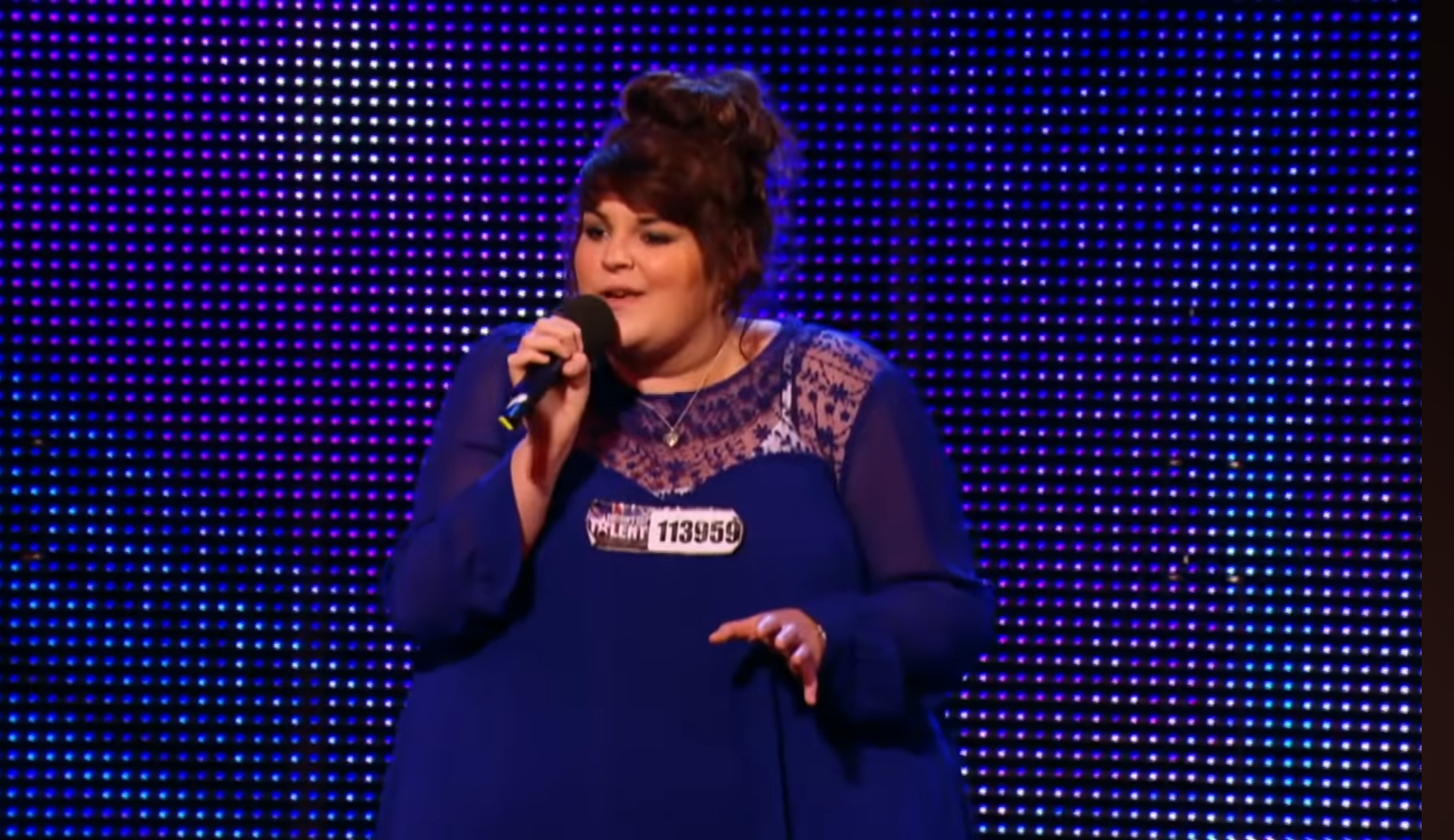
Nineteen-year-old Rosie O’Sullivan stepped onto the Britain’s Got Talent stage with a tremor of nerves that was almost visible. Hailing from Birmingham, she admitted up front that singing had been part of her life since primary school, but confidence had always lagged behind the talent. Rosie described herself as “always been a big big girl,” a phrase that carried more than a casual observation — it hinted at a lifetime of self-consciousness and worry about how others would perceive her. The thought of standing in front of a national audience filled her with dread; she feared laughter, judgment, and the sting of ridicule. For Rosie, a “yes” from the judges would be more than a green light in the competition: it would be the validation she had been searching for, proof that she really was “good at what I do,” and perhaps the first step toward quieting the voice in her head that told her otherwise.
As she took her place under the lights, there was a pause — a small, human moment where the performer and the person behind the performer met. You could see her hands search for steadiness on the mic stand, the way she breathed in and out as if counting invisible beats of courage. Then she launched into James Brown’s indelible classic, “It’s a Man’s, Man’s, Man’s World,” and almost immediately the atmosphere shifted. The nervous teenager morphed into a soul singer with a presence that felt older than her years. There was an authenticity in her approach that suggested she wasn’t merely covering a song; she was living it.
Rosie’s voice, when it arrived, was unexpected in the best way. It possessed a rich, resonant quality — a deep, smoky soulfulness paired with impressive technical control. She navigated the song’s demanding phrases with assurance, sculpting each line so that the words carried weight and meaning. Where the track demanded grit, she supplied it; where it called for tenderness, she found a fragility that tugged at the audience. There were smaller moments — a rounded vibrato on a sustained note, a husky inflection on a line about longing, a controlled pause that let the emotion sink in — that made the performance feel lived-in and sincere instead of showy.
The change in the room was palpable. Members of the audience who might have come with polite curiosity were now leaning forward, eyes fixed and faces softened. The judges, who had watched countless auditions, visibly registered surprise, then admiration. People stood, not because the song was familiar, but because Rosie had filled it with a kind of truth that made it feel new. She didn’t need flashy choreography or gimmicks; she had a voice that moved, and she trusted it enough in those minutes to let it do the talking.
After the last note lingered and the final chord faded, the reaction built into a ripple and then a wave — cheers, applause, and standing ovations that filled the theatre. It was a moment of collective recognition: the audience had witnessed someone confront her fear and turn it into something glorious. Rosie’s face, which had been tense with concentration, softened into a grin that was equal parts relief and disbelief. It was as if she had been given permission to believe in herself for the first time in a long while.
The judges’ comments reflected the emotional impact of the performance. Alesha Dixon was effusive, telling Rosie she had an “amazing” and “powerful voice,” and urging her to see herself through their eyes. Her words were meant to do more than praise; they were a gentle shove toward self-acceptance. David Walliams focused on control, admiring the way Rosie navigated the song’s demands and saying he wished he could “listen to you sing all night,” a compliment that underscored both the joy and the wonder of hearing someone whose talent feels effortless. Simon Cowell, often the show’s toughest critic, appeared genuinely moved and declared the performance “absolutely bloody fantastic.” Those three affirmations, joined by the fourth “yes” from the panel, didn’t just advance Rosie in the competition — they offered a form of redemption.
It’s worth pausing on the significance of that moment. For many performers, public validation can be a double-edged sword; it may bring fleeting confidence or the pressure to live up to a label. But Rosie’s situation felt more consequential. Her admission of fear in the beginning made the triumph at the end feel earned. The audition was not only a showcase of vocal talent but a small act of personal bravery: stepping into a place where she had feared ridicule and proving, to herself and others, that she belonged there.
Walking offstage, Rosie carried more than applause — she carried a tangible shift in her own belief. The nerves that had shadowed her entrance hadn’t vanished entirely, but they were reframed. What began as a performance aimed at judges became, in the space of a few minutes, a declaration that she had the voice and the heart to keep singing. For a nineteen-year-old from Birmingham, that kind of validation can be transformative. She left the stage with four emphatic “yeses,” a brighter sense of possibility, and, perhaps most importantly, a new story to tell herself: one where she is seen, heard, and genuinely applauded for who she is.