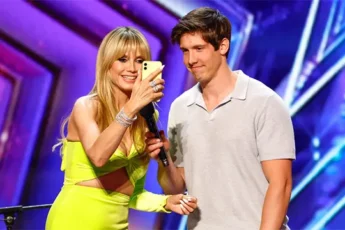

When Tate Stevens walked onto The X Factor USA stage, he didn’t carry the manufactured polish of a career contestant. He wore the kind of plain shirt and well-worn jacket that spoke of early mornings and honest labor, and his hands still seemed to hold a memory of the road — the calluses, the posture of someone used to a physically demanding job. Before he sang a single note, he chose to talk. That choice set the tone for the whole audition. He spoke plainly about being 37, about years spent on road construction crews in Missouri, and about the quiet, persistent ache of a dream deferred. He described the routine of providing for his wife and two children — the steady paycheck, the family dinners, the small moments that make up a life — and then admitted the truth: part of him had always been waiting for a chance to find out what would happen if he finally tried to be a musician.
Those confessions did something immediate and humanizing. The audience, which had already settled in for another round of polished performances, suddenly leaned forward. Tate wasn’t positioning himself as a tragic figure; he was simply honest. There was no sob story, just the relatable tension between responsibility and aspiration. That humility made him likable in a way that flashing talent alone can’t. People could picture him pulling on a reflective vest at dawn, then humming country tunes to himself on the drive home — a man whose life experience might just translate into the kind of emotional resonance great country music demands.
He chose Randy Houser’s “Anything Goes” for his audition, a song that requires both grit and nuance. When the opening notes hit, Tate’s voice emerged as something arresting: a deep, soulful baritone with the timbre of someone who has lived through the kinds of heartbreaks and quiet joys that give country music its gravity. He didn’t rely on ornamentation or vocal tricks. Instead, he delivered the lyrics with a steady, confident phrasing that allowed the story in the song to breathe. His lower register was warm and authoritative; his higher notes, when they came, were honest and well-placed, never pushed for the sake of showmanship. The sound wasn’t polished like a studio-produced track — it was textured, real, and comforting in the way a well-told story can be.
As he moved through the verses and into the chorus, the arena’s response shifted from polite attention to genuine engagement. People who had been scrolling their phones sat up. Hands that had been folded in laps began to clap in time. The judges, who often lean on rehearsed critiques, dropped their practiced facades and simply listened. L.A. Reid, in particular, seemed struck; he later commented that Tate had the “star quality” needed to make it in the industry. That comment wasn’t empty praise — it acknowledged the rare combination of voice, presence, and authenticity that can carry a country artist from local gigs to radio playlists.
Britney Spears and Demi Lovato responded with the kind of emotional remarks that showed they weren’t ticking boxes; they were moved. Britney noted how believable Tate sounded, how his performance felt like the kind of honest confession that connects with listeners beyond the structure of a song. Demi praised the emotional depth in his delivery, pointing out that his voice told a life story rather than just hitting notes. Those complementary reactions painted a picture of an artist whose appeal cross-cut age and genre — someone who could speak to longtime country fans and newer listeners alike.
Then there was Simon Cowell, whose reputation for bluntness can make even excellent performers nervous. But Simon’s response was notable for its sincerity. He acknowledged that Tate exemplified exactly what The X Factor set out to find: a hidden gem, someone whose talent had been overlooked by life’s responsibilities rather than by a lack of ability. When Simon admitted that Tate was the kind of person the show loved to discover, it carried weight. It was the recognition of an industry gatekeeper who saw not just potential in a vocal instrument, but the marketable combination of authenticity and stage presence.
By the time the final chord faded, the reaction was unanimous and emphatic. The crowd rose, and all four judges delivered “yes” votes with enthusiasm. Those affirmative responses were more than a gateway to the next round; they were a public validation of a dream that had been paused for years. For Tate, who had spent countless nights thinking about what might have been if he’d chased a music career sooner, the moment felt like a public reclaiming of possibility.
Of course, this audition was only the first chapter. Tate went on to use that opportunity to refine his craft and to connect with audiences who responded to his authenticity. The story of the road construction worker with a world-class voice resonated widely, and his journey through the competition culminated in a victory that seemed both surprising and inevitable. In the end, Tate’s path from hard hats to headlines became a reminder that talent often waits patiently in ordinary lives, ready to be discovered when someone finally gives it a stage.