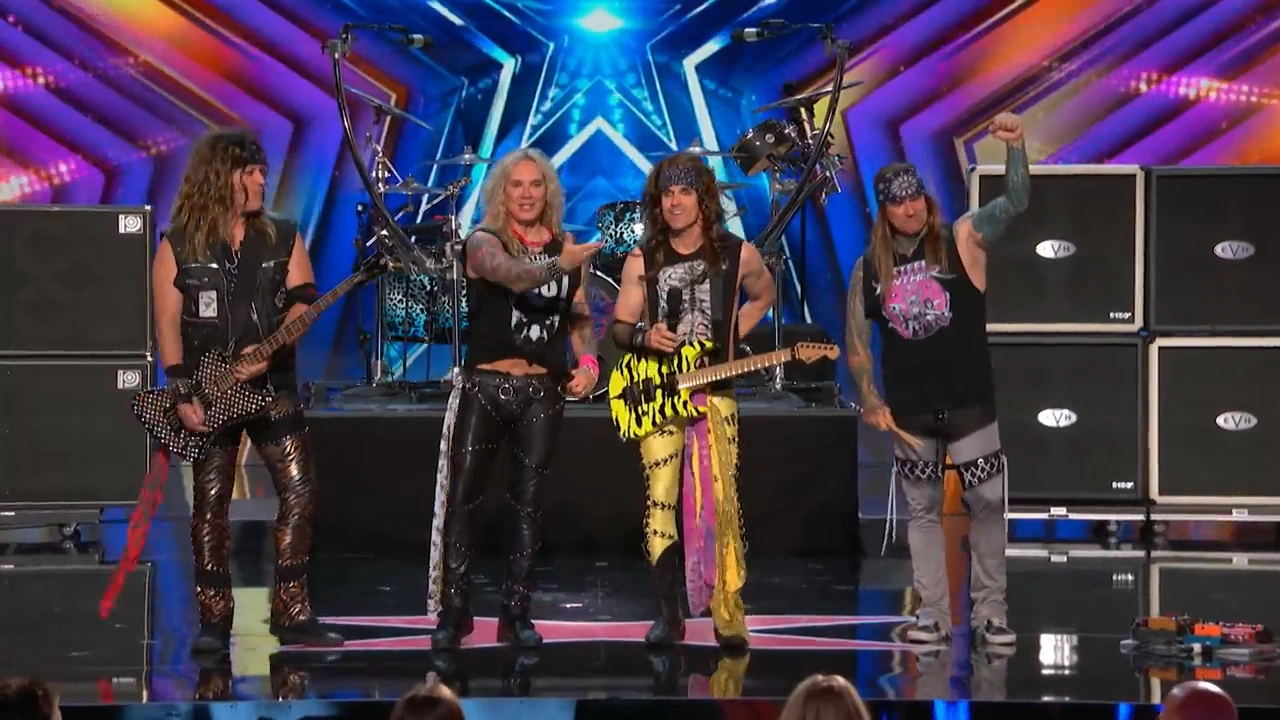
When Steel Panther walked onto the America’s Got Talent stage, the room felt like it had been transported back to an era of leather, neon, and unapologetic excess. Their arrival wasn’t subtle — it was cinematic. Satchel’s guitar case slammed down with a practiced thud, Michael Starr’s hair glinted under the stage lights, and the rest of the band filled the stage with the kind of swagger that comes from decades on tour. From the first second, it was obvious they weren’t treating the audition like a box to tick; they were staging an event. Their costumes were immaculate in that gleefully over-the-top 80s fashion: studded jackets, tight leather pants, and enough eyeliner to outline the whole theater. It was showmanship with a wink, the kind of theatrical self-awareness fans love.
Before a single note rang out, their banter with the judges set the tone. They traded jokes with Simon Cowell and teased the panel with the kind of confidence that reads as both respectful and cheeky. Michael Starr grinned and offered a quick quip about giving the judges “backstage passes for life,” a line that landed with laughter and a raised eyebrow from Simon. Those early interactions were more than comic relief; they were a reminder that Steel Panther’s appeal lies as much in personality as in musicianship. They understand how to connect with an audience, whether that audience is packed into a sweaty club or seated in a primetime television studio.
When they launched into “Eyes of a Panther,” the theater went from amused curiosity to full-on rapture. The opening riff cut like a neon blade — sharp, immediate, and impossibly precise. Satchel’s fingers moved across the fretboard with the kind of fluency only earned by years of breaking strings and dialing in tones on late-night soundchecks. Every bend, every pinch harmonic, had the confidence of someone who knows exactly how to make a stadium sing along. The drum fills were thunderous but tasteful, and the bass anchored the whole thing with a groove that made people in the audience involuntarily nod their heads.
Michael Starr’s vocal performance was a study in controlled excess. He hit those high, soaring lines with effortless theatricality, and then dropped into gritty, almost conspiratorial verses that felt like he was letting the crowd in on a joke. There was something almost touching about the way he balanced bravado with genuine musicianship — a living bridge between glam’s larger-than-life persona and the discipline of a seasoned rock vocalist. At one point, during a climactic high note, you could see a judge’s jaw drop; in another shot, audience members were already shouting along to a chorus they hadn’t known they’d remember so quickly.
Beyond the technicalities, the performance was a lesson in pacing and presentation. They didn’t play a full setlist’s worth of songs; instead, they crafted an experience. There were moments of humor baked into musical transitions — a staged wink here, a mock guitar duel there — that allowed the audience to breathe and laugh while still feeling the raw power of the music. Lighting cues hit perfectly, bathing the band in reds and purples that accentuated the retro vibe, while confetti cannons and a well-timed pyrotechnic flourish gave the finale a cinematic lift that left the crowd roaring.
The judges’ reactions were telling. Simon, who’s seen every kind of act imaginable, didn’t hide the respect creeping across his features; he applauded the band’s talent and acknowledged that merging a touring heavy metal act with a mainstream TV platform was a clever, bold move. Other judges nodded along, some cheering, some grinning like fans who had just glimpsed a favorite band up close. The mix of professional praise and genuine fan enthusiasm showcased why Steel Panther is uniquely positioned to succeed in this format: they can satisfy critics’ demands for musical credibility while simultaneously delivering the spectacle viewers expect from primetime television.
That unexpected fusion — an established glam metal band entering a talent show known for surprises and hopeful amateurs — is what made the moment feel viral almost instantly. Clips of Satchel shredding through impossibly fast licks and Michael Starr hitting impossibly high notes spread across social platforms within minutes. Fans of the band shared memories of sweaty club shows, while new viewers discovered the genre’s charm through a glossy, well-produced television moment. The conversation online wasn’t just about nostalgia; it was about the potential revival of a sound that many had written off as passé. People debated whether glam metal could reclaim a place in the cultural conversation, and Steel Panther’s audition became the proof point for those arguing in favor.
At the end of the set, when the band offered those tongue-in-cheek “backstage passes for life” and took their theatrical bow, the theater erupted. The moment felt celebratory rather than defensive — a confident proclamation that heavy metal, and particularly the flamboyant glam variety, still has a voice and an audience. Steel Panther didn’t simply perform; they reminded viewers that great rock is as much about attitude and storytelling as it is about technical prowess. Their audition wasn’t just a bid to advance in a competition; it was a statement: glam metal can still command a stage, win over skeptics, and turn a primetime audience into devotees. Whether or not they go on to win, they’ve already scored a victory by reigniting a conversation and proving that rock’s heart still beats loud and proud.