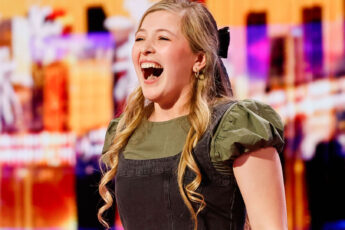

When 27-year-old Filipino singer Sephy Francisco walked onto The X Factor UK stage, she looked every bit the nervous hopeful the judges expected: modestly dressed, hands clasped, eyes bright but darting just a little as if trying to steady herself. The usual backstory followed — a singer with big dreams and a song to prove she belonged. She told the panel she’d be singing “The Prayer,” the soaring duet made famous by Andrea Bocelli and Céline Dion, and murmurs of anticipation rippled through the audience. What the room prepared for was familiar: a shy contestant offering the Dion lines, reaching for those iconic high notes with trembling grace. What unfolded was anything but familiar.
From the opening piano, Sephy’s voice arrived with a kind of confidence that felt quietly startling. She began with the Céline Dion part, and immediately it was clear she was no amateur. Her soprano was smooth, controlled and alive with emotion — those crystalline high notes ringing out with a steadiness that drew in the crowd. There was a purity to the tone, a soft vibrato at the edges, and she shaped phrases like someone who’d spent years learning the subtleties of breath and phrasing. As she climbed the melody, the audience hushed, leaning forward, as if trying to catch every nuance.
But then, in a moment that felt almost cinematic, she did something the room clearly didn’t expect. Mid-song, as the arrangement shifted, Sephy moved into the Andrea Bocelli lines — not by singing them in falsetto or imitating the timbre, but by genuinely dropping into a rich, operatic tenor. The change was startling because it was so complete; listeners weren’t merely hearing the same voice sing lower, they heard a different vocal texture altogether, full-bodied and resonant in a way that made the theater vibrate. The judges’ faces registered the moment in real time: eyebrows rose, jaws softened, and eyes widened in shared disbelief. Around the auditorium you could hear a collective intake of breath, the kind that precedes an eruption.
That instant of surprise wasn’t the end of the magic — it amplified what came next. Sephy moved between the soprano and tenor parts with such seamlessness that the duet, usually performed by two singers, sounded like a conversation happening within one person. She floated back up into the Céline lines with effortless grace, then dropped again into Bocelli’s warmth, coloring each phrase with appropriate dynamics and phrasing. The effect was theatrical and intimate at once: cinematic in its sweep, intimate in the way you could hear her breathing and the tiny expressive inflections that made the performance feel human.
Small details made the moment even more compelling. The stage lighting softened around her during the most delicate phrases, spotlighting the subtle rise and fall of her shoulders as she breathed. Cameras cut to the judges at key moments, capturing those brief, stunned expressions that tell you something extraordinary is happening. You could see people in the audience wipe their eyes; not everyone cries at auditions, but when the emotion is authentic, it has its own gravity. After one particularly rapturous passage, the applause rose in a wave, hesitant at first, then building into sustained cheers as people realized they’d witnessed something rare.
Sephy’s technique was impressive on a technical level, but it was her musicality that made the performance memorable. She understood the song’s emotional architecture — when to linger on a syllable, when to let the melody breathe, when to push forward with urgency. The contrast between the soprano’s luminous clarity and the tenor’s warm, robust tone underscored the prayerful quality of the lyrics, turning a well-known pop-classical crossover into a small dramatic narrative. In the moment, the duet’s dialogue felt more personal: not only a song about hope and comfort, but a conversation between two sides of one soul.
The judges’ reactions after the performance were a mix of stunned praise and joyful exclamation. One judge called it “one of the most astonishing things I’ve seen on this show,” while another marveled at her control and range. Compliments poured in not just for the technical feat but for the artistry — for making a familiar song feel fresh and alive. Sephy stood on stage, visibly moved by the response, offering a shy but radiant smile that made the applause feel like validation rather than spectacle.
Beyond the immediate thrill, the audition spoke to something broader about talent and expectation. Auditions often come boxed in stereotypes: the nervous balladeer, the flashy pop act, the quirky wildcard. Sephy subverted those expectations in the most elegant way possible, reminding everyone that artistry can’t be neatly labeled. The surprise wasn’t a cheap trick; it was the honest unfolding of a musician’s skill and imagination. For viewers at home and people in the theater, it was a reminder that talent can surprise us — not just by showing technical prowess, but by reshaping a known piece into a moment that lingers long after the last note fades.