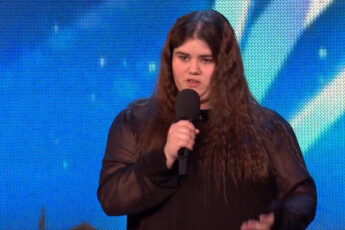
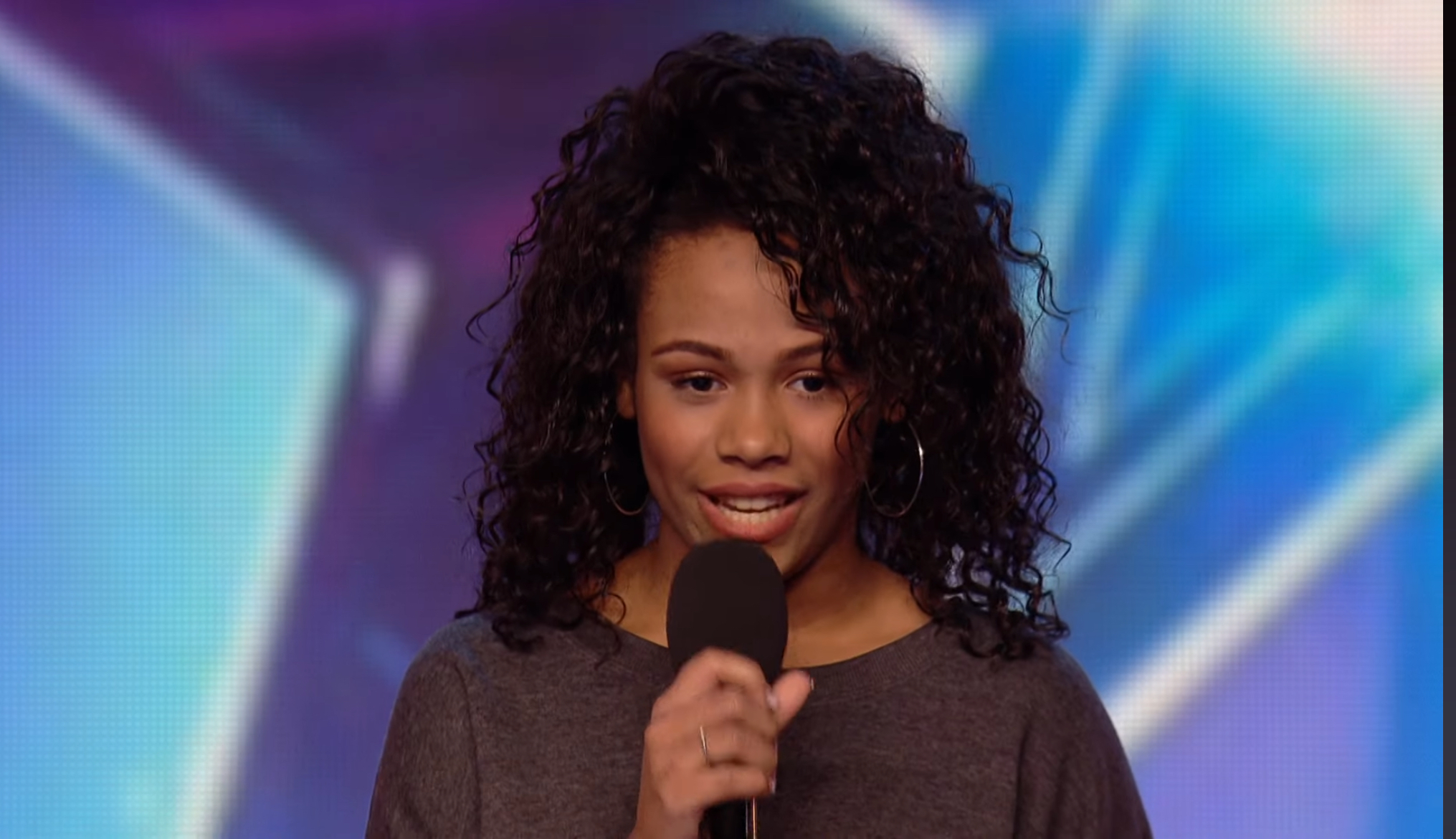
Fifteen-year-old Morgan Smith walked onto the Britain’s Got Talent stage with a quiet determination that felt almost tangible. Hailing from Watford, she carried with her a dream that seemed both modest and monumental: one day she wanted to perform for the Royal Family. For Morgan, music wasn’t just a hobby or a pastime — it was everything. You could see it in the way she stood, fingers nervously fidgeting at the microphone stand, and the way her eyes scanned the audience as if she were greeting an old friend. She admitted, almost sheepishly, that she feared freezing on stage, a confession that made her immediately relatable. Despite that fear, she had come to prove herself.
She chose Jennifer Hudson’s “Spotlight” to open the audition — a bold pick for a teenager, but one that showcased ambition. The song’s demanding vocal runs and emotional peaks seemed like an opportunity for Morgan to announce her presence. As she began, her voice was clear and technically sound, but something was missing. The judges listened politely, but the room never quite leaned in the way a truly captivating performance does. Midway through, Simon Cowell stopped her. It was a jarring moment: a seasoned star interrupted, not out of malice, but because he heard potential that wasn’t fully realized.
Simon didn’t just cut the song — he offered direction. He suggested she try something dramatically different: an emotionally raw classic, Etta James’s “I’d Rather Go Blind.” It wasn’t a safe option; the song demands vulnerability and a depth that separates singers who can hit notes from those who can inhabit a story. But Simon’s advice wasn’t merely about choosing a different track. He urged Morgan to be stronger, to believe in herself, and to let the judges feel her heart and spirit. It was coaching framed as tough love, the kind of nudge that can either crumble a young performer or send them into a new orbit.
What happened next felt inevitable and electric. Morgan took a breath, nodded, and returned to the microphone with a different posture. There was a subtle shift in her expression — a tightening around the eyes that signaled focus, a loosening in her shoulders that suggested she’d decided to stop fighting and start feeling. When she began “I’d Rather Go Blind,” she didn’t just sing the notes; she told the story behind them. The phrase “I’d rather go blind” came out not as melodrama but as lived experience, as if she had carried that heartbreak inside her. Her voice gathered texture, pulling in the huskiness and ache the song requires, and every phrase landed with intimacy.
The transformation was immediate and profound. Where the first performance had been technically fine, the second was magnetic. Morgan used the stage differently, leaning into the space, letting silence speak between lines, and milking small pauses so the emotional weight could drop and settle. There were tiny, human moments that made the performance believable: the catch in her throat on a particular line, a slow blink as if holding back tears, and a smile that flickered briefly when the melody turned hopeful. These details painted a fuller picture of a young performer who suddenly stopped performing and started communicating.
The judges’ reactions shifted in real time. What had been polite attention turned into visible surprise, and then into admiration. David Walliams admitted he was “actually really glad you’ve come on this show,” his words carrying an acknowledgment that Morgan possessed something moldable and rare. Alesha Dixon, always keen to spot latent ability, pointed to the vast potential in Morgan’s voice — and gently reminded her that she didn’t yet know how good she could be. Simon, whose interruption had catalyzed the change, offered perhaps the sincerest praise of all. Calling her one of the “better singers we’ve heard on the show this year,” he validated both her talent and the risk she’d taken by trusting his direction.
After the final note faded, there was a beat of silence that felt suspended, as if the room were catching its breath. Then came the applause — first tentative, then fuller, swelling with approval. The judges delivered a unanimous four “yeses,” a clear signal that Morgan had not only recovered from a shaky start but had turned the audition into a defining moment. It was a reminder of how resilience and adaptability can shape a performance as much as raw ability.
Walking off the stage, you could tell Morgan was still processing the intensity of what had just happened. The fear she’d confessed at the start hadn’t vanished, but it had been reframed: no longer a handicap, it was part of a story she’d begun to own. For a fifteen-year-old from Watford, the experience was more than a ticket to the next round — it was proof that with guidance, courage, and the willingness to be vulnerable, she could move people. And if her dream of singing for the Royal Family still felt distant, that night made it seem like a reachable horizon rather than an impossible star.