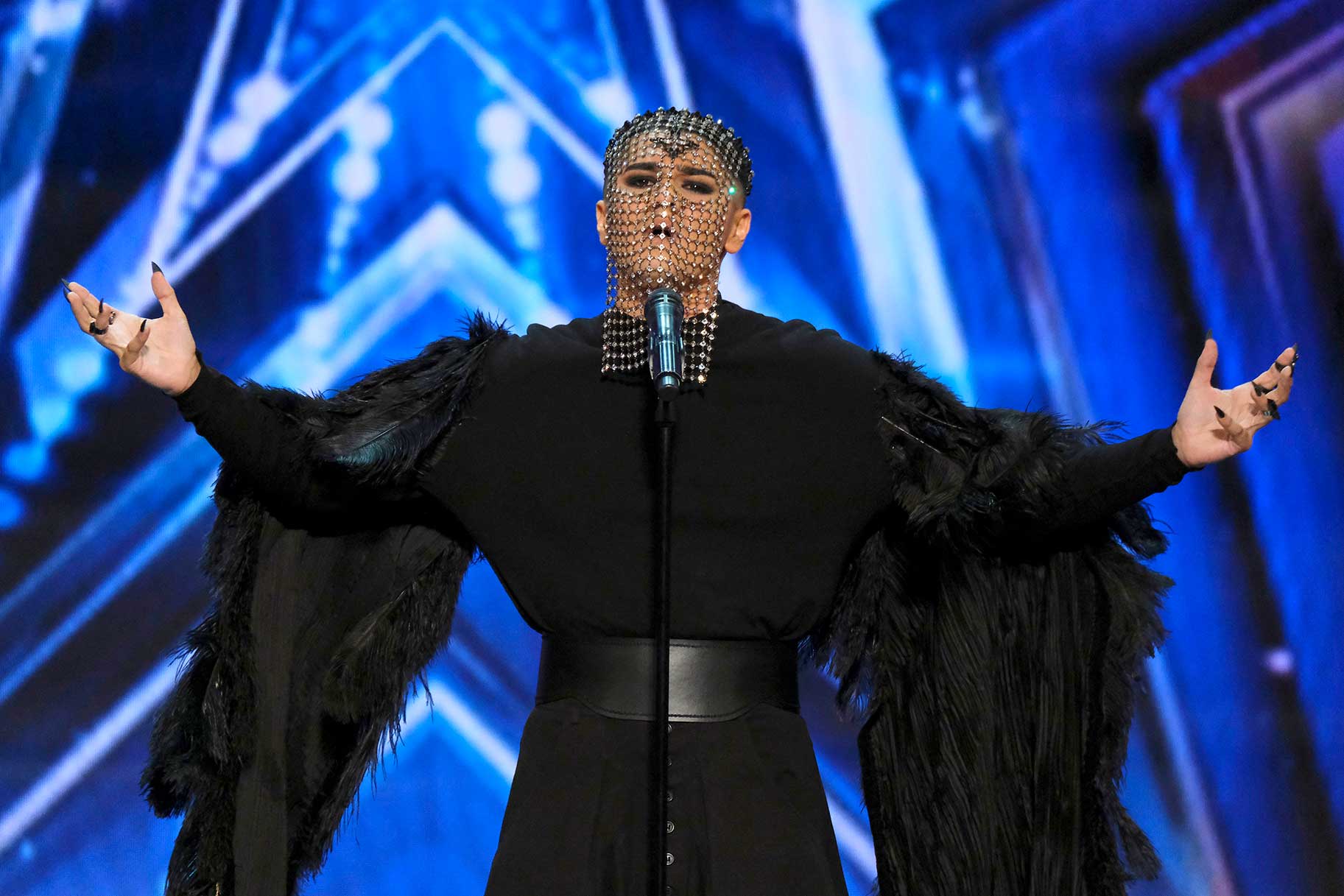
Sheldon Riley walked onto the America’s Got Talent stage like a living piece of art, every inch of him deliberately curated to provoke curiosity. His entrance was less about celebrity swagger and more about a statement: a glittering mask hid his face, and his clothing read like a cross between haute couture and theatrical costume. Cameras circled him, lights caught on sequins and metallic threads, and for a few long seconds the room filled with a kind of breathless, anticipatory silence. He didn’t speak. He didn’t unmask. Instead, he let the visuals do their work, inviting the audience to wonder who was behind the glitter — and to focus, ultimately, on the one thing he insisted should matter most: his voice.
When the music began and Sheldon opened his mouth, the mystery wasn’t just preserved; it was deepened. He performed Billie Eilish’s “idontwannabeyouanymore” with a tenderness and control that felt both contemporary and timeless. There was a haunting texture to his tone, a vulnerability threaded through every phrase that made the lyrics land like a confession. He navigated the song’s fragile moments with whisper-soft intonation, and then — when emotion demanded it — he expanded into richer, more resonant registers that seemed to vibrate through the auditorium. It was the kind of performance that makes people forget to breathe: phones lowered, whispers stopped, and the judges leaned forward as if to catch secrets carried on an especially honest breath.
Sheldon’s sartorial choices weren’t gimmickry so much as an extension of his artistic identity. The mask and avant-garde outfit created a frame for the music, giving his performance an almost ritual quality. Rather than hide behind the costume, he used it to illustrate a larger truth about appearance and self-expression. After the last note hung in the air and the applause rose, Sheldon finally spoke, and his explanation felt like a natural continuation of the artistry. He said that wearing elaborate makeup and sculptural pieces had helped him find confidence — that these external forms were how he discovered his internal voice. Growing up, he’d struggled to fit into conventional boxes and felt invisible until he embraced a look that made people stop and take notice. That admission made the earlier silence meaningful rather than coy: he hadn’t been hiding for drama; he’d been protecting a part of himself until he felt ready to share it on his own terms.
He also explained why he’d traveled so far from Sydney to stand on an American stage. For Sheldon, the United States represented a place where different is often celebrated rather than merely tolerated. He believed that performing for a broad, diverse audience in the U.S. could amplify his message — that self-expression isn’t a quirk but a kind of power. And his message was gentle but firm: authenticity matters, and the masks people choose can be tools of liberation rather than concealment. He admitted, with a flicker of vulnerability, that he’d shied away from opportunities before — afraid that being himself would risk ridicule — but now he wanted to show younger viewers that embracing who you are could open doors rather than close them.
The judges’ reactions captured the shift from curiosity to genuine admiration. Simon Cowell, often quick to strip away pretense, praised Sheldon for his originality and for bringing a fresh, enigmatic presence to the show. Simon’s approval carried the implicit recognition that Sheldon’s package — the look, the voice, the restraint — wasn’t a stunt but a coherent artistic vision. Sofia Vergara chimed in with a warm compliment, calling attention to his “Cleopatra eyes” and the way they seemed to pierce through the costume, reinforcing that even behind ornamentation, something very human was shining. Mel B and the rest of the panel echoed similar sentiments: they admired the courage it took to be this exact version of himself on national television, and they acknowledged the emotional honesty woven through his singing.
Small moments made the audition feel lived-in rather than staged. After his final note, Sheldon’s shoulders relaxed as if a weight had been lifted; his hands, previously still and composed at his sides, trembled barely as he listened to the audience’s response. Backstage footage later showed family and friends clasping his hands and whispering congratulations, and you could see how deeply meaningful the moment was to him personally. That intimacy resonated with viewers at home who might have their own private masks, and many responded online by thanking Sheldon for showing that difference can be beautiful.
When the votes were cast, Sheldon earned three enthusiastic “yes”es, a clear nod that his blend of visual daring and vocal sincerity had worked. More than advancing in the competition, the audition cemented him as one of the season’s most talked-about contestants — not only for a striking look, but for the layered artistry behind it. In a culture quick to judge appearances, Sheldon’s performance offered a reminder that identity can be crafted and communicated in countless ways, and that talent, when paired with courage and clarity of purpose, will always find its audience.