
Talent shows have become a cultural mirror of sorts: a place where ordinary people step into bright lights to share a piece of themselves, and where celebrity judges offer quick, decisive verdicts that can change a life in a single moment. Over the years the format has evolved, but its core appeal remains the same — raw, emotional performances that make viewers at home and audiences in the hall lean forward. Singing and dancing tend to dominate the conversation because they’re immediate and visceral: a melody or a movement can make you feel something in an instant. The crowd’s reaction in the theater often functions as a secondary judge, a barometer of authenticity that can be as powerful as anything a critic says onstage.
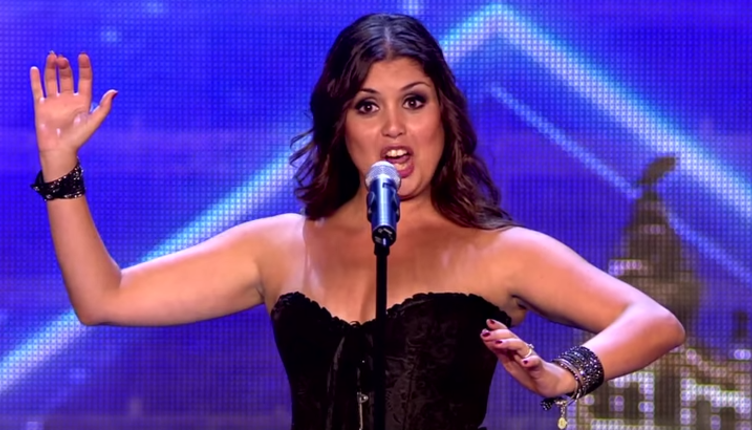
Into that charged atmosphere stepped 37-year-old Christina Ramos, a performer who understood how to play to both the heart and the element of surprise. She first captured attention with a poised, technically assured rendition of an operatic aria — the kind of number that highlights breath control, phrasing, and an ability to fill a room with tone. Christina’s voice in that early portion was nothing short of beautiful: warm, resonant, and emotionally controlled. The kind of singing that makes people stop talking and listen, not because the production asks them to, but because the voice itself insists on attention.
Her operatic selection earned her immediate praise from both the public and the celebrity judges. Comments focused on her technique and the emotional depth she brought to the aria — praise that felt earned, the result of years of training and a deep respect for the classical repertoire. But Christina had more in mind than a single, sumptuous aria. What she built into her audition was a theatrical pivot designed to defy expectations and to show range in the most literal sense.
Mid-performance, with the audience still basking in the afterglow of her operatic lines, Christina took a daring, theatrical step: she shed the trappings of the elegant evening gown and transformed into a hard-edged, rock-inflected persona. The change was more than cosmetic. The costume swap — a flash of leather, a shift in makeup, a different swagger in her stance — signaled a wholesale change in mood. The accompanists shifted gears too, and then she launched into AC/DC’s “Highway to Hell” with the kind of gritty verve that belongs on an arena stage rather than a velvet-draped recital hall.
The transition was seamless in its intent and shocking in its effect. At first, there was audible confusion — a scattered laugh, a few sharp intakes of breath — and then, quickly, delight. The audience moved from polite applause to open, surprised cheering. The judges’ faces were a parade of reactions: raised eyebrows, incredulous smiles, and then unabashed enjoyment as the number built. What made the moment so electrifying was not merely the novelty of shifting genres mid-song, but the seriousness with which Christina committed to each style. Her operatic delivery earlier had been earnest and precise; her rock persona was equally convincing, full of bite and presence. She didn’t mock either genre; she inhabited both, which is the real trick.
That kind of genre hop requires more than vocal flexibility. It’s a lesson in theatrical timing, confidence, and an instinct for drama. Christina’s change of costume and musical approach reframed the entire audition, turning it into a mini-show-within-a-show. It also gave the judges and the audience permission to revise their first impressions. A performer who can convincingly move from a delicate, classical phrasing to a driving, electric anthem demonstrates not just range but imagination. People began to see her not just as a trained vocalist, but as a storyteller who could shape a narrative arc in a single audition.
Online, the clip traveled fast. Viewers watched the arc unfold — the poised aria, the wardrobe flash, the roar of the amps — and then shared it, often with comments that mixed amusement and admiration. Some celebrated the humor of the reveal; others praised the sheer guts of attempting something so audacious in a competitive setting. For many, the performance served as a reminder that talent shows reward risk-takers. It’s one thing to sing well; it’s another to surprise a room and make the surprise feel like part of the art rather than a cheap trick.
Beyond the virality, there’s a human element to consider. Christina’s willingness to take that risk in front of a live audience and a panel of influential judges suggests confidence born of experience and a readiness to challenge expectations. That audacity can inspire other performers to think beyond genre constraints and to design auditions that reflect multiple facets of their artistry. In the moment, the crowd’s delighted reaction felt like a communal permission slip: it’s okay to be bold, and surprising choices can pay off.
When the last chord faded and the applause surged, Christina Ramos had done more than win a round — she had turned a classical showcase into a conversation about versatility, theatricality, and the power of reinvention. The audition became a small case study in how a performer can shape perception: start by meeting the audience’s expectations, then upend them in a way that reveals depth, humor, and bravado. In a format that thrives on memorable moments, that kind of transformation is exactly the kind of thing viewers keep watching, sharing, and talking about long after the season has ended.