Paul Gbegbaje’s audition on Britain’s Got Talent was the kind of story that reminds you how inventive determination can be when opportunity is scarce. At nineteen, Paul walked into the audition room carrying more than a hopeful smile — he carried a quiet history of improvisation and sacrifice. He told the judges that for much of his childhood there simply wasn’t a piano in the house, so he taught himself in the most literal sense possible: he drew keys on paper and practiced the hand movements until the motions felt natural. That image — of a young boy tracing invisible chords on a sheet of paper — stayed with everyone who listened. It framed the entire performance as not just an audition but the culmination of years of creative problem-solving.
Paul’s story was full of small details that made his journey tangible. He explained how he would sit down during school lunch breaks to sketch out melodies and jot chord progressions into a worn notebook, while other students ran around on the playing field. Those stolen minutes mattered; they were the laboratory where he tested ideas and built technical muscle. There was a tenderness to the way he described those sessions: the hush of the school hall, the scratch of pencil on paper, the imagined resonance of notes that weren’t yet sounded. It’s one thing to read about practice; it’s another to picture a teenager rehearsing invisible scales and composing in a corner, stubbornly refusing to let a lack of an instrument define his limits.
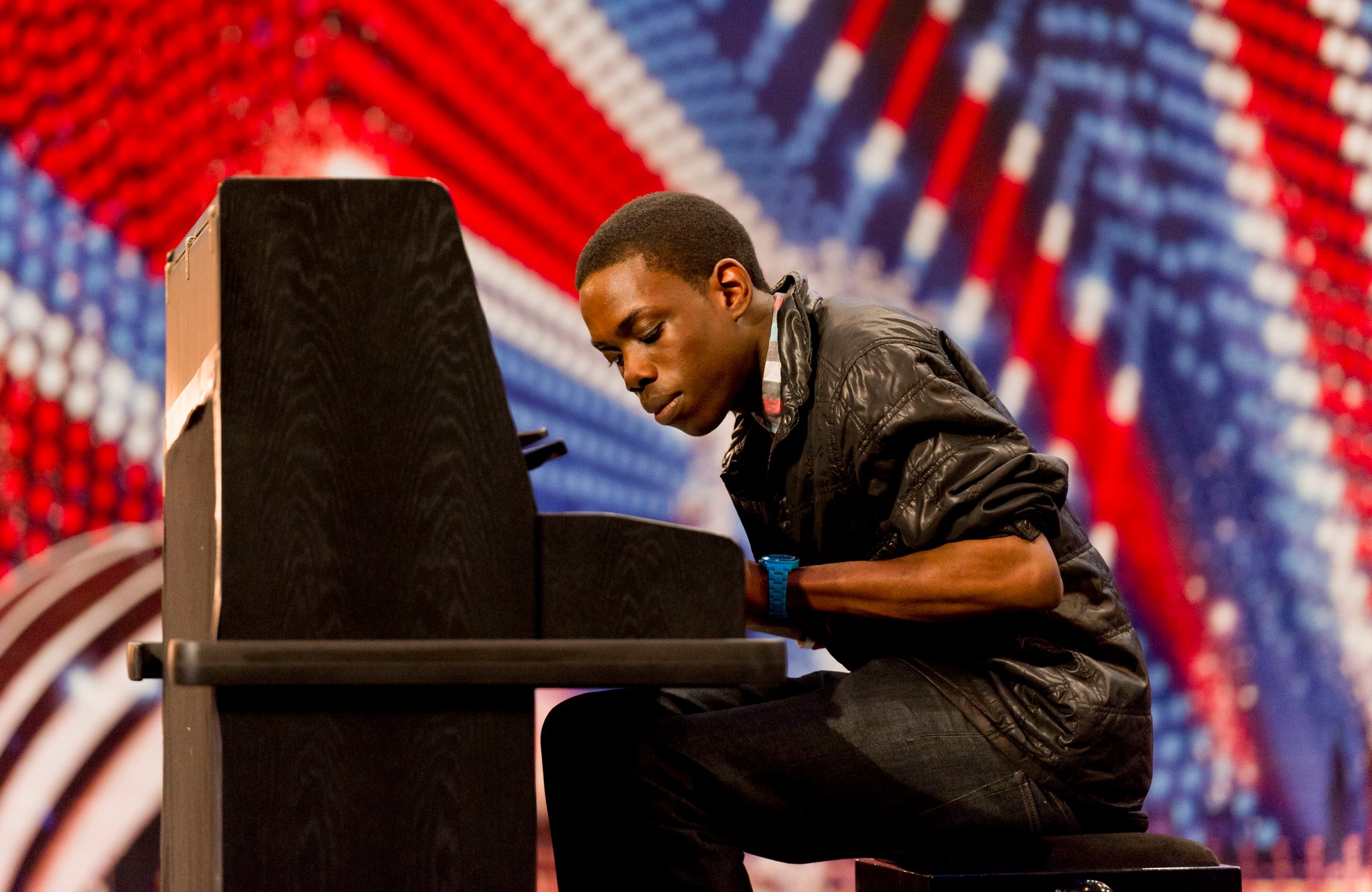
So when Paul finally sat at the gleaming grand piano on the Britain’s Got Talent stage, it felt like a meaningful homecoming. He approached the instrument with respectful concentration, as if meeting a long-awaited friend. From the very first chord, the audience could tell this wasn’t a casual recital. His touch on the keys was both confident and expressive: firm enough to command presence, nuanced enough to communicate subtle emotional shifts. He moved through the piece with a fluency that belied his relatively short time at the piano — he had only been playing for five years — and yet his playing conveyed a maturity that suggested those years had been intensely focused.
There were moments in the performance that captured why the backstory mattered. During a delicate passage, Paul softened his touch so the melody seemed to hang in the air, delicate and fragile as if he were sharing a private memory. Conversely, when the music swelled, he leaned into the dynamics and let the full weight of the instrument carry the emotion outward, filling the theater. Small physical details amplified those musical choices: the slight furrow in his brow during a complex run, the way his shoulders relaxed as a phrase resolved, the quick, satisfied nod when a tricky section landed cleanly. Those micro-expressions told the audience he wasn’t performing for applause; he was communicating something deeply personal.
The judges’ reactions reflected genuine surprise and admiration. They noted not only his technical skill — the accuracy of his runs, the clarity of his voicing — but also the emotional authenticity in his performance. One judge described him as “sensational,” emphasizing the rare combination of proficiency and heart that Paul brought to the stage. Comments highlighted how unusual it was to see someone develop such finesse in only five years, especially someone who had once practiced on paper. Their praise didn’t feel like platitudes; it felt earned, the verdict of listeners who had just witnessed a musician convert hardship into artistry.
Audience response matched the judges’ enthusiasm. There was an audible swell of appreciation as the final chord faded, and a standing ovation followed — not merely for technical fireworks but for the narrative of ingenuity behind them. In the seats, you could sense people drawing the line between what they’d heard and what they’d learned about Paul’s background. Applause in that setting often functions like communal acknowledgement: a way of saying, “We see what you’ve overcome, and we honor it.”
Beyond the applause and the advancing votes, Paul’s audition resonated because it distilled a few universal truths about talent and work. His story challenged the common assumption that great musicians always have early access to instruments and formal training. Instead, Paul’s path showed that resourcefulness — the willingness to invent practice methods and to use whatever time you have — can substitute for circumstances that others might deem essential. He demonstrated that progress can be made in the margins: during lunchtime, in the corner with pencil and paper, practicing invisible scales until they become second nature.
When the judges voted and Paul secured the support he needed to move forward in the competition, it felt like validation on multiple levels. It wasn’t only a ticket to the next round; it was affirmation that creativity and resilience can open doors even when resources are limited. For viewers, Paul’s audition served as both inspiration and a reminder: talent is important, but so are persistence, imagination, and the refusal to be defined by what you don’t have. His journey from sketched keys to standing ovations underscored a hopeful idea — sometimes the most unlikely beginnings lead to the most remarkable performances.