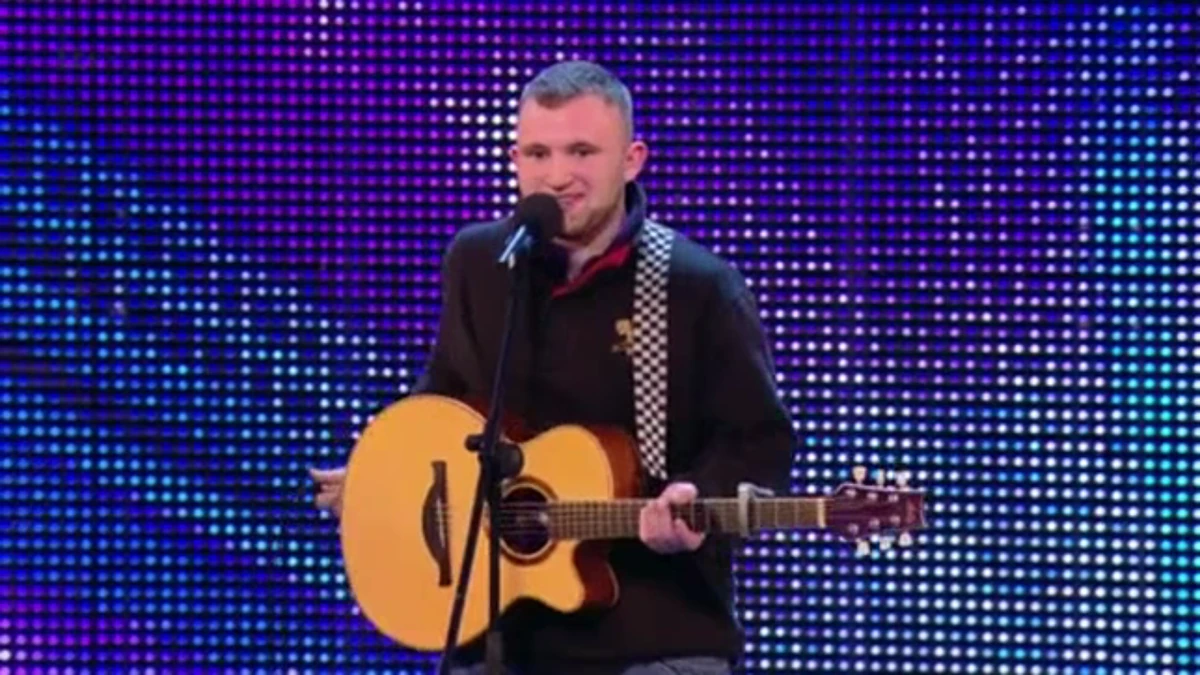
When twenty-two-year-old Robbie Kennedy walked onto the Britain’s Got Talent stage, he looked every bit the hardworking tradesman he’d described — sturdy frame, careful movements, the kind of easy, unassuming smile you might see on a bloke coming off a long shift. He told the audience and judges upfront that he was a bricklayer from Cwmbran, South Wales, a job he’d been doing since he was a teenager. Singing, he admitted, was just a hobby, something he’d picked up around four and a half years earlier by watching YouTube tutorials and teaching himself guitar in his spare time. The picture he painted was refreshingly ordinary: living at home with his parents, a longest gig that lasted half an hour at the local pub, and evenings spent practicing between shifts. That honesty endeared him instantly; he didn’t arrive on stage with a rehearsed backstory, just a humble, genuine bloke who loved to sing.
From the first chord, it was clear this wasn’t going to be the small, amateur set people expected. Robbie’s voice unfurled warm and resonant, carrying a depth that seemed far beyond a weekend hobbyist. He played with a steady hand on his guitar, fingers moving confidently along the frets — a sign that the countless hours he’d spent watching tutorials and practicing had paid off. There was nothing flashy about his entrance, which made the power of his singing all the more striking. The sound he produced was rich and textured, the kind of baritone many professional singers spend years cultivating. What began as a modest acoustic performance quickly revealed layers of emotion and technique that suggested Robbie had more than raw talent; he had an instinct for phrasing and an intuitive control over his instrument and voice.
Even before the twist, the judges were leaning in. Alesha Dixon’s expression thawed from polite curiosity to open admiration as Robbie mined the emotional core of his first song. It felt honest and lived-in, the kind of performance that comes from someone who uses music to process life, rather than to chase fame. The audience, initially polite and reserved, responded with a growing warmth. A few heads nodded along, others closed their eyes, carried by the sincerity of the moment. It was clear this wasn’t some staged audition persona — this was a man who loved singing for the sake of singing.
Then the music shifted. Seamlessly and without fanfare, Robbie transitioned into the Goo Goo Dolls’ classic “Iris,” and the room collectively took a breath. That song is a beloved staple, familiar to many and notoriously difficult to deliver with authenticity; it demands not only vocal power but an emotional vulnerability that can make or break a performance. Robbie didn’t just sing it — he inhabited it. His voice opened wider, carrying the melody with crystalline clarity while also maintaining a husky intensity that tugged at the heart. The sustained notes rang true, and his control over dynamics — when to lean into volume and when to whisper a line — was impeccable.
The reaction was immediate and visceral. The audience rose almost as one, clapping and cheering, swept up in a performance that felt both epic and intimate. It was the kind of moment that transforms an audition into a shared experience; you could see people wiping their eyes or smiling as if transported back to the soundtrack of their own lives. On the judges’ panel, expressions changed from surprised delight to outright disbelief. Alesha, usually measured with her praise, was effusive: “Robbie, you are so likable… you just knocked me out, you’ve been blessed with a true gift.” Her words felt like the validation of someone who could tell the difference between training and natural, soulful talent.
Amanda Holden, thinking ahead to the ripple effects of the broadcast, imagined Robbie’s workmates seeing him in a new light. She laughed and said he would “absolutely knock them dead” when the clip aired — picturing a group of bricklayers lifting their mugs and cheering for one of their own turned star. The idea of Robbie’s mates gathering round to watch him was a nice, human detail: fame presented not as a pedestal but as a surprise party of communal pride.
Simon Cowell, the hard-to-please adjudicator, captured the magnitude of the moment succinctly. “I wasn’t expecting that… I think if you put that record out you would have a number one hit with that song,” he said. Coming from Simon, that wasn’t empty flattery; it was a professional appraisal that suggested marketable potential. The fact that all four judges pressed their buzzers in unison confirmed the sense that something special had happened on that stage.
As Robbie left, the applause still echoing, it felt less like a contestant moving on to the next round and more like a turning point. The bricklayer who had once played half-hour sets at a pub had shown a roomful of strangers what he could do when given the chance. His story — modest beginnings, late-blooming passion, hours spent hunched over a guitar between shifts — suddenly read like a beginning rather than a hobbyist’s detour. For Robbie, the audition validated a private love for music and suggested a future where that passion might become a profession. And for the viewers, it was a reminder that talent can be found in the most unexpected places, waiting for the right moment to be heard.