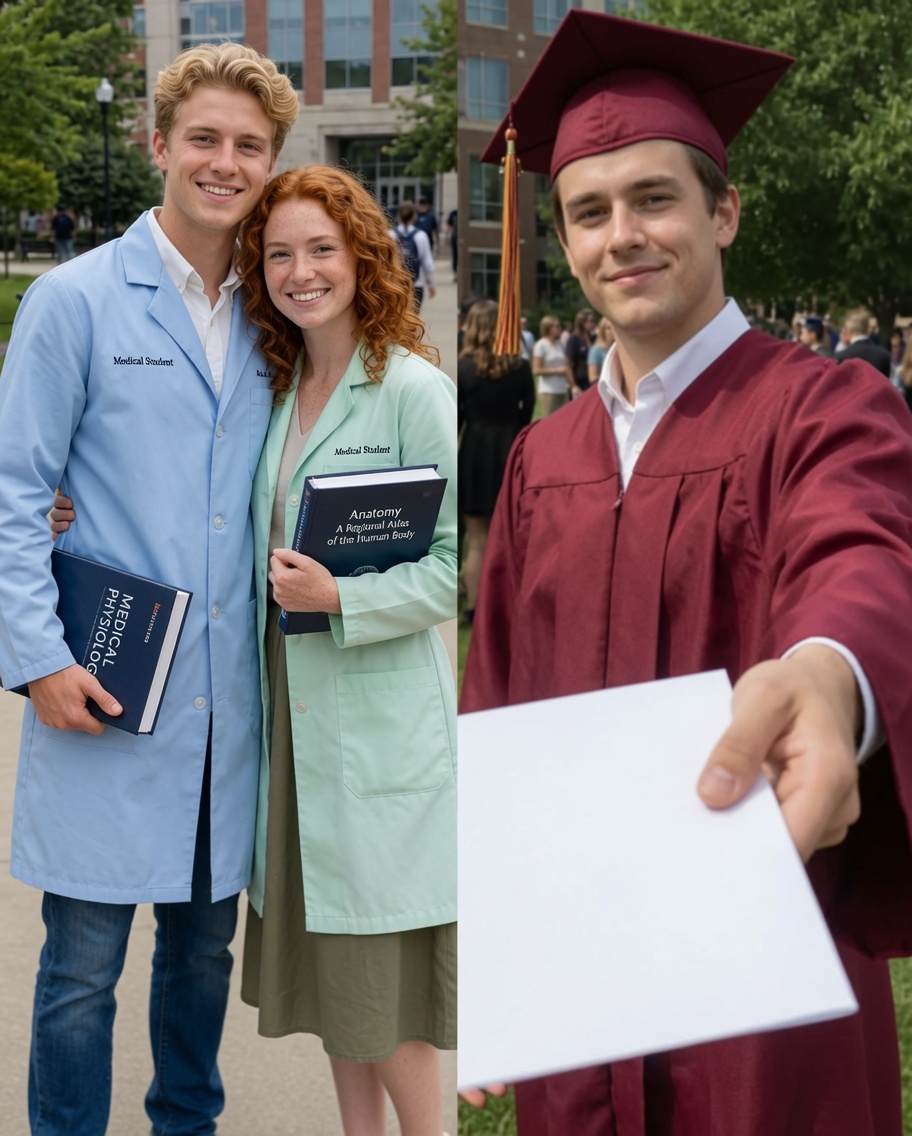
I met Trevor in a paralegal certification class when we were both twenty-four.
He wanted to be a lawyer. I wanted to be a paralegal. We used to joke that he’d argue the cases and I’d hand him the files.
We got married a year later in his mother’s backyard in Ohio.
Then his father had a stroke. His parents lost the auto shop. Trevor’s undergrad loans came due, and law school was suddenly a fantasy on a spreadsheet.
He sat on our couch one night with his acceptance letter to Ohio State’s law program in his hands and told me he was going to turn it down.
I didn’t let him.
“One lawyer in the family is enough, Trev. I’ll finish paralegal school. I’ll work. You go.”
He held my hands and cried. “I will spend the rest of my life making this worth it.”
I believed him.
For seven years, I worked three jobs. Reception at a dental office during the day. Billing at a chiropractic clinic on weeknights. Weekend shifts at a bakery, boxing muffins at four in the morning. I paid the rent, the car, the groceries, his bar exam fees, and the tuition his scholarships didn’t cover.
He graduated. He passed the bar. He got hired at a mid-sized firm in Columbus.
Three years later, they invited him to become the youngest partner in firm history.
The dinner was black tie. Rooftop restaurant. Twenty-four people at one long table. I wore the navy dress I’d saved four months for.
Trevor stood up during dessert, tapped his glass, and thanked his mentors. His mother. His late father.
He did not say my name.
Then he sat down beside me, slid a leather folder across the tablecloth, and whispered, “Open it later.”
Before I could touch it, his paralegal, a woman named Renée whom I’d only met twice, leaned across the empty chair beside me and whispered into my ear.
“Don’t sign anything tonight. There are two folders. He gave you the wrong one on purpose.”
Part 2 in the comments 👇👇
I froze with my hand halfway to the folder.
Renée’s face stayed perfectly polite, like she had just complimented my earrings. She stood, smoothed her blazer, and walked to the restroom.
I picked up my clutch and followed her.
The bathroom was empty. Renée was leaning against the marble counter with her arms folded, waiting for me.
“Renée. What are you talking about.”
She looked at the door, then back at me.
“Ma’am, I don’t know how much you know about what’s been happening at the firm. But I’ve been Trevor’s paralegal for eighteen months. I file every document he signs. I file every document that gets sent to his home address. And I have watched something happen this year that I cannot stay quiet about.”
My hands started shaking.
“Tell me.”
“Six months ago, Trevor met with a family law attorney named Owen Marsh. Owen is a friend of one of the senior partners. Owen prepared two documents. A divorce petition, and a post-nuptial agreement. Trevor asked Owen to draft the post-nup in a way that would be extremely favorable to him if you signed it under pressure.”
I gripped the edge of the counter.
“Tonight was supposed to be a happy surprise. Partnership announcement. Big dinner. Emotional moment. Trevor was going to hand you the post-nup in a leather folder and tell you it was ‘just some estate paperwork’ for the new tax bracket. He was going to ask you to sign it before dessert.”
“And the other folder?”
“The other folder has the divorce petition. He was going to give you that one next week. After you’d already signed away your rights to the marital assets.”
My eyes filled.
“How do you know all this?”
Renée reached into her clutch and pulled out a folded sheet of paper.
“Because Owen’s assistant is my cousin. She called me two weeks ago crying because she couldn’t stop thinking about it. She said the paperwork mentioned three jobs, seven years, and a woman named Meredith. That’s you.”
My name is Meredith.
“I’ve been trying to figure out how to tell you for two weeks. Then tonight I saw him slide the folder to you, and I panicked. I’m so sorry to do this to you here. But if you signed tonight, you would have lost everything.”
I wiped my eyes very carefully so my mascara wouldn’t run.
Then I straightened my navy dress.
“Renée. Do you have Owen’s assistant’s name and number?”
She nodded and wrote it on the back of a receipt.
“Thank you. Please go back to the table. Act completely normal. Do not look at me. Do not look at him. If he asks what we talked about, tell him I complimented your blazer and asked where you got it.”
She squeezed my hand. “You’ve got this.”
I walked back to the table with my head high. Trevor was laughing at something the managing partner had said. He turned when I sat down and touched my knee under the tablecloth.
“You okay, babe? You look pale.”
“Just a little dizzy. Champagne on an empty stomach.”
He smiled, satisfied.
I picked up the leather folder.
“Should I open it now?”
“No, no. Later at home. It’s boring stuff. Just some tax planning things now that I’m partner. Owen at the firm put it together.”
“Owen Marsh?”
Trevor’s eyes flickered. “You’ve heard of him?”
“You mentioned him once.”
I slid the folder into my clutch and smiled at him. “You should give a toast to your mother. She’s been waiting all night.”
He stood and toasted his mother. He did not toast me.
That was the last night we shared a table.
The next morning, I called Owen Marsh’s assistant. Her name was Bethany. We met at a Panera at ten a.m. She brought a manila envelope. Everything Renée had said was true, and worse. The post-nup would have signed over the equity in our house, waived my share of his partnership buy-in, and capped any spousal support at eighteen months.
I called a family law attorney of my own that afternoon. Her name was Karen. She was fifty-eight, twice divorced, and quietly furious on my behalf.
“Meredith,” she said, “in this state, seven years of documented income supporting a spouse’s professional degree is not invisible. It’s called a supporting spouse contribution, and courts take it very seriously. You have bank statements. You have pay stubs. You have his tuition receipts paid from your accounts. You have text messages where he thanked you for keeping him alive.”
I did. I had all of it. Something in me had known to keep every folder for seven years.
Karen filed first.
Trevor found out at the firm from his own managing partner, who had been served notice as a courtesy because a partner’s marital assets can affect firm liability.
He came home that night pale and shaking.
“Meredith. What is this.”
I was sitting at the kitchen table with a cup of tea and Renée’s blazer compliment still tucked in my memory like a small warm coin.
“It’s what you were going to do to me next week, Trevor. I just did it first.”
He tried to cry. He tried to explain. He said the post-nup was misunderstood. He said Owen had “gotten ahead of him.” He said he loved me. He said he panicked because partnership was scary and his mother was pressuring him and he wasn’t thinking clearly.
I let him talk until he ran out.
Then I said, “Trevor. You were going to hand me a folder in front of twenty-four people and ask me to sign away seven years of my life because you were embarrassed to be married to your bakery-shift wife now that you’re a partner. Don’t pretend it was anything else.”
He went to stay at his mother’s that week.
The divorce took nine months.
Karen was very good at her job. I walked away with the house, half his partnership buy-in, and a five-year supporting spouse award that reflected every muffin I ever boxed at four a.m.
I sent Renée a bouquet of white peonies the day the final decree came through. The card just said: Thank you for the compliment on my dress. She sent back a photo of the flowers on her desk with a thumbs up.
I used part of the settlement to go back to school. Not paralegal school. Law school.
I’m two years in now. I’m thirty-six. I’m the oldest person in my study group and the happiest.
Trevor sent me a long email last month. He said he’d been in therapy for a year. He said he wanted me to know he was sorry. He said he’d been terrified of the man he’d become.
I read it twice.
Then I closed my laptop and went back to studying contracts.
Because seven years ago, I bet on the wrong lawyer.
I don’t intend to make that mistake twice.