
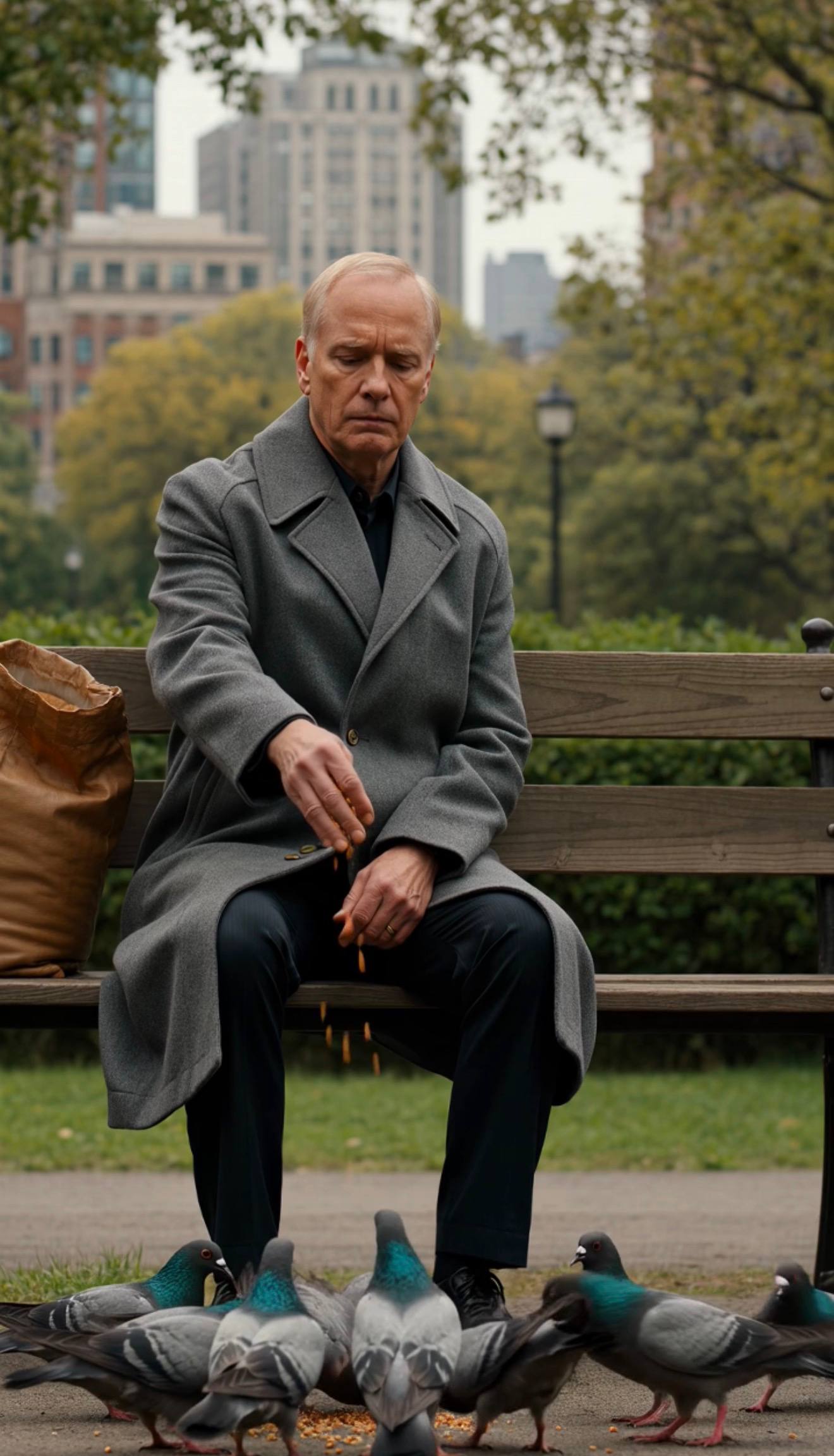
Every Sunday, same bench, same park, same routine.
The old man in the gray coat fed the pigeons at exactly nine in the morning. Rain or shine. Alone. He never spoke to anyone, and after a while, people stopped trying.
The neighborhood kids called him “the ghost.” Parents steered strollers around his bench. Seven years of Sundays, and nobody knew his name.
Then one morning, a girl sat down next to him.
Maybe six years old. Mismatched socks. She’d wandered from the playground while her exhausted mother rocked a crying baby by the swings.
The old man ignored her, tossing breadcrumbs.
The girl watched the pigeons for a while. Then she looked up at him and asked:
“Are you feeding them for somebody?”
His hand stopped mid-throw.
“What?”
“My grandma says people who come to the same place every time are usually keeping a promise to somebody.” The girl shrugged. “So who’s your somebody?”
The old man stared at this tiny stranger in mismatched socks.
And for the first time in seven years, in front of a child he’d never met, the ghost of Miller Park began to cry.
Continued in the c0mments 👇
The girl didn’t panic when he cried. That was the strange thing. Most adults would have stammered apologies and fled. Children either cry with you or wait for you — and this one waited, feet swinging above the ground, patient as the pigeons.
When he finally found his voice, it came out rusted from disuse.
“Her name was Evelyn. My wife.”
The girl nodded, like this confirmed something she already knew.
“Fifty-one years, we were married. And every Sunday, all fifty-one of them, she made me walk to this park with her to feed these ridiculous birds.” He huffed something that was almost a laugh. “I complained every single time. Told her pigeons were rats with wings. Told her we could be sleeping in. Fifty-one years of complaining.”
“But you still came,” the girl said.
“I still came.” His hands worked the bread bag without looking at it. “She died seven years ago. March. And that first Sunday after — I woke up at eight like always, and I didn’t know what else to do with myself. So I got dressed. And I walked here. And I fed the damn birds.”
“And you kept the promise,” the girl said simply.
“I never promised her anything.” His voice cracked on it. “That’s the thing. She never asked me to. I just — I couldn’t let the Sunday go empty. If the birds got fed, then some little piece of the world she built was still running. Does that make sense to you?”
He looked at the girl, suddenly embarrassed to be asking a six-year-old to validate seven years of grief.
The girl thought about it seriously, the way children do when adults finally ask them something real.
“My goldfish died,” she offered. “I still say goodnight to the bowl. Mommy thinks I forgot to stop. I didn’t forget. I just don’t want the goodnight to go empty.”
The old man stared at her.
“Yes,” he said quietly. “That’s it exactly.”
They fed the pigeons together after that, not talking much, the girl carefully copying his technique of scattering crumbs in a wide arc. When her mother finally came running — half-frantic, baby on her hip, apologizing in a torrent for her daughter bothering him —the old man stood up and did something no one in that park had seen him do in seven years.
He smiled.
“She wasn’t bothering me,” he said. “She was keeping me company. It turns out I’d forgotten what that felt like.”
The mother, a young woman with tired eyes who had clearly been running on empty for months, hesitated. Then she asked if he’d like to join them for hot chocolate at the cafe across the street — the girl’s reward for surviving another Sunday errand run.