My son Eli is ten and autistic. He’s clever, warm, and experiences the world on his own frequency. Noise and crowds can overwhelm him fast, but the water is different — it’s the one place he fully unwinds.
He’d been marking off days on the calendar for weeks before our trip. My husband and I had scrimped for nearly a year to afford four nights at a beachfront hotel, and the pool was all Eli could talk about.
That first afternoon, he waded in grinning ear to ear.
He wasn’t splashing anyone, wasn’t loud, wasn’t in anyone’s way — just floating on his back, humming softly, using the exact self-regulation technique his therapist had spent months teaching him.
I sat nearby, watching him this calm for the first time in ages.
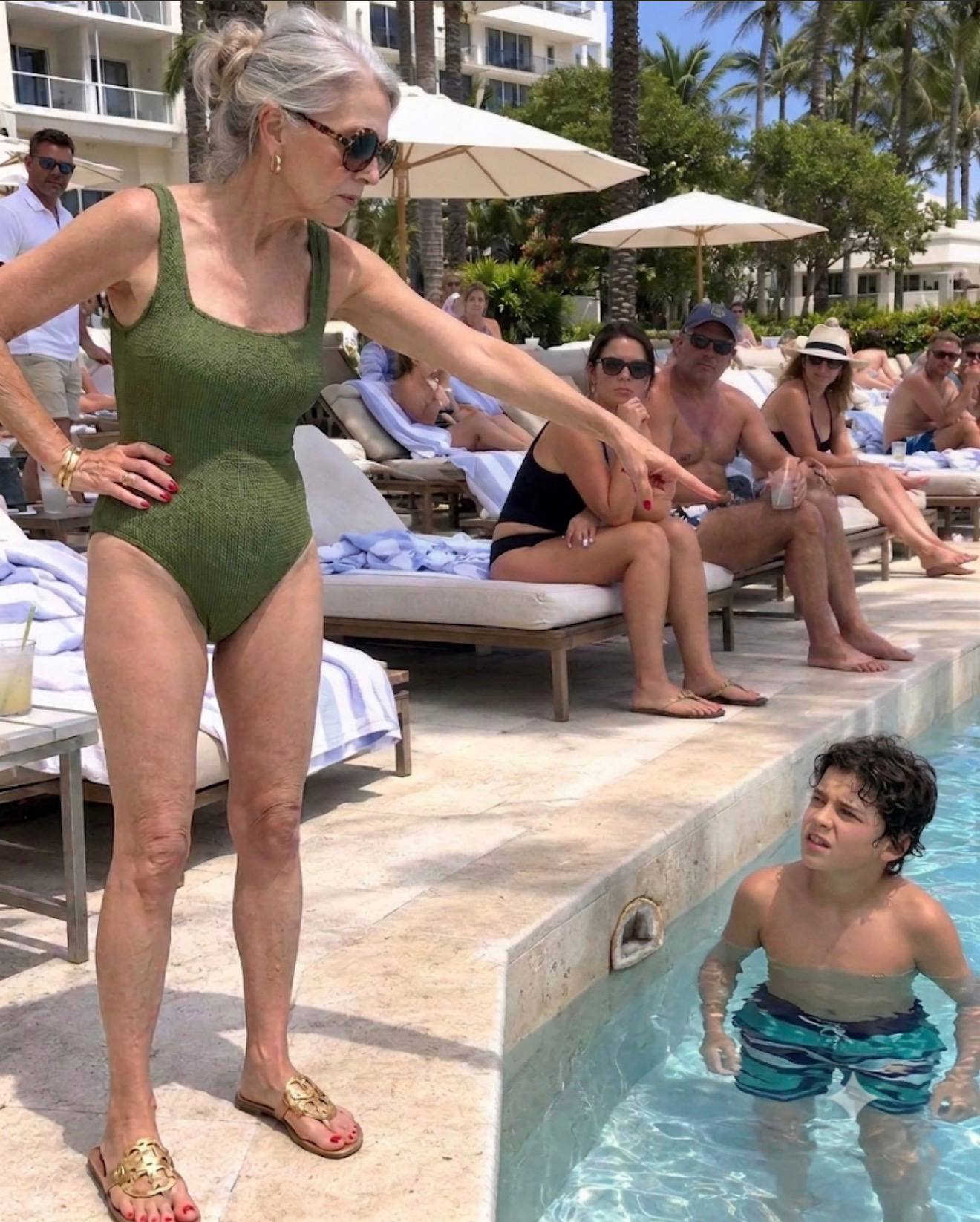
Then a woman in oversized sunglasses and designer sandals marched up to my chair, no greeting, no introduction.
“Get your son out of the pool. People pay good money to be here, and he’s disturbing them.”
I thought I’d misheard.
She crossed her arms and said it again, louder this time, clearly wanting an audience.
Heads turned. I felt Eli notice the attention, and I knew exactly how fast this could spiral for him.
I stood up slowly, met her eyes, and did the one thing she never expected.
By the time hotel management showed up, she wasn’t smug anymore.
Continued in the c0mments 👇
“Excuse me?” I said, keeping my voice level. “What exactly is he doing that’s bothering you?”
She blinked, clearly not expecting to be questioned. “He’s just — he’s making noise. Groaning. It’s weird. People are staring.”
“People are staring because you’re standing over my chair shouting,” I said. “He’s humming. That’s it. He’s autistic, and humming helps him stay calm in a new place. If anyone’s disturbing the pool right now, ma’am, it’s you.”
A few guests nearby had gone quiet, watching. I saw one older man lower his sunglasses to get a better look at her.
She scoffed. “I didn’t come here to be lectured. I came here to relax, not to deal with a scene.”
“Then I’d suggest you stop making one,” I said.
Eli had drifted closer to the edge of the pool by then, sensing the tension the way he always does, his hands starting to flap slightly at his sides — his tell that things were getting to be too much. I crouched by the edge and kept my voice soft and steady, the way we’d practiced.
“You’re okay, buddy. Nothing’s wrong. Keep floating.”
He nodded, took a breath, and eased back into the water. That alone seemed to unsettle the woman more than anything I’d said.
That’s when a hotel staff member — a young man named Dario, name tag still catching the sun — walked over, having clearly heard the last part of the exchange.
“Is there a problem here?” he asked, glancing between us.
The woman straightened up fast, switching to a sweeter tone. “Yes, actually. I’d like this child removed from the pool. He’s disturbing the other guests.”
Dario looked at Eli, floating peacefully, humming to himself, bothering exactly no one. Then he looked at her.
“Ma’am, I’ve been standing at the pool bar for the last ten minutes. The only person I’ve heard raise their voice is you.”
Her mouth opened, then closed.
“This hotel has a clear policy on guest conduct,” Dario continued. “Harassment of another guest, especially regarding a disability, isn’t something we tolerate. I’m going to have to ask you to lower your voice, or I’ll need to involve my manager.”
“A disability?” she repeated, like the word had teeth. “I didn’t ask for his medical history.”
“You don’t need it,” I said. “You just need to leave him alone.”
The pool manager arrived a minute later, a calm, no-nonsense woman named Priya, and Dario briefed her quietly. Priya turned to the guest with the kind of polished patience that comes from handling exactly this kind of situation before.
“Ma’am, I understand you have concerns, but we don’t ask guests to leave a public pool for existing quietly in it.
If the noise level is a concern for you personally, I’m happy to offer you a cabana on the quieter side of the property, away from the main pool.”
“I don’t want a cabana,” the woman snapped. “I want him gone.”
“That’s not something we’re going to do,” Priya said simply. “But I can have someone escort you to guest services if you’d like to file a formal complaint. I should mention, though, that I’ll be documenting this interaction as well.”
The woman’s face went through several colors. She grabbed her bag, muttered something about “ridiculous policies,” and stormed off toward the lobby, sandals slapping against the tile the whole way.
A woman two loungers down caught my eye and gave me a small, solidarity nod. Someone else actually applauded, quiet and brief, just enough to make Dario smile as he walked away.
Eli, blissfully unaware of most of it, floated over to the edge and grinned up at me.
“Mom, watch my dolphin kick!”
“I’m watching, baby. Show me.”
He kicked off and glided across the water, laughing, completely unbothered — which was the whole point of coming here in the first place.
We stayed at that pool every day for the rest of the trip. Nobody bothered us again. And every time I think back on it, what stays with me isn’t the woman’s ugly comment — it’s Dario’s steady voice, and Priya’s, choosing to protect a kid who was doing absolutely nothing wrong.
That’s the version of “five-star service” that actually matters.