Oliver had never been a child who noticed strangers. Seven years old and perpetually lost in his own thoughts, he usually walked beside me in silence, adjusting his little tie, counting cracks in the sidewalk.
So when he suddenly stopped walking and stared, I followed his gaze without expecting much.
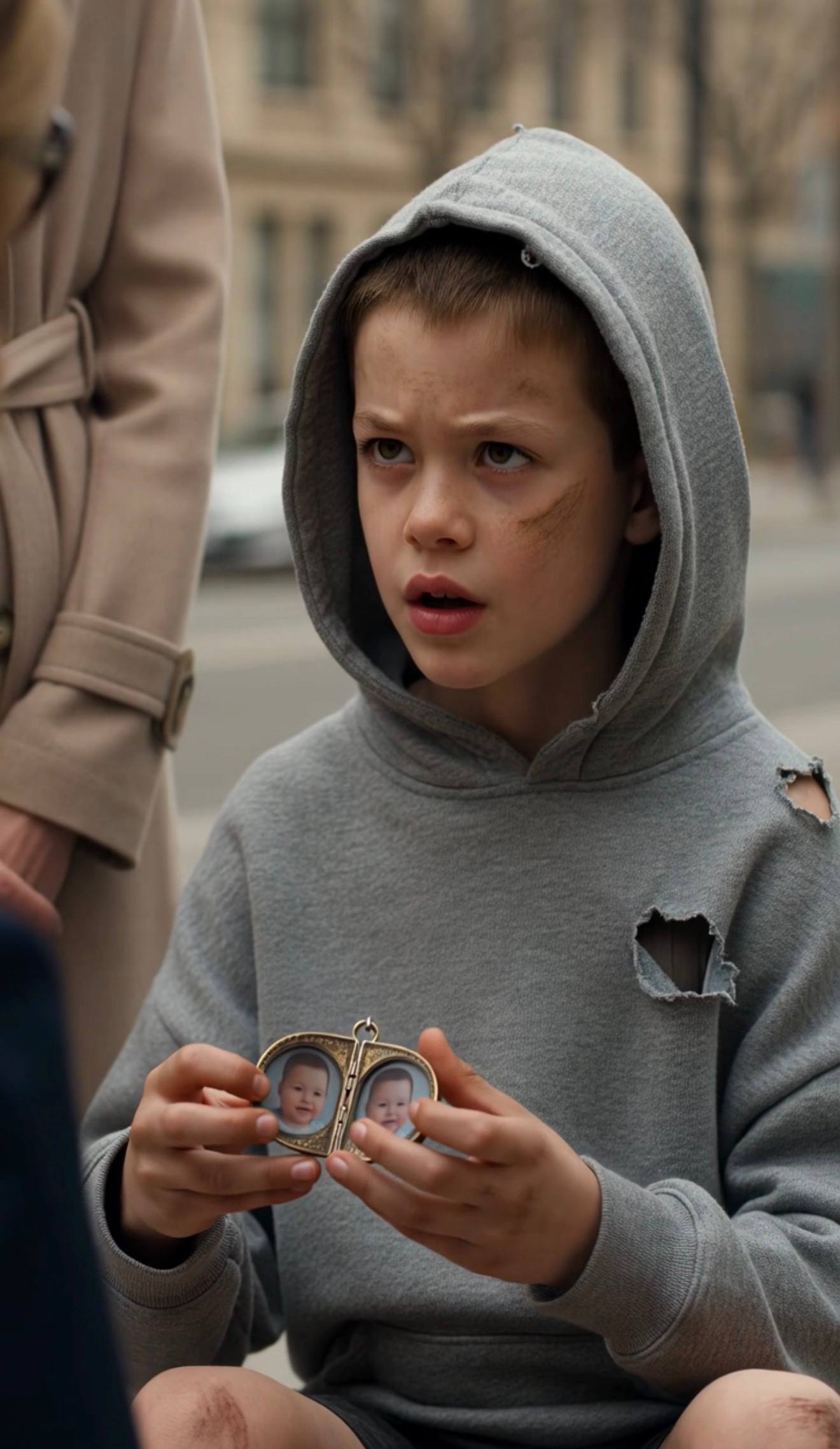
A boy sat against a lamppost — barefoot, hoodie torn, scraped knees pulled to his chest.
“Mom,” Oliver said slowly. “That boy… he looks like me.”
I laughed it off at first. “Lots of boys look alike, sweetheart.”
But then I actually looked. Really looked.
The shape of his face. The exact curve of his eyebrows. Even the small dimple on his left cheek — the one people always said was so unique to Oliver.
I pushed my sunglasses up, heart suddenly racing for no reason I could explain.
The boy stood slowly, wincing, and reached into his hoodie. He pulled out a small, tarnished locket on a chain.
He opened it without a word and held it out to me.
Two identical black-and-white baby photos stared back at me.
Engraved above them, four words: “To our twin suns.”
I stopped breathing.
“That’s not possible,” I whispered.
Continued in the c0mments 👇
Oliver looked between me and the boy, his small face crumpled with confusion. “Mom? What does that mean?”
I couldn’t answer him. My hands were shaking too hard to hold my phone, my purse, anything solid. The locket sat open in the boy’s palm, the two photographs staring up at me like accusations from a life I’d spent seven years trying not to think about.
“Where did you get this?” I finally managed, crouching down to his level despite my dress, despite the city sidewalk, despite everything.
“A woman gave it to me,” the boy said. His voice was rougher than Oliver’s, roughened by years I couldn’t account for. “At the place I used to live. Before I ran. She said it was my mother’s, and that someday it might help me find my way home.”
“What place?” I asked, though some part of me already knew, already understood with a sick, sinking certainty exactly what he was about to say.
“St. Agnes,” he said. “The children’s home on Fifth.”
The world tilted.
Seven years ago, I had given birth to twins. Complications during delivery. A doctor’s grim face. A nurse’s hurried explanation that one of my sons hadn’t survived the night, that the NICU had done everything they could, that I should focus on the healthy baby I still had.
I had held Oliver in my arms that first night and grieved a son I never got to hold at all.
I had never questioned it. Why would I? Grief doesn’t leave room for suspicion. I had trusted the hospital, trusted the doctors, buried an empty casket in a private ceremony three days later because the hospital said there wasn’t a body suitable for a family viewing.
“That’s not possible,” I whispered again, though even as I said it, I was already reaching for him, already searching his face for confirmation my mind refused to accept. “My son died. He died the night he was born.”
“I don’t know anything about dying,” the boy said quietly. “I just know I’ve been at St. Agnes since I was a baby. Until three weeks ago, when I ran.”
“Why did you run?”
His jaw tightened, and for just a moment I saw something flash across his face that looked less like a child and more like someone who had survived things no seven-year-old should have to survive. “Doesn’t matter now. I just knew I had to find someone. I didn’t know it would be you.”
Oliver, still processing, tugged my sleeve. “Mom, is he… is he my brother?”
I looked at the two boys standing in front of me — my son in his tailored blazer and pressed tie, and the boy who should have been his identical twin, filthy and thin and barefoot on a public sidewalk, holding a locket that had apparently outlived a lie I’d been told seven years ago.
“I don’t know yet,” I told Oliver honestly, though everything in my body was already screaming the answer. “But we’re going to find out.
Right now.”
I called my lawyer before I called anyone else — some instinct telling me that whatever had happened seven years ago, whatever paperwork had been falsified or mishandled or deliberately destroyed, I would need documentation, need proof, need someone whose entire profession was built around making sure the truth couldn’t be buried a second time.
The DNA test came back nine days later.
99.99% probability of a full sibling match — identical twins, to be precise, which the geneticist explained was statistically almost impossible to fake or misread.
I sat in my lawyer’s office holding the printed results and thought about seven years of birthdays celebrated for one son when there should have been two. Seven years of a headstone with a name and a date that apparently marked nothing but an administrative decision made by someone who thought a grieving mother wouldn’t ask enough questions.
Oliver has a twin brother now. His name, we learned, had been recorded simply as “Baby B” for seven years, no name ever given, no family ever assigned, shuffled through an underfunded system that apparently lost track of exactly which children belonged to exactly which families.
We named him Nathaniel, after my father.
It’s been four months. He still doesn’t sleep well most nights — some things, I’m learning, don’t heal as quickly as paperwork can be corrected. But every morning, I watch my two sons sit across from each other at breakfast, identical faces studying each other like mirrors neither of them ever knew they had.
“To our twin suns,” the locket had said.
I finally understand what that meant. And I will spend the rest of my life making sure both of my sons know exactly how true it always was.