
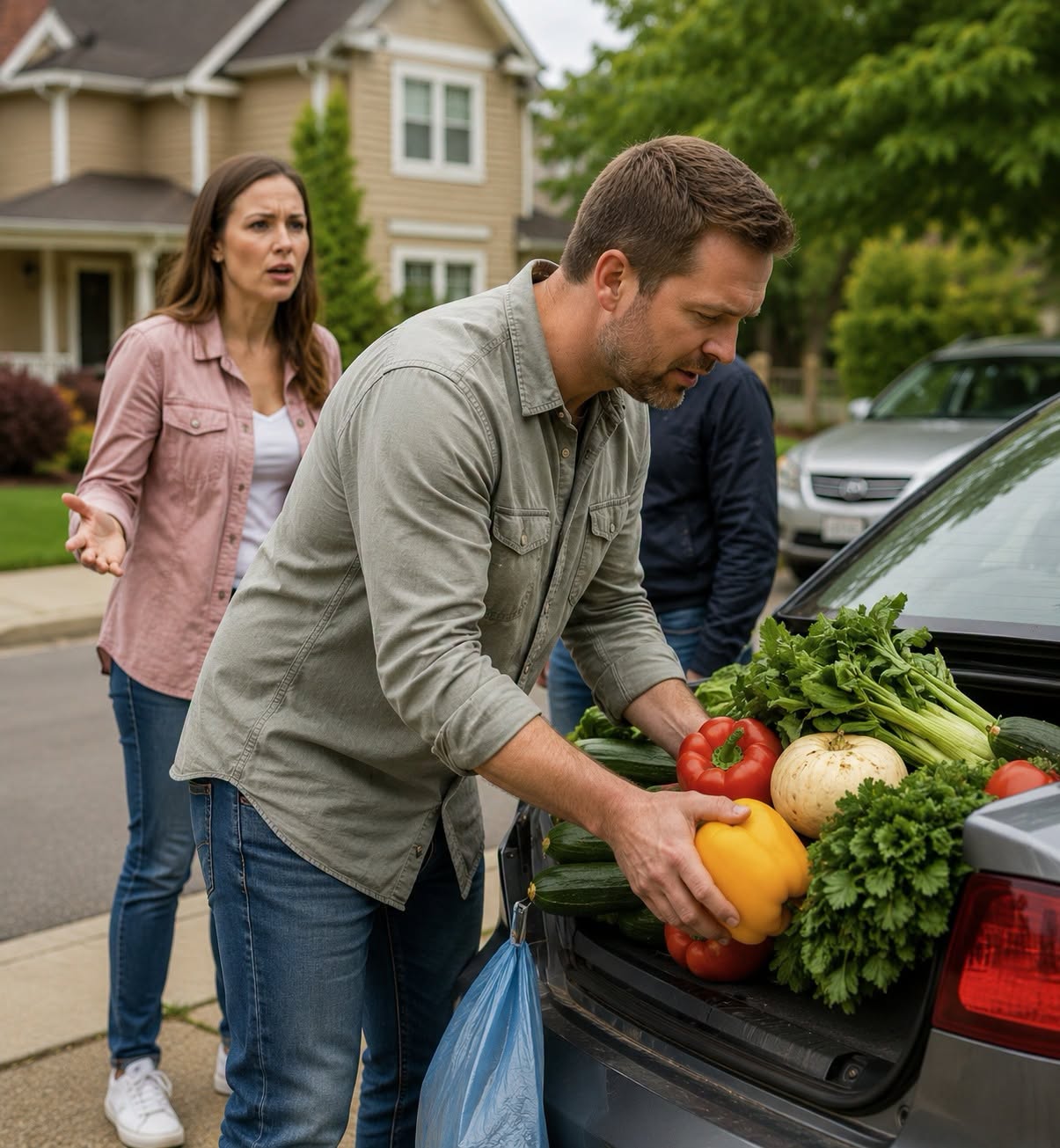
Three sacks of potatoes had been standing by the gate since early morning, and Sarah nearly tripped over them as she went out to get the mail. Nearby were two buckets of carrots, covered with an old plaid cloth, and a net of onions, still smelling of earth. She stopped, set the bag on the porch, and looked at her husband, who was just then steering the neighbor’s Ford straight toward the gate.
“Sean, where’s this going?”
“To Mom,” he said curtly, without looking at her, and began to haul the sacks into the back of the truck.
“To Mom,” she repeated. “The whole harvest?”
“Not all. We’ll keep some for ourselves, too, don’t worry.”
Sarah looked at the garden beds behind the house—empty, dug over, with black holes where the tops had been sticking out just yesterday. All the onions had been dug up. The entire row of carrots, down to the last root. The potato patch he and his daughter, Ellie, had spent a month and a half cultivating and watering with a watering can now resembled a graveyard—bare earth, here and there a forgotten potato top, trampled into the mud by the tires of a pickup truck.
“Sean,” she said, stepping closer. “We spent two weeks harvesting this. I was on my knees every day after work, digging up the potatoes. Ellie helped me, her hands all calloused.”
“So what?” He finally turned to her. He was holding a heavy sack, as if it gave him some special right not to answer questions. “Mom needs it more. She has a small pension, she doesn’t have an extra three thousand to buy potatoes in the winter.”
“We don’t have an extra three thousand either, Sean. Our daughter is going to art school, remember? She needs uniforms, brushes, and special paper.” I’ve been saving up these potatoes for this, too, so I wouldn’t have to buy them in the winter.
“Well, you’ll buy them.”
He said it so matter-of-factly, as if he weren’t talking about two sacks of potatoes but about a pack of cigarettes you could pick up at any corner store. Sarah stood and watched him throw the last sack into the back of the truck, wipe his hands on his pants, take out his phone, and text something—probably to his mom—that he’d left.
“Didn’t think to ask me?”
“What’s there to ask? It’s my crop too; I planted it.”
“We planted it together. And we dug it together. And I watered it alone, because you went fishing every weekend while I ran around the garden beds with a watering can.”
Sean winced as if he had a toothache. Continued in the comments.
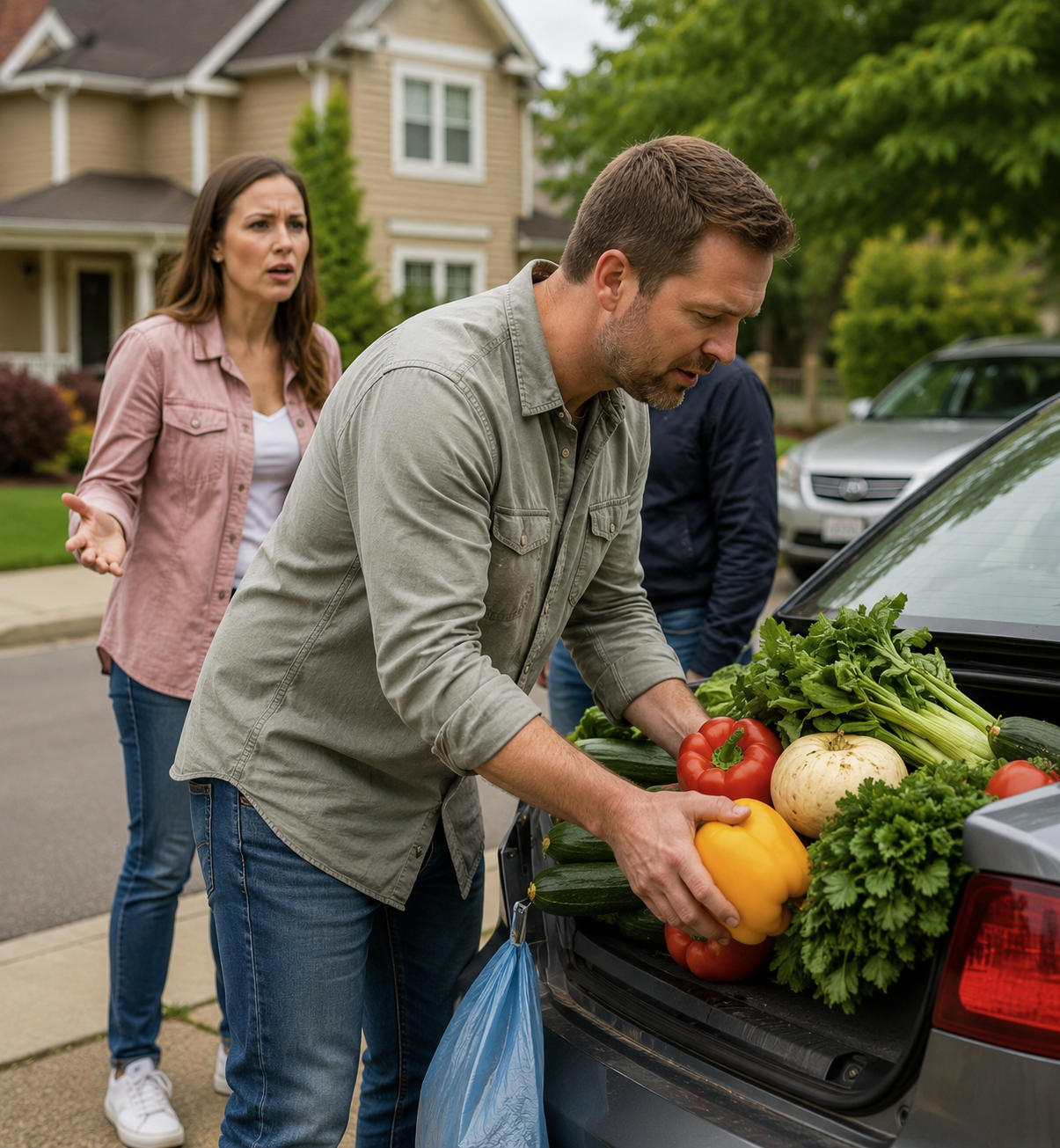
— Sarah, don’t start. Mom’s alone, she’s sixty‑eight, she can’t keep the garden up by herself anymore. She needs potatoes for the winter. What’s so hard to understand?
— What’s hard to understand is why you couldn’t tell me this yesterday. Or a week ago. Why am I finding out when the sacks are already by the gate?
— Because I knew you’d start… all that. — He waved his hand toward her as if shooing a fly. — I figured it’d be easier to just do it and not listen to the whining.
Ellie came out onto the porch — her T‑shirt sliding off one shoulder, a book in her hand — and stopped, looking from her mother to her father to the empty beds behind the house.
— Dad, where’s our potatoes?
— Took them to Grandma, — Sean said quickly, sounding almost pleased that he’d found someone to tell in a bright voice. — She doesn’t have a supply.
— And what will we eat in the winter?
— We’ll buy it, — he was climbing into the truck. — No big deal.
Ellie looked at her mother. Sarah said nothing. She watched the pickup drive out of the yard, kicking up dust down the dry lane toward the small town where his mother, Margaret, lived — the woman who, in twenty years, never learned to call Sarah by her name, preferring “that one” or, on a good day, “the daughter‑in‑law.”
— Mom?
— Go do your homework, Ellie. I’ll be back in a minute.
Her daughter left, glancing back. Sarah stayed by the bare beds alone, and for the first time in a long while she felt no tears — just a strange, calm silence in which a thought began to form somewhere at the bottom. The thought had no shape yet, but she knew: she would do something. What exactly she didn’t know yet.
That evening Sean came home proud and flushed from the cold, smelling of gas and a stranger’s kitchen — Margaret had fed him borscht, as usual. He walked in, kicked off his boots, sat at the table and, without looking at his wife, said:
— Mom says thank you. She asks to send her good wishes to you, Sarah.
Sarah stood at the stove stirring buckwheat for Ellie’s dinner — no meat, because there was only enough meat for one meal and payday was ten days away.
— Tell her I appreciate it, — she said evenly.
There was no sarcasm in her voice — she said it flatly, and that flatness made Sean tense for a second, like someone who hears an unfamiliar noise in the dark.
— Why are you so… calm? I thought you’d sulk all evening.
— What good is sulking? — she turned to him, same steady tone. — You can’t undo it. The potatoes are already at your mother’s. Sulking’s pointless now.
Sean clearly expected a fight — maybe even wanted one so he could vent and close the matter in the usual way: yell, she cry, he apologize in a couple of days with a candy bar, and life move on. But Sarah didn’t give him that scene. She put a bowl of buckwheat in front of Ellie, ate her portion standing by the window, washed the dishes and went to the bedroom to read a book, as she did every night.
Sean sat at the kitchen table alone, more puzzled by her behavior than he would have been by any shouting.
The next morning, Saturday, Sarah got up early — before her husband. She put on an old jacket, took her phone and slipped out quietly.
Mrs. Tammy, who sometimes let Sarah take eggs from her hens, sat on her porch with a cup of tea.
— Sarah, honey, why so early? Did something happen?
— No, Mrs. Tammy, everything’s fine. I wanted to ask — how’d your harvest go this year? Any extras?
— Oh, plenty, sweetheart. My daughter moved to the city; she doesn’t need half of it. Why?
— I thought maybe we could swap with neighbors. My beds are empty; I need some vegetables for the winter, and some folks have more than they can use. We could trade, help each other.
Tammy brightened — she loved those neighborly plans. In the village they called it “looking out for one another,” and Sarah knew that phrase would open more doors than a straight ask for help.
In two hours Sarah had gone to six houses. Somebody had extra zucchini, someone else had jars of pickles from last year, and Mrs. Zina had a whole pantry of apples nobody was eating because the grandkids lived in the city. By noon Sarah’s porch held two buckets of apples, a jar of honey from Mr. Michael the beekeeper (which she’d traded for some tutoring — she’d promised to help his grandson with math later), and three heads of cabbage from Tammy, given “just because.”
When Sean came outside around midday he found his wife sitting on the porch sorting apples by size.
— What’s all this?
— The neighbors helped. I asked who had extras.
He stood, not sure whether this was something to be glad about or not.
— Why didn’t you tell me you were going out?
— I don’t report to you, Sean, — she said, not looking up from the apples. — You didn’t report when you took the potatoes, either.
It was the first sentence in two days that sounded even a little like reproach, but delivered so plainly that Sean had nothing to say and went to the garage to tinker with the engine — his usual move when he didn’t understand what was happening at home.
* * *
On Monday Sarah went to Margaret’s house herself — unannounced, which she hadn’t done in years; she preferred to see her mother‑in‑law at holidays and keep a distance.
Margaret’s house smelled like mothballs, boiled cabbage and old rugs. Seeing Sarah on the doorstep, Margaret looked so surprised she forgot to greet her first.
— Why are you here? Is Sean sick?
— Sean’s fine, Margaret. I’m here on my business.
She walked in without waiting and immediately saw the sacks of potatoes in the corner of the entryway — the ones from their plot, neatly stacked, untouched.
— I wanted to ask, — Sarah said calmly, looking Margaret straight in the eye, — do you really need that many potatoes? Three sacks is a lot for one person.
Margaret tensed, preparing for the usual battle she and her daughter‑in‑law had fought over everything for years.
— Sean said I was in need. And I am.
— I’m not saying you don’t need help. I’m just asking how much you actually need so I know what to expect at home. Ellie and I have to get school supplies, and I’d been saving this harvest so we wouldn’t have to buy potatoes in winter.
It came out so direct and businesslike that Margaret was flustered. She was used to Sarah either staying silent, biting her lip, or calling her son in tears. The calm, no‑nonsense tone threw her off more than any shouting.
— Well… maybe a sack will do. Two would be too much. I can’t eat that much alone.
— Fine. — Sarah nodded as if arranging an ordinary household matter. — Then I’ll take two sacks back. I’ll leave you one — that’s enough for one person, and you can always ask if you need more. But from now on, if Sean decides to give away anything from our garden without talking to me, I’ll come and count. So it’s fair.
Margaret fell silent, at a loss for words. The usual accusations she’d hoarded for years — “city woman,” “she doesn’t respect my son,” “she turns him against his family” — hung in the air without purchase because Sarah offered no emotional handle: no tears, no shouting, no ammunition. She simply counted the sacks, took two and had a neighbor, Uncle Nick, help carry them to a taxi she’d called — she didn’t wait for her husband.
— Tell your son thank you for caring, — Margaret finally managed as Sarah left the yard. — But taking someone else’s goods without the owner’s permission is not care; it’s overstepping.
Sarah paused at the gate.
— I’ll tell him, Margaret. Have a good day.
* * *
That evening when Sean came home he saw two sacks of potatoes on the porch — the same ones, with the chalk mark he’d made a week earlier.
— What’s this?
— Potatoes. Your mother said one sack would be plenty; the rest was too much. I took them back.
Sean froze with his keys in his hand.
— You went to my mother?
— I went. We talked like adults.
— Sarah, what are you doing? I brought those for her, and now you come and take them back like a… like a thief!
For the first time in days there was a sharpness in her voice — not a shout, but a firmness he hadn’t heard in a long time.
— A thief, Sean, is someone who takes what doesn’t belong to them. I took what’s ours — what Ellie and I grew for two months while you went fishing every weekend. Your mother herself said one sack was enough. So it wasn’t her who needed three sacks — it was you who needed to look like a good son at our expense.
He opened his mouth to argue and found nothing to say — her point was airtight, offered without a crack.
— You embarrassed me in front of my mother.
— I didn’t embarrass you. I counted the produce. If that’s embarrassing, maybe you should ask why.
Ellie, doing homework at the table in the next room, listened and for the first time in a long while saw her mother not crying or staying silent in hurt, but composed, steady, and unyielding.
* * *
A week passed. Sean didn’t shout — he sulked silently, ate in front of the TV, and avoided the family table. Sarah either didn’t notice or pretended not to. She kept on with daily life: canning apples, making compote, helping Ellie prep for the art school audition, advising which portfolio to pick.
One evening, when Sean was especially quiet, she went to him.
— Sean, I want to say one thing, and then we’re done talking about it. — She sat across from him at the table, hands folded. — I’m not mad that you help your mother. Help her as much as you want. I’m mad that you decide for both of us, like my work and labor don’t matter. If you ever haul anything off our plot again without talking to me — even a sack of onion skins — I won’t yell and I won’t cry. I’ll simply do what I did this time: handle it myself and act as I see fit. Without your permission, just like you acted without mine.
Sean looked at her long, and in his gaze something new was there — not anger so much as a confused respect mixed with the hurt of being put in his place in such a matter‑of‑fact way, without a scene to exploit later.
— You’ve changed, — he said at last.
— No, — Sarah answered, getting up to clear the plates. — I just stopped waiting for you to figure things out on your own.
She went to wash the dishes. He stayed at the table, staring at his hands, thinking something he couldn’t yet put into words — about his mother, about his wife, and about himself: the man used to decisions being made by two people — his mother and himself — who suddenly found a third voice in the house that had been quiet but was now plainly heard.
* * *
On Friday Ellie came home from art school with news: the instructor liked her work and there was a real chance of a scholarship. She burst into the kitchen, flushed, hugged her mother.
— Mom, she said I have a good sense of composition!
— Of course you do, — Sarah smiled, truly light for the first time that week. — You dug potatoes for two months; your hands learned precise movements.
Ellie laughed, and even Sean, sitting with a paper in the corner, couldn’t help but smile — for the first time since that Saturday morning when three sacks of potatoes had sat by the gate, seeming like the most important thing in the world.
Sarah poured tea into three cups — three cups, as always — and thought that the sacks had long cooled in the cellar, the forgotten tops on the beds had rotted under the rain, but this calm she now lived with — not answering overstepping with a scream but calculating and acting for herself — was what she had been wanting all along, not even knowing how to name it.
Outside, October was starting, and on the edge of the garden in the dug‑over soil an unexpected little parsley plant was green and alive — the only thing left of that season’s patch. Sarah thought she’d plant again in the spring, but this time she knew exactly where she would draw the line between what belonged to her and what someone could take without asking.