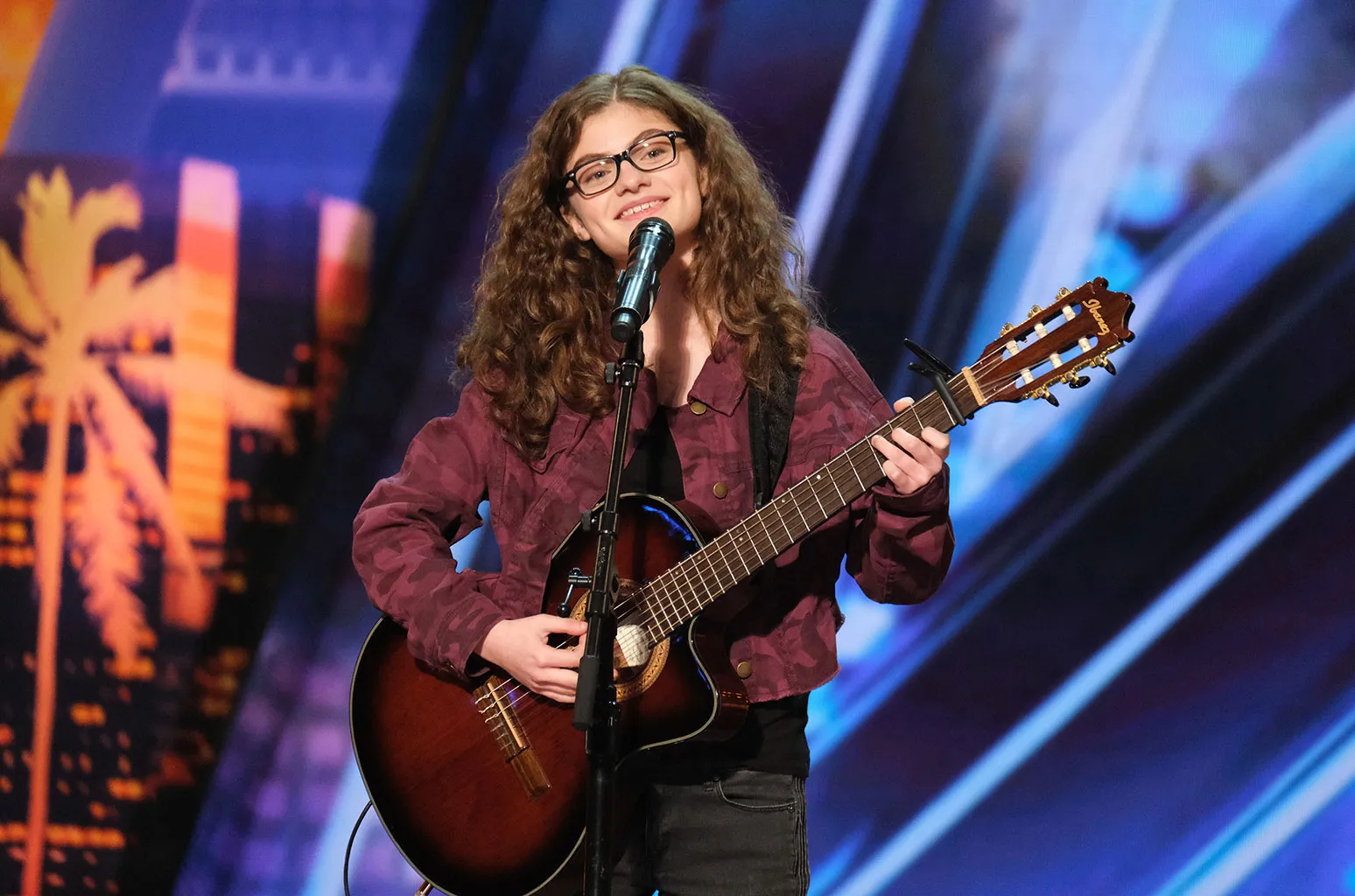
When 15-year-old Sophie Pecora walked onto the America’s Got Talent stage, she carried more than a guitar and a melody — she carried a story that had quietly shaped her for years. In a calm, honest introduction she told the judges and the audience that the song she was about to play grew out of a painful chapter in seventh grade: relentless teasing, whispered jokes in hallways, and the hollow feeling of being excluded at lunchtime. Those details landed in the room not as melodrama but as the kind of small, specific moments that become big inside a young person’s head. Rather than burying those memories, Sophie had turned to songwriting as a way to make sense of them, and tonight she was offering that sense-making back to anyone who might need to hear it.
From the first chord, the performance felt like a conversation rather than a showcase. Her lyrics mapped the ordinary cruelty of school life — furtive trips to the bathroom to avoid classmates, the sting of a comment that won’t easily be forgotten, the lonely ritual of sitting under a tree because the cafeteria felt like an ocean of strangers. She didn’t paint everything with broad strokes; she gave the hurt concrete edges. Those images made the song feel immediate: you could see the scenes as she sang them, and that made the vulnerability she displayed feel earned and true. Sophie’s delivery was never theatrical; it was steady, subtle, and full of intention.
Her voice matched the honesty of her words. It had a warm, slightly raw quality that made quiet lines land with intimacy and gave crescendos a real sense of release. She knew when to pull back and let a phrase breathe, and when to push forward and let a note break open. That restraint — choosing to let silence and softness carry meaning instead of filling every moment with power — revealed both artistic maturity and a respect for the story she was telling. At one point she reached up to tuck a strand of hair behind her ear before a chorus, a small, human gesture that made the whole room feel closer to her. Later, as a particularly vulnerable line came, she closed her eyes and the intensity in her face made it clear she was revisiting the memory as she sang it.
The song’s structure helped too. Sophie used a simple, memorable melody that never got in the way of the lyrics; instead, it acted as a vessel for them. She punctuated verses with little melodic inflections and thoughtful pauses that felt like the musical equivalent of taking a breath after a hard story. These choices made the song feel less like a polished audition piece and more like a journal entry set to music — messy in the best way, honest and evolving.
Audience reaction shifted from polite attention to a genuine emotional charge as the performance moved along. Early on there was the polite silence audiences reserve for something they’re about to judge; by the second chorus you could feel people leaning in. Phones were lowered; heads tilted; a collective empathy seemed to settle over the studio. The cameras caught a close-up of one judge with a hand at her mouth, eyes glistening. When a quiet, tender line landed, you could hear the room collectively take a breath; when Sophie released into a slightly stronger refrain, the applause that followed felt less like approval and more like gratitude.
The judges’ feedback reflected different aspects of the impact. They praised her songwriting craft — how she turned specific moments into universal feeling — and they admired her vocal control and tasteful dynamics. But what kept coming up in their remarks was courage. Several of them mentioned how brave it was for a teenager to stand up and name something that had hurt her, and to do it in front of millions. That bravery seemed to validate what Sophie had been doing for herself in secret for years: using music not just to perform, but to process.
When the votes were counted, Sophie received four “yes” votes, sending her through to the next round. The affirmation felt like more than a competition victory; it was a kind of collective acknowledgment that her story mattered. In the green room afterward she was hugged by family members and fellow contestants, and she talked about the practical support that had helped her — late-night practice sessions with a parent, a teacher who encouraged her to keep writing, friends who helped tweak a lyric. Those small details reminded viewers that talent often grows in community, shaped by people who notice and nurture it.
Beyond the immediate triumph, Sophie’s audition carried a longer-lasting message. For anyone who’s ever felt isolated by cruelty or exclusion, seeing a peer translate that pain into something creative can be a potent reminder that there are ways out. Her performance suggested that art can be a mirror and a bridge — a way to hold up an experience for others to recognize themselves in, and a route toward healing. For many viewers, the image of a 15-year-old standing upright because she could sing her truth will linger longer than any single critique or score. Sophie’s audition proved that when vulnerability meets craft, the result can be powerful, redemptive, and unexpectedly communal — a reminder that true connection often comes exactly when someone chooses to speak their truth out loud.