
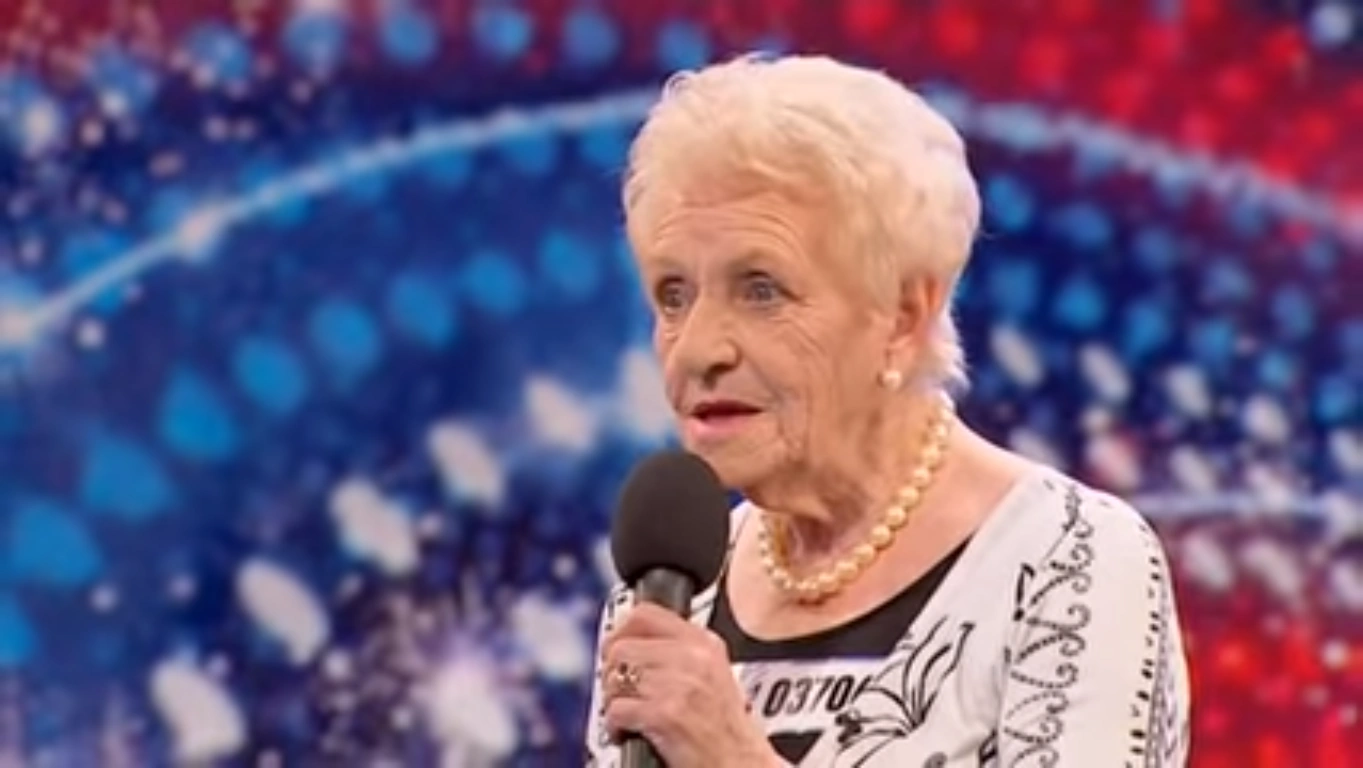
Eighty-year-old Janey Cutler from Scotland stepped onto the Britain’s Got Talent stage with a quiet confidence that immediately charmed the judges. She moved slowly, smiling politely as the cameras tracked her, and there was something disarmingly ordinary about her: a floral dress, sensible shoes, a handbag clasped in both hands. That modest look made her feel familiar before she even opened her mouth, like someone you might meet at a church bake sale or see at a children’s school play. The audience learned a little about the life behind that appearance — Janey is a mother of seven, a grandmother to 13, and a great-grandmother of four — and that short backstory framed her not as a career-seeker but as a woman taking a personal leap.
Janey explained in her soft Scottish lilt that she had come simply because she enjoyed singing. Friends had nudged her, she said, telling her she should “go for it,” and she took their encouragement to heart. There was no hit-the-road ambition, no secret history of stardom waiting to be revealed; instead, her story felt rooted in everyday music — lullabies sung at bedtime, hums while doing the washing-up, songs shared at family gatherings. Choosing Edith Piaf’s “Non, Je Ne Regrette Rien” was almost perfectly suited to that life. The song’s famous refusal to regret resonated as both defiant and tender, a fitting declaration for someone stepping onto a national stage at 80. It said, quietly but clearly, that life is for living and that it’s never too late for a new chapter.
When the music began, the transformation was immediate and breathtaking. The tiny, unassuming woman who had shuffled to center stage opened her mouth and released a voice that seemed to come from some deep, hidden place. What followed was anything but tentative; Janey delivered the iconic French chanson with a powerful, rich tone that filled the theatre. Each phrase was shaped with clarity and control, her diction surprisingly crisp even through the song’s most dramatic passages. It was as though years of private singing had honed not just her technique but her sense of storytelling; she didn’t simply hit notes, she inhabited them.
There was a specific moment, halfway through, when the spell fully took hold. The chatter in the auditorium hushed; people leaned forward as if the air itself had grown thinner. Even the judges stopped writing and tilted their heads, caught off guard by what they were hearing. Janey’s voice carried a lifetime: the hardened edges that come from decades of living and the softness of someone who had loved and lost and loved again. It wasn’t only the volume or the polish that impressed — it was the emotional truth behind every sustained note. Her performance had the sweep of someone who knew how to perform, yet it retained the raw, unaffected quality of a woman singing from the heart rather than for fame.
You could see it in the small details that followed the last phrase. Audience members who had been polite began to cry; some wiped their faces with the backs of their hands. When the final note faded, the theatre erupted into a standing ovation that felt both spontaneous and deeply deserved. The applause wasn’t merely for vocal power; it was a celebration of courage. Here was a woman who had lived most of her life away from the spotlight, stepping forward and saying, in effect, “This is me.” The reaction suggested that viewers recognized something universal in that act — a reminder that the ordinary can be extraordinary when offered honestly.
The judges’ responses captured the mood perfectly. Piers Morgan, part bewildered and part delighted, admitted he “didn’t know what to expect” and certainly didn’t foresee “a set of lungs on you like that.” His surprise mirrored the joy in the room: the kind that comes when expectations are upended. Amanda Holden, equally moved, offered a playful compliment about the royal family, reflecting both genuine admiration and the timeless glamour of Janey’s Piaf-style performance. Their praise was warm and unforced, fitting for a moment that felt more like an intergenerational hug than a critique.
Unsurprisingly, the judges gave her three resounding “Yes” votes, sending Janey to the next round. For many viewers, her audition became an instant highlight of the season — not only for the technically impressive singing but for the story it told about age, bravery, and the small, everyday acts that build a life. Janey left the stage hugged by strangers and showered with compliments, her smile bright and easy. It was clear the experience had been about joy as much as recognition. She had answered a friend’s nudge, stepped into the light, and in doing so gifted the nation with a moment of pure, unexpected beauty — a reminder that talent knows no age and that sometimes the most moving performances come from those who simply sing because they must.