
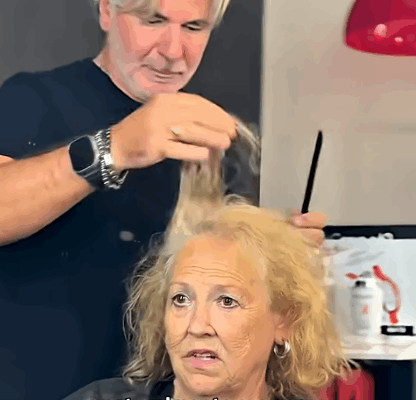
When the woman walked into the salon that morning, she expected nothing more than a practical change — a short haircut that would be easy to style, forgiving on busy mornings, and suited to her straightforward sense of style. She’d made the appointment between errands, arriving with a tote bag slung over one shoulder and a list of modest demands: trim the ends, take a little weight out, give it a shape that would be simple to manage. There was a calm about her, the kind that often hides a reservoir of unspoken fatigue. She smiled politely at the receptionist, sank into the stylist’s chair, and folded her hands on her lap as though preparing for a routine appointment.
The stylist greeted her with the kind of attentive curiosity that professionals acquire over years of listening. Rather than launching into a one-size-fits-all approach, she asked about daily routines — how much time the woman liked to spend on styling, whether she worked in a climate-controlled office or spent time outdoors, and whether she wanted a look that could be dressed up for evenings or kept easy for mornings. Those questions felt practical, but something about them began to loosen the woman’s reserve; she answered with small stories about hurried school runs, weekend coffee with friends, and the handful of special events she’d been meaning to attend but hadn’t quite found an outfit for.
As the stylist combed and sectioned the hair, she explained the plan: a shorter, layered cut that would frame the face, textured ends to remove heaviness, and a soft side sweep to bring attention to the eyes. The scissors came to life with steady, confident movements. With each careful snip, a little more of the hair that had become familiar and comfortable fell away. It was a precise choreography — the stylist’s hands moving in rhythm, the comb marking out new lines, the mirror capturing incremental change. The sound of hair dropping to the cape was oddly cathartic, like the physical shedding of something long overdue.
As the layers were shaped, the woman began to watch herself more closely. At first it was merely curiosity: How will my face look with less weight around it? Will I still recognize myself? But those practical questions gave way to something softer. When the stylist tucked a finished section behind her ear and asked her to turn, there was a brief, searching pause. The woman leaned in, studying the reflection as if reading a new chapter of a familiar book. The shorter length revealed the curve of her neck and the subtle sweep of the jawline — details she hadn’t noticed in years because they had been tucked behind longer hair. The change was small, but it opened a new frame through which she could see herself.
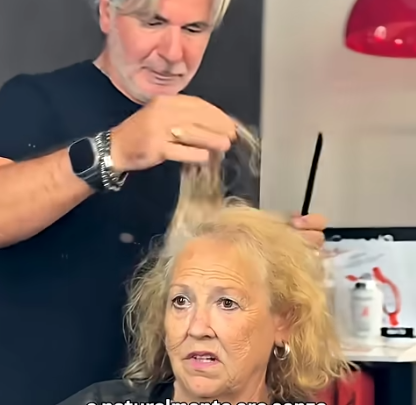
When the styling was finished and the final touches were added — a little smoothing cream to tame flyaways, a quick, warm blast from the dryer to set the shape — the stylist spun the chair for the reveal. The moment felt suspended. The salon’s low music seemed to fade; other conversations softened. The woman leaned forward, eyes wide, and for a beat she was silent. Then the first tear slipped down her cheek. It was not a tear born of sorrow but of recognition and relief: the astonished, almost grateful reaction people have when they discover something they had misplaced within themselves.
She laughed softly through her tears, the sound a mix of delight and disbelief. “Is that really me?” she asked the stylist, half joking, half in awe. The stylist smiled, pleased but not surprised; transformations like these were familiar territory, but each one carried its own nuance. The woman touched her fingertips to the shorter strands, feeling the texture and the lightness. She tilted her head and watched how the new cut moved freely, catching the light differently, emphasizing her cheekbones and making her eyes look brighter. The shorter hair made accessories, like a simple pair of studs, pop in a way they hadn’t before. Even her everyday glasses framed her face differently now, integrating with the haircut to create a more polished, intentional look.
People around the salon noticed the shift in her energy. A nearby client complimented the cut, and the receptionist offered an enthusiastic thumbs-up. Such small external acknowledgments mattered less than the internal shift, though — the way she straightened, how her shoulders fell back a fraction, how her smile broadened into something more candid. The confidence didn’t arrive as a flash of bravado; it settled in quietly and naturally, like the easing of a long-held breath.
When she rose to leave, she paused in the doorway, took one more look in a mirror by the exit, and smiled again — this time steady and sure. The practical haircut she had requested did exactly what she wanted: it was low-maintenance and stylish, compatible with her life. But it also did something she hadn’t planned on. In pruning away the weight of habit, she’d uncovered a version of herself that felt lighter, more visible, and unexpectedly renewed. What began as a simple salon visit had turned into a modest but profound reclamation of confidence.
She walked back onto the street with a little more spring in her step, the new cut catching the breeze as if to announce a fresh start. That afternoon, everyday tasks felt a touch brighter; the reflection in store windows drew a small, pleased smile. It was a reminder that sometimes the smallest changes — a few inches taken off, a fresh shape that suits the face — can unlock something much larger inside: the recognition that we can surprise ourselves, and that confidence often begins with a single, thoughtful choice.