
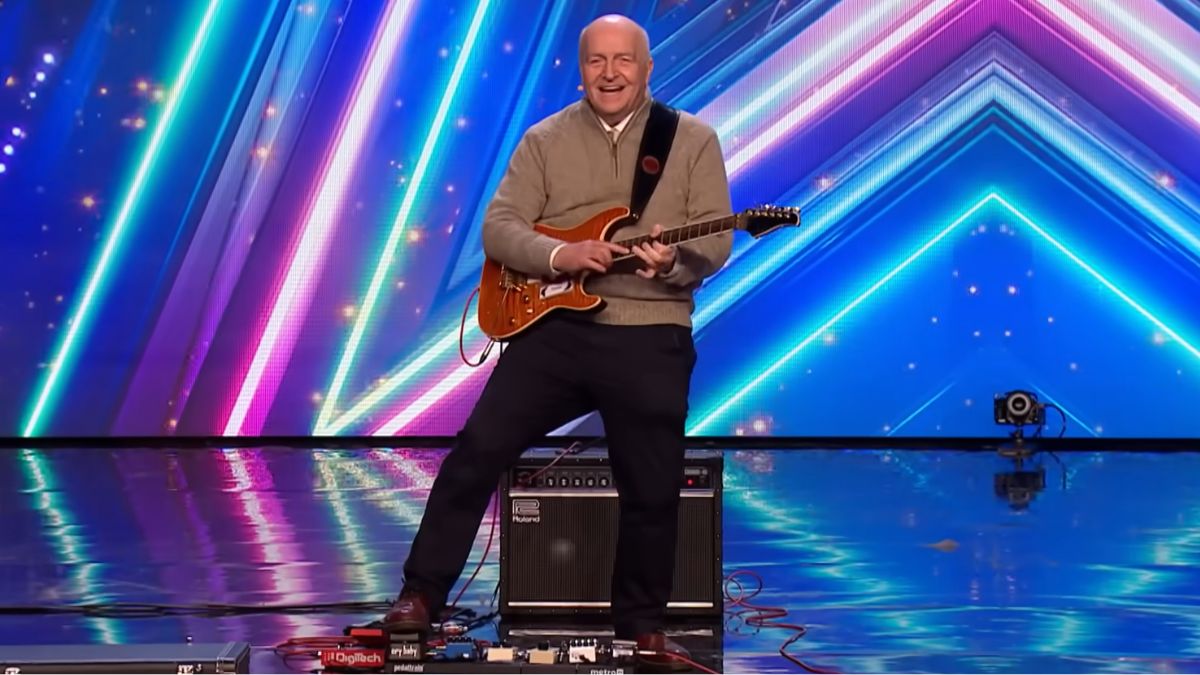
When sixty-four-year-old Kenny Petrie from Fife walked onto the Britain’s Got Talent stage, he looked every bit the polite, mild-mannered gentleman you might pass in a grocery aisle: neatly dressed, soft-spoken, and unassuming. There was a grandfatherly calm about him — the kind of ease that makes people smile politely rather than stare. He introduced himself with a disarming blend of modesty and dry humor, saying he hoped to “take a good part in the show” and even suggesting, in a half-joking aside, that Her Majesty the Queen might enjoy his act. That casual confidence set the tone for what seemed like a friendly, low-key audition. No one in the auditorium, from audience members to the judges, had any reason to suspect the storm that was about to break.
Kenny’s manner was the perfect setup for the surprise. He spoke about his love of music without flourish, almost embarrassed by his own enthusiasm, and when he picked up his guitar the moment felt gentle and unremarkable. But the contrast between appearance and action is often where the most compelling performances live, and within seconds of the first chord, the room was transformed. The gentlemanly façade dropped away as Kenny unleashed a thunderous rock anthem, complete with chunky guitar riffs, propulsive drumming from the backing track, and a vocal performance that soared with power and conviction. It was like watching someone flip a switch — one minute he was the kindly neighbor next door, the next he was a frontman commanding the stage with an authority that belied his age.
There was a theater-of-contrasts quality to it that made the moment fun and electric. Kenny moved with rock-star swagger, stepping into the spotlight as if he’d been doing it his whole life. He dug into the lyrics with a rawness that suggested not just technical skill but lived experience — the sort of weathered intensity you associate with singers who have paid their dues on smoky club stages. His voice was gritty where it needed grit, and surprisingly elastic when the melody demanded it. He hit high notes with clarity and pushed his lower register with a rasp that gave the performance real texture. Even small stage gestures — a dramatic bend of his wrist on a solo, a wink toward the crowd — felt earned and charismatic rather than staged.
The audience reaction was immediate and visceral. There was a collective intake of breath when those first full chords erupted, followed by a roar that grew as Kenny built momentum. You could see heads turn in the judges’ panel, expressions shifting from polite curiosity to astonishment as the reality of Kenny’s talent registered. People were clapping along, many standing midway through, swept up not just by the sound but by the sheer joy of being surprised. It’s a particular kind of pleasure when something subverts expectations in such a wholehearted way — you find yourself cheering not only because the music is good but because a person you might have underestimated has revealed themselves in full color.
Simon Cowell’s reaction summed up that progression of surprise and admiration. He admitted that when Kenny first produced the guitar, his immediate thought had been, “this isn’t going to go well.” That frankness made his later praise feel all the more powerful. By the end of the performance, Simon had eaten those words, calling Kenny “actually brilliant” — a short, definitive appraisal from a judge known for his high standards. Amanda Holden echoed that sentiment, pointing out the sheer unpredictability of seeing such a ferocious rock delivery from someone so calm and reserved in person. There was a genuine warmth in her praise; she seemed delighted by the pleasant shock of the whole package.
The other judges chimed in with similar enthusiasm, noting not just Kenny’s vocal prowess but the showmanship he brought to the moment. His timing was impeccable, his phrasing full of character, and his ability to sustain intensity across the song proved he wasn’t relying on a single wow moment. Instead, he built a coherent, convincing statement: age was no barrier to energy, and a quiet life could easily conceal an electrifying creative force.
When the votes were tallied, Kenny received four unanimous “yeses,” a payoff that felt inevitable after such an electrifying reveal. The yeses were more than a ticket to the next round; they were recognition of a man who had chosen to step into the light and show himself honestly. For viewers at home and those in the theater, Kenny’s audition was a reminder of the joy that comes from shattered expectations. It celebrated the idea that talent can emerge at any stage of life and that you should never judge a book by its cover — especially when the cover contains someone who, with one thunderous chord, transforms into a bona fide rock god.