
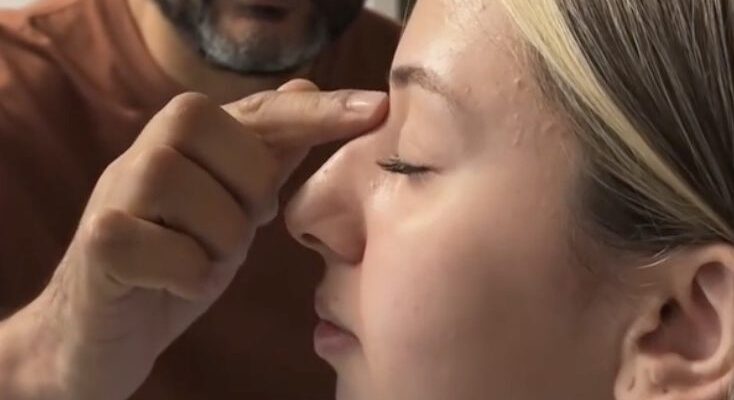
For as long as she could remember, there was a small, private conversation she had with herself whenever she saw her face in a photograph or in a mirror: a tiny, persistent note about the shape of her nose. It wasn’t an all-consuming obsession; she had a life full of work, friends, hobbies, and moments she loved. But that quiet concern threaded through certain memories — the profile in a summer selfie she deleted the next day, the way she angled her face in group photos so the camera would catch her “better side,” the flicker of discomfort when catching herself in a window reflection. It lingered not because anyone had ever said anything unkind, but because she kept comparing what she saw on the outside with how she felt on the inside.
To outsiders, her nose was probably just one more feature among many. People complimented her smile, her eyes, the way she listened. Yet to her, the shape of her nose felt disproportionate to the rest of her face, a small detail that somehow bent the mirror of her self-image. Over time, that feeling accumulated. It made her tilt her head in photos, choose hairstyles that distracted, and occasionally avoid profile shots altogether. The weighing of choices was subtle but constant, an energy she thought might always be there.
After years of thinking and quietly researching, she reached a point where she wanted something different—not because she felt pressured by trends or because someone else suggested it, but because she wanted to bring her outward appearance closer to the person she saw inside. She spent nights reading patient stories, medical journals, and surgeon bios. She watched videos of consultations and post-op recoveries, learning technical terms and realistic expectations. She spoke with people who had been through similar journeys, asking them what surprised them and what they wished they’d known. It took time—months of notebooks filled with questions, lists of pros and cons, and conversations with friends she trusted.
When she finally made the decision to undergo rhinoplasty, it felt deliberate rather than impulsive. She wasn’t chasing perfection; she wanted gentle refinement. During her consultation, the surgeon listened carefully, sketching and explaining how subtle changes could harmonize her features. They discussed nasal proportions, the angle at the tip, and what “balanced” would mean for her unique face. She appreciated that the surgeon emphasized natural results and recovery timelines, and she left the office feeling more informed and in control.
The day of the surgery, she felt a complicated mix of nerves and quiet resolve. Friends drove her to the clinic and stayed until she was settled; their steady presence reminded her this choice was supported by people who cared. The anesthesia dulled the world pleasantly quickly, and when she woke up, there was a soft, surreal quality to the first few hours. Swelling, slight discomfort, and the careful instructions from the surgical team became her immediate reality. Recovery demanded patience: cool compresses, sleeping propped up, and avoiding anything that might jar the healing tissues. She surprised herself with how attentive she became to small details—how she held her head, the foods she chose, the gentle way she laughed.
In the weeks that followed, changes emerged slowly. The initial swelling softened, bruising faded, and the cast finally came off. There was a curious moment of hesitance when she first looked at her face without the bandages: the same person, but nudged in a new direction. Her nose was straighter, its tip a touch more refined, its bridge smoother and more proportional to her other features. It wasn’t dramatic in the cinematic before-and-after sense; instead, it was quietly corrective, like a sentence edited for clarity. The overall effect was subtle balance rather than transformation.

Friends and family reacted with a mixture of surprise and delight. They noticed something different before they could put words to it—an ease in her expression, a certain lightness. A sister hugged her and said, “You look like yourself, but happier.” A longtime friend remarked that she seemed more present in photos, more willing to face the camera head-on. Compliments came, but what mattered more to her was how little the chatter centered on appearance and how much it centered on the change she felt internally.
Confidence didn’t arrive all at once. There were days when she still caught herself unconsciously angling her face, remnants of old habits that take time to erase. But gradually those habits loosened. She began saying yes to pictures she might previously have dodged. She arranged to meet friends for lunch at a new place and didn’t spend the whole time worrying about how she looked in window reflections. In conversations, she made eye contact more readily. The small, steady accumulation of these moments built a new baseline for how she carried herself.
What the surgery gave her wasn’t some magic key to an easier life; it was an act of kindness she offered herself. It wasn’t about hiding who she had been but about aligning her external presentation with her internal sense of self. That alignment brought more than a change in profile—it brought a measure of self-assurance that allowed her to step into social and professional situations with a bit more openness. People noticed the difference because it was genuine: a quiet confidence replacing a longstanding reservation.
Looking back, she describes the whole experience as a gentle reinvention rather than a reinvention wholesale. The operation didn’t rewrite her identity; it clarified it. It was a personal decision grounded in care, research, and realistic expectations. Above all, it was a small but meaningful form of self-love—a way of saying to herself that she deserved to feel comfortable in her skin. And when she catches her reflection now, there’s a different ease in her gaze, a sense that her outside and inside are finally in better harmony.
Watch it here: