
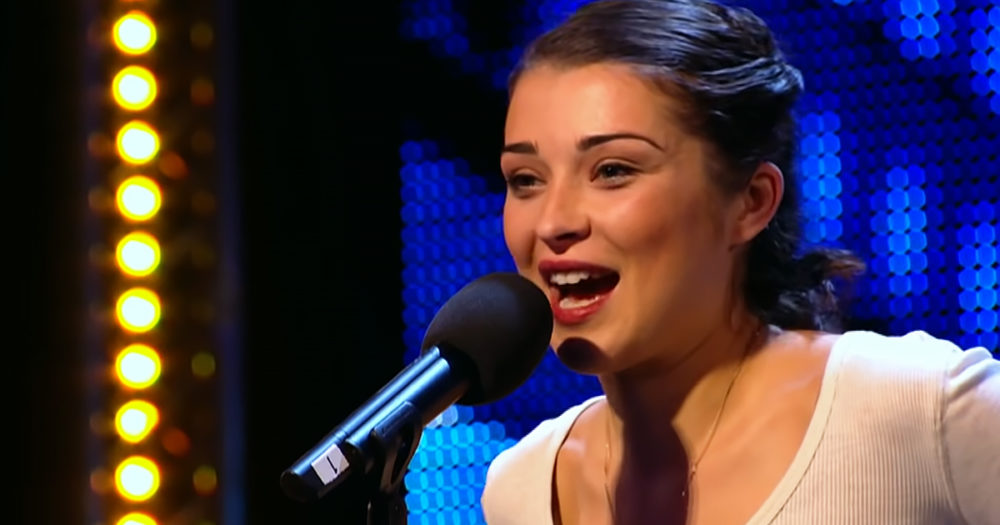
When Alice stepped onto the stage, you could see the tremor in her hands before she even spoke. The judges leaned forward, offering the practiced comfort that comes with live television — “How are you feeling?” — and she answered with a single, honest word: “Scared.” It was the kind of admission that made the room feel smaller and more human. Backstage she had told interviewers the same thing: stage fright had shadowed her whole life. She described it like an old acquaintance — unnerving, persistent, but not invincible.
Much of Alice’s anxiety seemed to center on the judges themselves. To her, their nods or raised eyebrows weren’t just critiques; they felt like verdicts on her worth. The idea of being dismissed in front of millions had tightened her chest, and you could tell she’d rehearsed bravery on the way in. When the band or piano cued the opening chords, the theatre quieted as if everyone had been waiting for permission to breathe. The choice of song only added to the tension: “My Funny Valentine,” a jazz standard indelibly linked to Chet Baker’s fragile, melancholic style. It’s a song that lays bare the singer; every imperfection on the mic becomes part of the story.
The intro hummed in the air, and for a heartbeat Alice’s voice arrived breathy and tentative. The first line — “My funny valentine, sweet comic valentine…” — came out slightly shaky, as if the note itself were testing the waters. Simon Cowell, who has built a reputation on a stern gaze and blunt assessments, had his head down at first. It almost looked like he was giving her space, not watching to catch flaws but refusing to be the instrument of her fear. That quiet, however, didn’t last long. There was a subtle shift in the room when Alice hit the second phrase. Her volume rose, not in bravado but in clarity, and the wavering steadied into purpose.
By the time she reached “You make me smile with my heart,” something changed that had little to do with technique and everything to do with connection. The notes she found were warmer, richer, and threaded with a timbre that surprised the audience. It wasn’t only that she had improved mid-song; it was that she allowed herself to inhabit the lyric. For a singer, that moment — when you stop merely performing and start confessing — is what makes listeners lean in. Heads turned, breaths held, and you could see recognition ripple across the judges’ faces. Simon’s head came up slowly; the corners of his mouth lifted into a smile, the kind that says he’s been caught off-guard in the best possible way.
Alice didn’t just sing; she moved with the music. Her gestures were economical but expressive — a hand against her chest at a yearning line, a gentle sweep of the arm that seemed to shape the air into something intimate. There was a Nina Simone quality to the way she used space and stillness: pauses that elongated emotion, phrasing that tugged at the silence rather than filling it. Those touches made the performance feel lived-in, like the song belonged to her in that moment and she to it. The audience responded as if recognizing an old friend in a new guise, warm applause rippling like approval through the theatre.
As the song built toward its final thread of notes, Alice’s confidence didn’t shout; it simply settled into her delivery. The last phrases were sustained with a control that belied the tremor at the start. You could see relief and exhilaration cross her face: relief that she had navigated a personal gauntlet, exhilaration at having been understood. When the final note lingered and faded, there was a beat of stunned silence — the kind that happens when an audience collectively processes something unexpectedly beautiful — and then the theatre erupted. It wasn’t just polite clapping. People stood, some hoarse from cheering, some wiping at eyes. The judges, initially inscrutable, rose as well.
Amanda’s applause was loud and immediate; she mouthed something approvingly. Alesha, often quick with critique, looked genuinely moved, leaning forward as if to bridge the distance between observer and performer. Simon, who had begun with his head down and a protective nonchalance, offered a smile that felt like an apology turned into praise. When the verdict came — a thumbs-up to move on to the next round — it was accompanied by a standing ovation that included all four judges. That unanimous show of approval felt like a benediction after a private battle.
What made Alice’s audition memorable wasn’t only the technical climb from nerves to control. It was the vulnerability she brought to the stage, the way her initial fear made the later triumph more affecting. Her performance reminded everyone watching that even seasoned professionals get scared, and that courage isn’t the absence of fear but the choice to keep going despite it. In that short, luminous rendition of “My Funny Valentine,” she didn’t just win a pass to the next round — she earned a moment of shared humanity with thousands of strangers who, for a few minutes, held their breath with her and then exhaled in applause.